
You must log in or # to comment.
If you’re going to send me the output of some LLM, do me a favour and just send me the prompt instead. Otherwise I’m going to spend as much time reading it as you spent writing it.
LLMs are stochastic. If I send you the prompt instead of the output, then there’s no guarantee that the output you get will be correct. If I generate the text myself, I can verify that it’s correct before sending it off.
The problem is that as the recipient, you have no idea whether I’ve even read the output, let alone verified or understood it. And with the low barrier to entry, it’s much more likely that you’re getting unverified slop. Sharing the prompt isn’t going to help with that.
Edit: sorry, posted before I finished writing.
Of course it will be correct: the prompt contains the idea you wanted to convey. I’ll read that and know what you meant. Feeding that prompt into an LLM doesn’t add any new ideas from you, it just inflates the text like a balloon and gussies it up with useless window dressing.
If anything, it obscures what you meant!
They add new information all the time. That’s part of the problem with blindly accepting everything they output.
Yeah and since what they add doesn’t come from you, it’s not your idea, so it isn’t coming from you anymore. It’s like if you commissioned an artist to paint something for you and then gave the painting to a friend and told them you painted it for them… no, you didn’t!
Of course. That’s a separate problem. I’m just commenting on the part where you say that they should give you the prompt.
Sticking with your analogy, it’s like if you commissioned someone to paint something specific, then decided that you liked the result and wanted to share it with your friends, so you give your friend the instructions you gave to the painter instead of the painting itself.
It’s not the same thing because a human painter understands meaning and intent.
“Write a message to a girl so I look nice and not a creep that wants to fuck her”?
The new kind of writer’s block
The AI “artists” really crack me up.
It’s like someone telling you they can run really fast, like crazy fast, faster than anyone else in the world.
And then when you ask them to show you, they give you a shit-eating grin and get in a car and hit the gas.
deleted by creator
If you need an LLM to tell you how to write then you’re a fraud and a hack. It’s a skill, get good or fuck off, if you want to learn then you have to fucking learn, otherwise you’re just a plagiarist who doesn’t know shit.
there are ways to implement LLM Generative AI creatively but it has nothing to do with what we traditionally perceive as writing fiction. It is more of text adventure interactive writing kind of thing and you still need to do much of everything while generative AI adapts it on the go. that’s one of the few legitimate use cases that actually accomplish something that is hard to do otherwise.
I hope I understand correctly what you mean. Lika a text based adventure game but instead of fixed options you write your action and the AI reacts to it.
So a developer could write his own LLM Model and define a setting on what he trains it and then the player have a text based adventure. The game dev has set the story but he player can write his own actions instead of using the predefined ones. The LLM then reacts to them so there is more dynamic in the game.
Is that what you mean for example? If so I would say that is a use case with the limitation that simply using chatgpt or similar would defeat the use case because it is a to general model.
basically yes. technically, you still set a lot of immutable things within the system and establish rigid framework over everything so that AI doesn’t go overboard - otherwise it just get instantly amorphous and falls apart.
i’ve seen two implementations - one featured chatgpt api and it basically freestyled a text adventure over a set framework - you still have to come up with questline patterns and faction dynamics formulas with AI playing up the immersion - things like weather, semi-randomized world-building encounters, basic dialogue. it was gimmicky but workable. the other one was much more sophisticated - it was built around ollama and it was basically all setting and faction politics built on THEREFORE BUT beats shuffling in and out - basically Fistful of Dollars kind of thing and the goal was to “sequence break” your way into endgame of sorts. So it was a bit of immersive riddle. It was clumsy but intriguing.
Fuck that. Writing is hard in general, if you’re not willing to do the work then you’re not doing the work, doesn’t matter if it’s hard, if you didn’t write it then you’re not writing. No excuses. Stop handing over your imagination just because things that are difficult to do well are difficult to do well.
i don’t think you understand what i mean and your comment has nothing to do with what i said.
I don’t think you understood what you meant.
whatever.
The best way I have found to make sense of why some people are so enthousiastic to shill for AI, is to see AI as yet another product that preys upon people’s insecurities. In this case it’s maybe the worst insecurity of all: feeling like you’re less intelligent than other people.
Taking that insecurity as the through-line, this kind of shilling makes perfect sense IMO. It’s essentially a form of self soothing, saying “everyone is or will be using this, it’s not just me!”.
The only people who would use AI for creative work are those who are unwilling to take the time to become good at it or are incapable of doing so.
They’re really after the money.
I’ll grant that there will be people out there who also don’t have the ability to notice that it’s garbage being generated.
Where I do live, not only there is absolutely poor art education and appreciation, but there are people who don’t care about the artwork – mostly event and product advertisements on Facebook – they’ll handwave the damn thing as long as it delivers the intended message.
I use AI to help me write poetry in 2 ways:
-
I have a thick accent and it helps me count syllables and determine what the meter will feel like most readers
-
I feed it completed poems and ask it to analyze it for themes and metaphors to ensure that my meaning is being conveyed properly
Rhyming dictionaries and thesaurus.com for the rest
LLMbeciles completely suck at counting anything or checking anything mechanical with text.
As an example, if I try to write a jueju and pass it to an LLMbecile to check if the rules were followed, it will fail to notice:
- Jueju must have 5 characters on each line or 7 characters on each of their four lines. The LLMbeciles often don’t notice faux jueju that have, say, 8 or 6 characters on a line. Or that alternate between 5 and 7 characters. Or other routine counting analyses like that.
- Jueju have very specific rhyme patterns. The LLMbeciles will not spot (ever!) faux jueju that don’t conform to that.
- Jueju have, as their single hardest element (and the very reason why the poetic form is so well-regarded: someone who can write one of those to this requirement has formidable language skills!), a tonal pattern they must obey.
These three items are entirely mechanical. Counting characters on lines. Checking rhymes. Checking that words conform to tone patterns. There are programs you can get that will mechanically check that for you in microseconds. They’re that mechanical and regular. But LLMbeciles can never successfully negotiate all three, and will quite often fail on all three.
And I haven’t even got to the part of structural checking; things that require comprehension. Like how the jueju must be formed from two couplets. like how the two couplets form a kind of question/answer, call/response, state/reason or other such relationship. How line 3 must be a twist that shifts the subject of the first couplet to give new insight into the overall topic of the poem, etc. There’s just no way in Hell a next-word-guesser is going to handle that.
It works enough for my needs
It works enough for the needs of someone with no standards, I agree.
Why are you being so rude? What do you get out of it?
Possibly I get a slop gobbler to leave a group that is literally called “Fuck AI” and go where his idiocy is welcomed.
Doesn’t seem to be working so far, though.
Ok
-
This is an unpopular opinion, but as someone who builds stuff from scratch, this is the same feeling i get when someone holds up a 3d printed item and goes “i made this”
If they’ve created the 3d file themselves that seems like an accurate thing to say, as opposed to just printing something off the internet. Obviously the amount of effort and perhaps artistic expression is gonna differ, but like, I think most printed stuff only exists to serve a specific function anyway
That depends, really. Making a decent print can be really difficult and people can be pround of succeeding at that part of the process. Especially if you have a bad printer. Making the actual 3D models yourself on the other hand is no different than making stuff from scratch. It’s a skill that you have to aquire.
3d scanning is actually a lot of fun. I had a stint in a museum and we were scanning sculptures for replica molds (because some bitches just can’t stop firing ballistic missiles at our museums). However, fixing those 3d models in Blender afterwards was not fun.
I’m pretty amazed what you can do with simple photogrammetry at home, but Blender is still not fun.
it is even less fun when you’re just thrown into it without prior training. learning it on the go just because folks who were supposed to do it dropped out was rough.
I don’t think that’s wrong, but from the other direction.
They’re both tools, and as long as you’re open about what it actually means to use the tool and what you actually did I don’t see an issue.Sometimes 3D printing is as creative as printing someone else’s design. Sometimes the creativity is a modeling and design problem. Sometimes it’s a machine operation skill.
AI tools can be “write a book” or “draw me a cat”, which isn’t much , or it could used to do spot touch ups in a photo, or get feedback on a written work.
Doing something with or without different tools has different advantages and disadvantages, and changes the criteria that you judge it by.
Some people feel the same way about digital cameras or cell phone cameras. I don’t think the device picking the exposure time and white balance makes it not your picture, it just means I’m not being impressed by your color pallet, but instead your subject and composition.To me that’s the least annoying part of AI at the moment. I’m open to the notion that you can be creative with tools that remove parts of the challenge, you just don’t get credit for the challenge.
Be careful of your use of AI here too.
My phone’s camera has “AI” all over it. But since the phone predates the degenerative AI craze, obviously it’s not talking about LLMs and something-or-other diffusions and all the other degenerative, hallucinating AI things.
The term “AI” covers a whole bunch of technologies, and most of those have found niches where they’re actually useful and don’t burn up the planet to use. Like, say, the “AI” photo retouching features of my phone. Which, to be clear, predate what is shilled as “AI” today.
Of course modern phones call what my phone calls “AI” something else: “software”. Because that’s what “AI” that actually works is called after it has found its niche.
Not to be a serial contrarian, but I’d say what’s being “shilled” as AI today is just as much AI as the AI of yesterday. Which is to say intelligent in the sense of “responsive to environmental changes”, not “sentient or sapient”.
Autocorrect, red eye reduction, and white balance correction are all different types of AI. So is the tuning function on most decent rice cookers. (Depending on the retouch feature you mean it actually could be from the modern AI wave. It started with images because humans notice a 10% gibberish rate in text, but we don’t see a 10% error rate when removing a ketchup stain)I don’t think we’re actually in disagreement, but I think in this particular threads context it’s implicit that the intention of “fuck AI” isn’t “fuck my rice cooker and its weight/heat interpolation function”.
People feel that same way about any tool, and get a sense of dismissiveness towards people how use them. I usually don’t care about the tools people use as long as they don’t try to take credit for the part they didn’t do. Whittling and using a lathe are different skill levels when making a table leg, and I won’t be impressed by your radial symmetry if you used a lathe, but I can still like the table leg.
The biggest difference is that I don’t think there’s any generalized ethical issues with lathes that need to be addressed.Getting upset about someone being open about using the tool, or even not being open about using it, is like getting hung up on questions of who gets credit for the symmetry of a table leg when the carpenter used a lathe powered by a live puppy grinder.
Oh, “AI” is purely a marketing term. You know how we know this? We can’t define intelligence. There is literally no definition for intelligence that is broadly accepted. So anybody selling “AI”, whether it’s “neural networks” or “ant colonies” or “genetic algorithms” or whatever technobabble is being used is not intelligence of any kind. You can’t make the artificial version, after all, of something we can’t identify.
What I was pointing out only is that “AI” photo retouching is not automatically degenerative “AI” photo retouching. The “AI” retouching in my phone is not prone to hallucination. It predates the hallucination machines. It just does stuff like (mostly) smoothly removing things like strung cable in photos and that kind of stuff, or does some pretty splendid night time photography.
Modern phones with the same features don’t call those features “AI” because today “AI” means the degenerative crap. They just call it “filtering”. (And then, tragically, they put the degenerative crap into the camera software because we’re not allowed to have nice things apparently.)
Ah, yes. The only bit of marketing terminology that has multiple high profile university research labs dedicated to it since the 50s.
literally no definition for intelligence that is broadly accepted
You’re conflating human intelligence with what it means in computer science. We have no way of consistently and meaningfully ranking human intelligence. The intelligence being referred to in AI is not the same thing. It’s not even comparing apples to oranges. It’s comparing the abstract notion of a triangle to a rabbit.
You may as well say “signals intelligence doesn’t exist because we can’t define intelligence”.Calling things techno babble doesn’t help you look like someone who knows what they’re talking about making a distinction.
The “AI” retouching in my phone is not prone to hallucination. It predates the hallucination machines. It just does stuff like (mostly) smoothly removing things like strung cable in photos and that kind of stuff, or does some pretty splendid night time photography.
I hate to break it to you, but that’s largely generative AI. You haven’t mentioned your phone specifically, but the features in question are at least quite similar to googles magic eraser and night sight features.
Unless your phone is hilariously old, it doesn’t predate googles use and development of generative AI.
In one sentence you say it doesn’t hallucinate, and the next you say it “mostly” smoothly removes things. First, where do you think it’s getting what’s behind what it removed? Second, what do you think is happening when it fails to get it right?
The computational photography features are largely a machine learning model being applied to techniques used by traditional photographers.If you want to use them, I don’t care. Just don’t pretend they’re fundamentally any different than using Photoshop AI tools to do the same thing. It’s not. You’re using an AI based tool to do something that someone else is doing by hand. It’s trained on a dataset pulled from every picture on earth ever uploaded to the Internet.
Your perfectly color calibrated hdr+ photo without any weird stuff blocking the sky doesn’t get the same credit as a person who meticulously composited and exposed a set of film photos for those bits.I literally said one message earlier that my phone predates the outbreak of degenerative AI. I got it in 2021. If that’s “hilariously old” to you, so be it. It works (unlike degenerative AI).
The only bit of marketing terminology that has multiple high profile university research labs dedicated to it since the 50s.
The intelligence being referred to in AI is not the same thing.
Now ask yourself this, Sparky. Why was it called “Artificial Intelligence”? If it was, and I quote:
… comparing the abstract notion of a triangle to a rabbit.
I’ll give you a little clue: “artificial intelligence” gets more research grants than does any of these:
- string of fancy-schmancy if/then statements
- brain-damaged linear classifier
- string of fancy-schmancy if/then statements disguised as a flowchart
- curve fitting through brain-damaged linear classifier
- precious, fussy line-drawer
- shallow pattern matcher but hey at least it eats all the available hardware (phase I)
- scoreboard-directed brute force button masher
- “what if we ran the shallow pattern matcher backwards” but hey, at least it eats more than all the available hardware (phase II)
Yeah, so your phone is definitely using the modern iteration of generative AI for the features you’re defending. By “hilariously old” I meant more along the lines of “2014”. It is exactly what I was talking about when I was talking about smartphone AI features.
It kinda feels like your problem with modern AI is less the ethical issues and more the results you get from it, with the way that you’re defending it in the use case you like by saying it’s a different type.As for your odd attack on an academic field: none of those things existed when the departments were founded. Those were all the names for the grants they proposed that led to them creating those things.
Why do you have a hard time accepting that maybe a term has different meanings in different contexts, and using that as the basis for your criticism is shallow compared to any of the other incredibly valid reasons to criticize how it’s built, supported, marketed, used or advertised?
That’s an interesting take. It does beg the question: What is “from scratch?”
Does a potter need to go to a river bank to dig the clay he will make into a beautiful tea pot? Or is it still “from scratch” if he buys prepared clay? The question can apply to a woodworker. Does the use of power tools to make a chest of drawers less of a creative endeavor than someone that uses all hand tools to make the same chest? Do you need to fell the tree and mill it in to boards yourself to fit your definition?
Where does “from scratch” begin, and where does it end?
I was wondering the same myself. I carve signature seals/chops. I didn’t make my knives from ores I refined myself. I didn’t cut the various stones into the traditional chop sizes and shapes. I didn’t invent the calligraphic forms used to represent the characters in the various seal scripts.
Is this “from scratch”? Is anything really “from scratch” anywhere?
I don’t know myself. I don’t think anyone really has an answer.
What you do requires skills. And most people don’t have hose skills. I perhaps view what you do as being a craftsman. You take things that others have shaped and then assemble them into something that is different and more desirable. And there can be craftsmanship and artistry involved by everyone along the way.
I was a toolmaker. I designed and built tools. I sat at my desk and designed the tool in a CAD program, generated tool paths in a CAM program. Then used CAM to create all the G-Code needed. I then sent the program to the machine. I loaded the code and fixtured the piece of steel. At the push of a button the machine did the work as I stood there and watched. Not much different than AI in some ways.
If one sets aside the ecological disaster that AI is for a moment, (and this is the biggest evil IMO). I start wonder if AI is in and of itself “evil” or is it just a tool we haven’t mastered the use of yet. I honestly go back and forth in this. I don’t like AI generated art that is passed off as “real”, but I can understand and be impressed by the skills it took to manage the tool to make that art. I certainly don’t have those skills. But I’m all for the AI currently looking at my MRI scans for signs of cancer cells that even the most skilled radiologist might easily miss at the early stages.
It’s a fuzzy and hazy world. And the older I get, the less sure of the answers I thought I had.
I’ve shouted from the rooftops before many times there is nothing creative from AI writing. It just repeats the same terse, sentence structures! AI had never fallen in love, grieved, or inspired before!
If she was taking about just a proof read, then I’m okay with it. But I don’t believe she is taking about proof reading. AI should be nowhere near the creative process.
If you need to proof read something you can do it with spell check in your weird processor and an understanding of grammar.
I ran your comment through my weird processor (my brain) and found a typo!
Awesome. I love it when I fuck up lol
there’s actually an entire subgenre of writers pretending to workshop story ideas with generative AI but actually trolling to get the most ridiculous responses. it works best with Claude because it create dedicated skills to make it even more stupid. Not everyone’s cup of tea but sometimes it is funny when clanker attempts to make sense of some obviously ridiculous story pitch while the writer keeps pulling the rug from under it.
AILLM hallucinations are incredible for creativity, but the people who just lean on them for the majority of it are lazy.
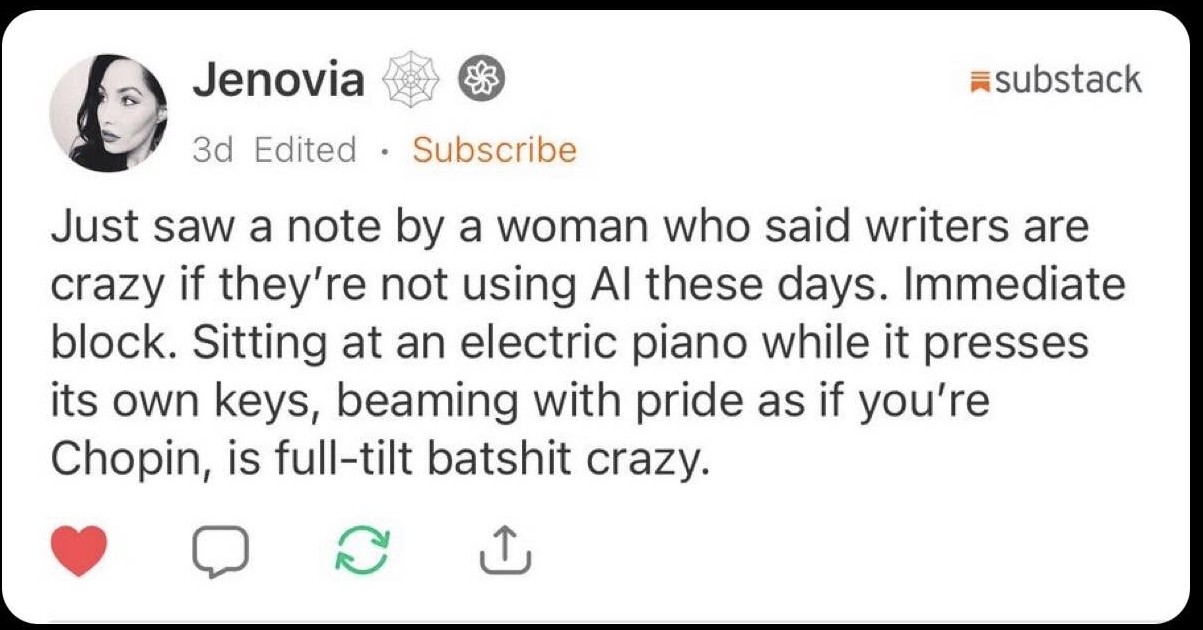
to be fair - player piano is a great idea and there were composers who did stuff specifically for it - Nancarrow is the most prominent one. it’s a completely different aesthetic and requires not trying to make it seem like anything it is not though.
Pointless sidebar: Westworld (Season 1) uses a player piano as a metaphor for AI.
And player piano is what they should have said. Don’t besmirch electric/Rhodes pianos, they’re awesome.
This made for a nice block list. Thanks!
Quite ironically, this statement is probably a true one whether it’s a slop gobbler or a slop hater looking at the comments. 🤣
Indeed
I am speaking from the perspective of a hater, and if gobblers end up blocking me instead, its still a win for me lmao
😆 Ayup. This post has been a gold mine of accounts to block. After mocking them.

Some of these fanatics are utterly arrogant greedy narcissists with no redeeming qualities at all.
Explosion of creativity? Do you mean the laziest, untalented, uninteresting people on the planet finally being able to vomit their stupid ideas out into the world in the style of the greatest human artists of history?
Bruh, NPR had an interview recently with an author who is a fairly big name already. She was preaching the glories of ai. Like how do you fall so hard‽