I don’t think that’s wrong, but from the other direction.
They’re both tools, and as long as you’re open about what it actually means to use the tool and what you actually did I don’t see an issue.
Sometimes 3D printing is as creative as printing someone else’s design. Sometimes the creativity is a modeling and design problem. Sometimes it’s a machine operation skill.
AI tools can be “write a book” or “draw me a cat”, which isn’t much , or it could used to do spot touch ups in a photo, or get feedback on a written work.
Doing something with or without different tools has different advantages and disadvantages, and changes the criteria that you judge it by.
Some people feel the same way about digital cameras or cell phone cameras. I don’t think the device picking the exposure time and white balance makes it not your picture, it just means I’m not being impressed by your color pallet, but instead your subject and composition.
To me that’s the least annoying part of AI at the moment. I’m open to the notion that you can be creative with tools that remove parts of the challenge, you just don’t get credit for the challenge.
My phone’s camera has “AI” all over it. But since the phone predates the degenerative AI craze, obviously it’s not talking about LLMs and something-or-other diffusions and all the other degenerative, hallucinating AI things.
The term “AI” covers a whole bunch of technologies, and most of those have found niches where they’re actually useful and don’t burn up the planet to use. Like, say, the “AI” photo retouching features of my phone. Which, to be clear, predate what is shilled as “AI” today.
Of course modern phones call what my phone calls “AI” something else: “software”. Because that’s what “AI” that actually works is called after it has found its niche.
Not to be a serial contrarian, but I’d say what’s being “shilled” as AI today is just as much AI as the AI of yesterday. Which is to say intelligent in the sense of “responsive to environmental changes”, not “sentient or sapient”.
Autocorrect, red eye reduction, and white balance correction are all different types of AI. So is the tuning function on most decent rice cookers. (Depending on the retouch feature you mean it actually could be from the modern AI wave. It started with images because humans notice a 10% gibberish rate in text, but we don’t see a 10% error rate when removing a ketchup stain)
I don’t think we’re actually in disagreement, but I think in this particular threads context it’s implicit that the intention of “fuck AI” isn’t “fuck my rice cooker and its weight/heat interpolation function”.
People feel that same way about any tool, and get a sense of dismissiveness towards people how use them. I usually don’t care about the tools people use as long as they don’t try to take credit for the part they didn’t do. Whittling and using a lathe are different skill levels when making a table leg, and I won’t be impressed by your radial symmetry if you used a lathe, but I can still like the table leg.
The biggest difference is that I don’t think there’s any generalized ethical issues with lathes that need to be addressed.
Getting upset about someone being open about using the tool, or even not being open about using it, is like getting hung up on questions of who gets credit for the symmetry of a table leg when the carpenter used a lathe powered by a live puppy grinder.
Oh, “AI” is purely a marketing term. You know how we know this? We can’t define intelligence. There is literally no definition for intelligence that is broadly accepted. So anybody selling “AI”, whether it’s “neural networks” or “ant colonies” or “genetic algorithms” or whatever technobabble is being used is not intelligence of any kind. You can’t make the artificial version, after all, of something we can’t identify.
What I was pointing out only is that “AI” photo retouching is not automatically degenerative “AI” photo retouching. The “AI” retouching in my phone is not prone to hallucination. It predates the hallucination machines. It just does stuff like (mostly) smoothly removing things like strung cable in photos and that kind of stuff, or does some pretty splendid night time photography.
Modern phones with the same features don’t call those features “AI” because today “AI” means the degenerative crap. They just call it “filtering”. (And then, tragically, they put the degenerative crap into the camera software because we’re not allowed to have nice things apparently.)
Ah, yes. The only bit of marketing terminology that has multiple high profile university research labs dedicated to it since the 50s.
literally no definition for intelligence that is broadly accepted
You’re conflating human intelligence with what it means in computer science. We have no way of consistently and meaningfully ranking human intelligence. The intelligence being referred to in AI is not the same thing. It’s not even comparing apples to oranges. It’s comparing the abstract notion of a triangle to a rabbit.
You may as well say “signals intelligence doesn’t exist because we can’t define intelligence”.
Calling things techno babble doesn’t help you look like someone who knows what they’re talking about making a distinction.
The “AI” retouching in my phone is not prone to hallucination. It predates the hallucination machines. It just does stuff like (mostly) smoothly removing things like strung cable in photos and that kind of stuff, or does some pretty splendid night time photography.
I hate to break it to you, but that’s largely generative AI. You haven’t mentioned your phone specifically, but the features in question are at least quite similar to googles magic eraser and night sight features.
Unless your phone is hilariously old, it doesn’t predate googles use and development of generative AI.
In one sentence you say it doesn’t hallucinate, and the next you say it “mostly” smoothly removes things. First, where do you think it’s getting what’s behind what it removed? Second, what do you think is happening when it fails to get it right?
The computational photography features are largely a machine learning model being applied to techniques used by traditional photographers.
If you want to use them, I don’t care. Just don’t pretend they’re fundamentally any different than using Photoshop AI tools to do the same thing. It’s not. You’re using an AI based tool to do something that someone else is doing by hand. It’s trained on a dataset pulled from every picture on earth ever uploaded to the Internet.
Your perfectly color calibrated hdr+ photo without any weird stuff blocking the sky doesn’t get the same credit as a person who meticulously composited and exposed a set of film photos for those bits.
I literally said one message earlier that my phone predates the outbreak of degenerative AI. I got it in 2021. If that’s “hilariously old” to you, so be it. It works (unlike degenerative AI).
The only bit of marketing terminology that has multiple high profile university research labs dedicated to it since the 50s.
The intelligence being referred to in AI is not the same thing.
Now ask yourself this, Sparky. Why was it called “Artificial Intelligence”? If it was, and I quote:
… comparing the abstract notion of a triangle to a rabbit.
I’ll give you a little clue: “artificial intelligence” gets more research grants than does any of these:
string of fancy-schmancy if/then statements
brain-damaged linear classifier
string of fancy-schmancy if/then statements disguised as a flowchart
curve fitting through brain-damaged linear classifier
precious, fussy line-drawer
shallow pattern matcher but hey at least it eats all the available hardware (phase I)
scoreboard-directed brute force button masher
“what if we ran the shallow pattern matcher backwards” but hey, at least it eats more than all the available hardware (phase II)
Yeah, so your phone is definitely using the modern iteration of generative AI for the features you’re defending. By “hilariously old” I meant more along the lines of “2014”. It is exactly what I was talking about when I was talking about smartphone AI features.
It kinda feels like your problem with modern AI is less the ethical issues and more the results you get from it, with the way that you’re defending it in the use case you like by saying it’s a different type.
As for your odd attack on an academic field: none of those things existed when the departments were founded. Those were all the names for the grants they proposed that led to them creating those things.
Why do you have a hard time accepting that maybe a term has different meanings in different contexts, and using that as the basis for your criticism is shallow compared to any of the other incredibly valid reasons to criticize how it’s built, supported, marketed, used or advertised?


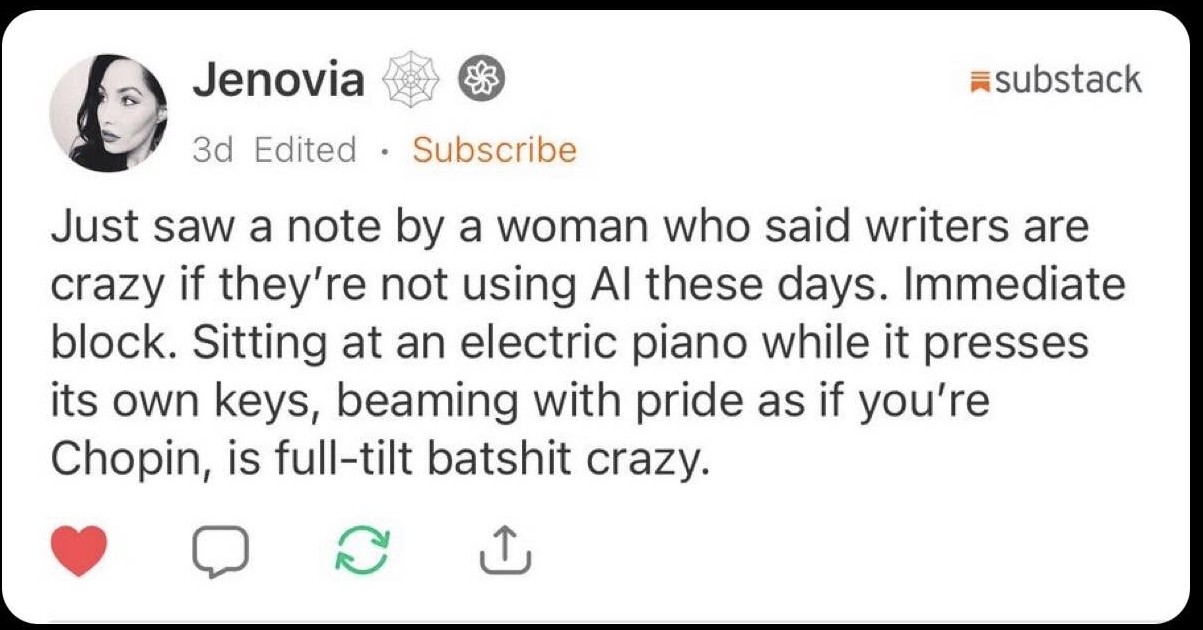
I don’t think that’s wrong, but from the other direction.
They’re both tools, and as long as you’re open about what it actually means to use the tool and what you actually did I don’t see an issue.
Sometimes 3D printing is as creative as printing someone else’s design. Sometimes the creativity is a modeling and design problem. Sometimes it’s a machine operation skill.
AI tools can be “write a book” or “draw me a cat”, which isn’t much , or it could used to do spot touch ups in a photo, or get feedback on a written work.
Doing something with or without different tools has different advantages and disadvantages, and changes the criteria that you judge it by.
Some people feel the same way about digital cameras or cell phone cameras. I don’t think the device picking the exposure time and white balance makes it not your picture, it just means I’m not being impressed by your color pallet, but instead your subject and composition.
To me that’s the least annoying part of AI at the moment. I’m open to the notion that you can be creative with tools that remove parts of the challenge, you just don’t get credit for the challenge.
Be careful of your use of AI here too.
My phone’s camera has “AI” all over it. But since the phone predates the degenerative AI craze, obviously it’s not talking about LLMs and something-or-other diffusions and all the other degenerative, hallucinating AI things.
The term “AI” covers a whole bunch of technologies, and most of those have found niches where they’re actually useful and don’t burn up the planet to use. Like, say, the “AI” photo retouching features of my phone. Which, to be clear, predate what is shilled as “AI” today.
Of course modern phones call what my phone calls “AI” something else: “software”. Because that’s what “AI” that actually works is called after it has found its niche.
Not to be a serial contrarian, but I’d say what’s being “shilled” as AI today is just as much AI as the AI of yesterday. Which is to say intelligent in the sense of “responsive to environmental changes”, not “sentient or sapient”.
Autocorrect, red eye reduction, and white balance correction are all different types of AI. So is the tuning function on most decent rice cookers. (Depending on the retouch feature you mean it actually could be from the modern AI wave. It started with images because humans notice a 10% gibberish rate in text, but we don’t see a 10% error rate when removing a ketchup stain)
I don’t think we’re actually in disagreement, but I think in this particular threads context it’s implicit that the intention of “fuck AI” isn’t “fuck my rice cooker and its weight/heat interpolation function”.
People feel that same way about any tool, and get a sense of dismissiveness towards people how use them. I usually don’t care about the tools people use as long as they don’t try to take credit for the part they didn’t do. Whittling and using a lathe are different skill levels when making a table leg, and I won’t be impressed by your radial symmetry if you used a lathe, but I can still like the table leg.
The biggest difference is that I don’t think there’s any generalized ethical issues with lathes that need to be addressed.
Getting upset about someone being open about using the tool, or even not being open about using it, is like getting hung up on questions of who gets credit for the symmetry of a table leg when the carpenter used a lathe powered by a live puppy grinder.
Oh, “AI” is purely a marketing term. You know how we know this? We can’t define intelligence. There is literally no definition for intelligence that is broadly accepted. So anybody selling “AI”, whether it’s “neural networks” or “ant colonies” or “genetic algorithms” or whatever technobabble is being used is not intelligence of any kind. You can’t make the artificial version, after all, of something we can’t identify.
What I was pointing out only is that “AI” photo retouching is not automatically degenerative “AI” photo retouching. The “AI” retouching in my phone is not prone to hallucination. It predates the hallucination machines. It just does stuff like (mostly) smoothly removing things like strung cable in photos and that kind of stuff, or does some pretty splendid night time photography.
Modern phones with the same features don’t call those features “AI” because today “AI” means the degenerative crap. They just call it “filtering”. (And then, tragically, they put the degenerative crap into the camera software because we’re not allowed to have nice things apparently.)
Ah, yes. The only bit of marketing terminology that has multiple high profile university research labs dedicated to it since the 50s.
You’re conflating human intelligence with what it means in computer science. We have no way of consistently and meaningfully ranking human intelligence. The intelligence being referred to in AI is not the same thing. It’s not even comparing apples to oranges. It’s comparing the abstract notion of a triangle to a rabbit.
You may as well say “signals intelligence doesn’t exist because we can’t define intelligence”.
Calling things techno babble doesn’t help you look like someone who knows what they’re talking about making a distinction.
I hate to break it to you, but that’s largely generative AI. You haven’t mentioned your phone specifically, but the features in question are at least quite similar to googles magic eraser and night sight features.
Unless your phone is hilariously old, it doesn’t predate googles use and development of generative AI.
In one sentence you say it doesn’t hallucinate, and the next you say it “mostly” smoothly removes things. First, where do you think it’s getting what’s behind what it removed? Second, what do you think is happening when it fails to get it right?
The computational photography features are largely a machine learning model being applied to techniques used by traditional photographers.
If you want to use them, I don’t care. Just don’t pretend they’re fundamentally any different than using Photoshop AI tools to do the same thing. It’s not. You’re using an AI based tool to do something that someone else is doing by hand. It’s trained on a dataset pulled from every picture on earth ever uploaded to the Internet.
Your perfectly color calibrated hdr+ photo without any weird stuff blocking the sky doesn’t get the same credit as a person who meticulously composited and exposed a set of film photos for those bits.
I literally said one message earlier that my phone predates the outbreak of degenerative AI. I got it in 2021. If that’s “hilariously old” to you, so be it. It works (unlike degenerative AI).
Now ask yourself this, Sparky. Why was it called “Artificial Intelligence”? If it was, and I quote:
I’ll give you a little clue: “artificial intelligence” gets more research grants than does any of these:
Yeah, so your phone is definitely using the modern iteration of generative AI for the features you’re defending. By “hilariously old” I meant more along the lines of “2014”. It is exactly what I was talking about when I was talking about smartphone AI features.
It kinda feels like your problem with modern AI is less the ethical issues and more the results you get from it, with the way that you’re defending it in the use case you like by saying it’s a different type.
As for your odd attack on an academic field: none of those things existed when the departments were founded. Those were all the names for the grants they proposed that led to them creating those things.
Why do you have a hard time accepting that maybe a term has different meanings in different contexts, and using that as the basis for your criticism is shallow compared to any of the other incredibly valid reasons to criticize how it’s built, supported, marketed, used or advertised?