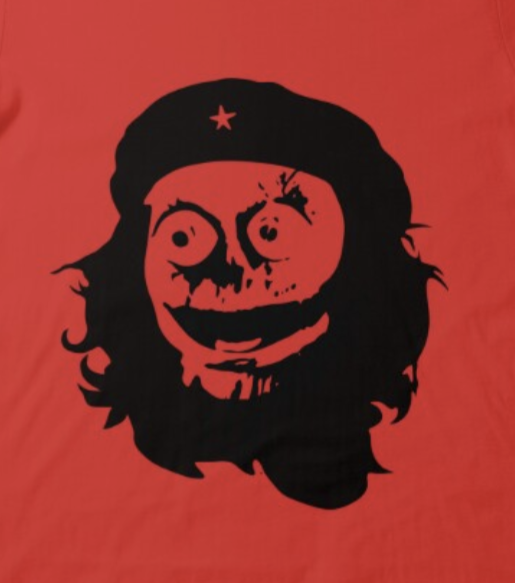
Apparently us “tankies” don’t live rent free in their heads.
No. We own all of the estate up in there.
Absolutely unable to think about anything else.
Once again I am asking libs to please come up with an argument that properly understands and disproves Marxist analysis. Seriously. I don’t want to have to do a revolution, I don’t want people to die, just voting problems away would be way easier. Except that voting away problems doesn’t actually work, the ruling class will not give up their power peacefully.
But all they ever have is lies and bullshit, they can’t ever attack our position based on anything we actually believe, because they can’t prove it wrong. They’re just mad their vibes based analysis doesn’t actually work, and think that shooting the messenger will magically fix that.
But have you considered that the democrats will, on the first day of the next democratic presidency, approve a tax credit, payable after 48 months, to any business that starts a family in a
brow…underprivileged neighbourhood?!Checkmate, tankies, all the problems will be solved with this one move!
Why do that, when you can do what this guy did, and send me a genuinely illegible listicle?
Good old strawman argument never lets them down

Would love to hear this worthless little shitstain explain how these two are morally equivalent, would love to hear all about chattel slavery in modern day Russia
Tell me a single fucking story about a child being ripped from their mother’s arms and sold, I’m all ears
Russia = Bad
Confederacy = Bad
See tankie? These two are exactly the same and therefore you support both because you’re an evil redfash tankie.

Of the two, the US is the one with slavery still legal under its constitution. I haven’t read the Russian Federation’s constitution, but I’d bet money on slavery not being legal there under any circumstances. The abolition of serfdom was a major part of their history, under both the tsars and the bolsheviks.
deepseek once called the rise of fascism “pretty wild stuff” when i used it. they don’t, and don’t want to, have it in them to treat even their horror stories with the gravity they deserve. they’re a collection of pathologically smug hedonists, it’s their entire world/moral philosophy: they are virtuous because they have fun all the time and are wealthy. and they go into histrionics iff they are personally inconvenienced.
Contemporary Marxists supported the union unanimously. Libs just cannot comprehend why we are always right
the virgin soil of immense tracts
The stunning Eurosity comes crashing in
liberals reading about a conflict between two different modes of production in an extremely stratified class system: muh freedom fighting revolutionaries
Crushing the Confederacy was the one time the Untied States was progressive. Of course the libs of the era made sure that slavers got away scot free and that black people were still oppressed afterwards.
It was as Frederick Douglass said in Boston in 1865, that the Civil War was begun "in the interests of slavery on both sides. The South was fighting to take slavery out of the Union, and the North fighting to keep it in the Union; the South fighting to get it beyond the limits of the United States Constitution, and the North fighting for the old guarantees;-both despising the Negro, both insulting the Negro.
– Black Reconstruction in America
Crushing the confederacy wasn’t about freeing enslaved people, it was about ending the slave plantation production model and replacing it with the industrial factory employment mode of production. The northern bourgeois had a more efficient system that pushed a lot of the responsibilities of the slave owner back onto the employee, they did not give a shit about the plight of the slave.
That still makes it more progressive in a strictly materialist sense, since it creates conditions (urbanization, expansion of the proletariat, concentration of production) more conducive to socialist revolution.
Yeah, progressive is not a moral analysis but a materialist one
Bleak racism
The north got fucking terrified because of Haiti and the common sentiment at the time was that black people couldn’t compete with white people in the free market and would thus die out on their own. When that didn’t happen abe lincoln himself was looking into ways to deport them to africa, but his general said black people would procreate faster than they could deport and so they just started burning villages and destroying everything black people built after the civil war instead.
No, the US was also progressive from roughly 1930-1945, and not just because of the New Deal. It was also because of genuinely anti-imperialist foreign policy in Latin America.
[G]enuinly anti-imperialist foreign policy in Latin America
I can’t claim to know too too much on the subject, but I do know Puerto Rico must be a rather notable exception to this assertion
It certainly is. Even at its most progressive moments, the US never stopped being a racist colonizer run by capitalists for capitalists for a second. But in certain periods, due to a complex set of conditions (especially involving interstate conflict and powerful mass movements), the US was in aggregate a progressive force for the world. Probably totals up to less than 10% of the country’s existence.
If you wanna read more on the Latin America stuff, check out Greg Grandin’s work, like America, América. Under FDR, the Vice President was going to Bolivian indigenous peasant unions and fighting on their behalf against US corporations, the Secretary of State supported and enforced pan-American labor rights and minimum wage, and the Ambassador to Mexico materially defended Mexican land expropriation of American corporate property. Communists across the continent were vocal supporters of the US and thought it was about to make a lasting turn towards anti-imperialism and worker power. Latin American states run by leftists were seeking closer integration so the US could aid them politically suppressing fascists. It was a brief period, but it was legit. I don’t think the US is capable of repeating that, structurally, without a revolution or at least a working class powerful enough to threaten one.
This was unfortunately not the case in Guatemala where they supported anti-communist Jorge Ubico for his support of the United Fruit Company.
Yeah, they weren’t doing anything to unseat right wing governments. But they were actively strengthening the left wing ones, and at the end of the period, Guatemala was one of the few countries left under a right wing government. At the end of the period, Latin American social democracy broadly was very strong.
Added to the ever-expanding reading list. Thank you, comrade!
Great post!
That website with all the John Brown emotes, that just posted an original John Brown fan videogame? Yep. They’re Confederates.
Didn’t the original sub get banned for John brown posting
the prevailing theory is that the subreddit got banned because of an influx of “slave owners deserve to die” posts, yes. as it happens a lot of those were also John Brown posts

John Brown fangame‽ send link
Wow, art isn’t dead
If they could grasp material analysis they wouldn’t be Libs.
Those on lemmy.world would also say the confederates are hamas not Israel
Oh right cause of the wall the Northerners built around the confederate states controlling who could come and go, and their previous invasions, makes sense
they call themselves rebels is the only thought process that’d go into it.
The CNT(Confederación Nacional del Trabajo/National Confederation of Labor)) an anarcho-syndicalist trade union who along With the FAI formed the majority of the anarchist faction of the Republican(left-wing anti-nationalist anti-fascist) side in the Spanish civil war, believe it or not advocates for slavery, it right there in the name! /s
“Anyone who criticizes or opposes US foreign policy is a fan of the Confederate States of America”
Is this seriously the best these dipshits can come up with? This exceeds liberal self-parody and runs smack into unreality, but what can you expect from reject reddit trash
Why did the Chapo sub get banned again?
Liberal: “I bet you tankies would have supported the confederacy!”
Leftist: “Kill every slaver, write the history of liberation with the blood of the oppressors”
Liberal: “Mooooods?
 ”
”I remember they tried to make it seem like the old sub was full of bigotry
And thus was born the artist ChaCha subsequently know as Hexbear
Huh, I wonder if Communists have written about the class dynamics at play during the civil war? Probably not…
got any links to reading material? it’s a gap for me for sure
The Civil War in the United States is a collection of articles and letters from Marx and Engels that follows the whole war.
Black Reconstruction in America by WEB Dubois is essential reading
The meme confused me so I googled “Lenin, US civil war” and found this:
https://www.marxists.org/archive/lenin/works/1918/aug/20.htm
(This is not meant in a demeaning way but rather to be clear about my own ignorance on the topic.)
Is this sarcasm?
I feel comfortable being blatantly sarcastic here lol. I’ve been telling people to read The Civil War in the United States by Marx for years on this site.
Obviously the US Civil War had an effect on the revolutionary consciousness of the world. English workers were actively organizing against the textine owners and holding rallies/striking. Marx was running around documenting the working class movements in the North and in England.
The positions of the Abolitionists were later absorbed by many Communists, and expanded on with the concepts of Wage Slavery. The black revolutionaries in America all built their consciousness in the context of the Civil War.
Reconstruction is used frequently as an example of liberal failure and the need for an organized vanguard (“tankies”) to solidify the gains of revolution.
Lenin’s dual revolution idea was derived from the failure of the American workers and liberated slaves to sieze power.
I’ll def check that work out, but I’d have to recommend reading Black Reconstruction in America before any other work. I’ve never read another book as thorough and soaring of an analysis on every level, and its beautifully written.
But the M&E collection will be interesting to do a comparison, I don’t know much about the movement in Europe to oppose trade with the south. I’ve heard that workers movements in England had kept these efforts at bay, but Dubois cites northern fears of the South resuming trade with England, Spain, etc., as one of the catalysts for arming former slaves who self emancipated into the Northern armies.
Only recommending M&E because they had a large influence on all Communist movements (obviously), and this was after the Manifesto, so you get to see a lot of the “newer” ideas taking hold (the ones that evolved into ML/“tankie” theory).
For understanding the Civil War from the perspective of the slaves, anything else is probably much better since Marx was interfacing mostly with American and English workers at the time. I will say that all of this ended up combining into ML over time though. The US Civil War had a massive influence on all theory that came after.
Other than Anti-Duhring and Capital, what works in the m&e canon evolved into ML? I also think there’s a major omission in this statement since The German Ideology has been commonly referenced by any ML I’ve had the privilege of discussing theory with.
The major theories that I’m aware of that Marx mostly abandons by Capital is the idea that socialism only develops out of Capitalism, and he kinda drops the theory of Lumpen Proles, although his class analysis in the 18th Brumaire is so insightful and important that I’d be reluctant to.say he completely abandoned this theory (although I used to kinda think that.)
Im just saying that you can see the influence there Civil War had on Marx’s later works. He realized that American slaves had much more in common with the proletariat than he previously saw (tacit abandonment of the concept of lumpenproletariat).
He also saw that the working classes of both America and England were capable of understanding longer term goals that may be immediately harmful to them (striking to prevent the supply of raw material from a slave source).
It has been a while since I’ve read the book though, so I’m a bit rusty. I just know that you get to see a lot of his internal thought processes hitting points that were later adopted by ML leaders.
Thanks for the recc, I’ve read Marx’s letter (on behalf of the English IWMA) to Abraham Lincoln, but hadn’t considered there was a collection of writings from that time. I think of the years before 1867 as Marx being like shut up in the library of England so yeah I’m curious about his correspondence and organizing outside of that work.
Dubois mentions some early American Marxists before the civil war but said they didnt really know what to make of the issue of slavery. I’m actually not very aware of the early history of American Marxists, I don’t know of any real serious showing of American Marxists until the St. Louis commune of 1877
These are the same people who would’ve been like, “I’m against slavery, but it’s just too complex of an issue to just get rid of it!”
“It wasn’t about slavery! It was about culture and heritage!”
The culture and heritage is slavery.
That’s the joke, yes.
Liberals WERE like:
We need to reach across the aisle and compromise with these slavers