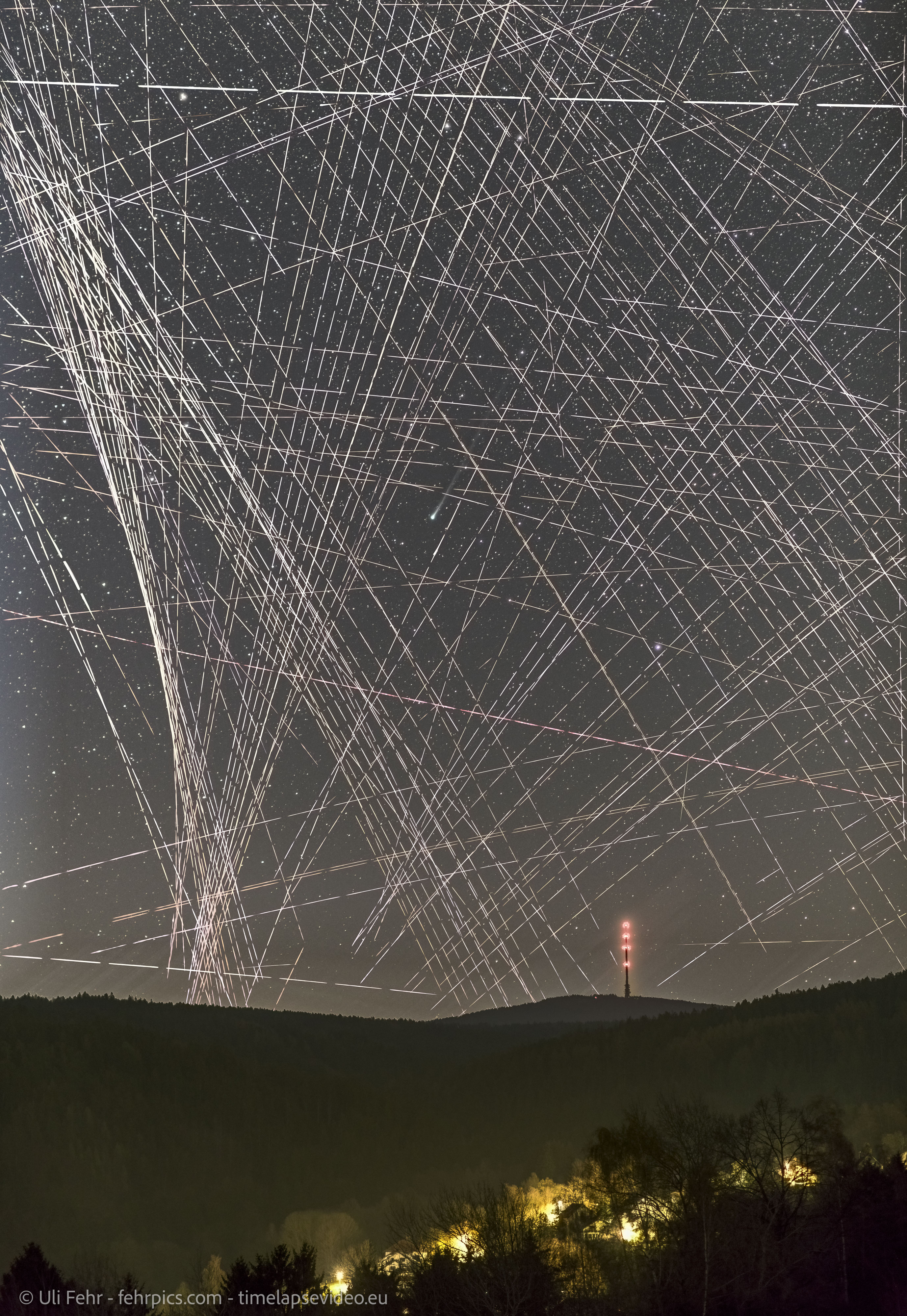
“a bright visitor passing through the inner Solar System. Now, the orbiting satellites themselves only appear as streaks because of the long camera exposure, over 10 minutes in this case. On the contrary, to the eye, satellites appear as points that drift slowly across the night sky and shine by reflecting sunlight – primarily just after sunset and before sunrise. The featured image was taken just before sunrise two weeks ago from Bavaria, Germany.”
I guess the only ways to access the natural sky is to leave the atmosphere or to use AI to remove the trails.
i was so worried about this when I first heard of the sheer amount of starlink crap being launched into orbit. upset that my worries were justified :(
Don’t worry too much yet, it’s still bound to get worse
Kepler syndrome Wall-E worse.
I wonder what those “no contact” tribes think of the increase in moving stars
The Sentinelese are the last men standing.
I really admire the Sentinelese. In the face of overwhelming technological disparity, they still fight back against any outside intrusion. I wonder what kind of stories they tell each other about the outside world
upset that my worries were justified :(
That’s a succinct summation of life for many of us about far too many things, sadly.
What community is this? Oh…. Right.
This is terrible, but in isolation, this picture looks dope
We had laser background options for our family photos as kids and my mom would never let us get them.

It’s right there.Easiest where’s Waldo yet
I remember being a kid and looking up at a mostly still and dark sky. Fast forward to when I started hiking and camping much more in my thirties. I’m creeped out by the LEO satellites whipping around. I dont know exactly why. It feels like something changed that shouldn’t have. A place that we used to stare into the limitless beyond is now barred or trespassed by something so terrestrial.
You were looking at a mostly dark sky because of light pollution. If there is no clouds, a night sky is anything but dark and empty.
It’s only a matter of time before one hits another and the debris from that hits a 3rd one, and so on until there’s nothing left but debris, preventing the launch of any more. Maybe then we’ll get some peace around here.
That would actually be a dope terrorist movie plot. Just launching a satellite with the sole purpose of destroying as many satellites as possible.
The USA, China, Russia and India have all already tested such things, to no one’s surprise.
Yeah the major powers have anti satellite weapons. Shits fucked
EMP boom!
Thankfully they’re low enough orbit that their orbit would decay pretty quickly. It’d be a superb show as the sky lit up with millions of pieces of burning debris. Not sure what it would do for the atmosphere though. It would be a fair amount of metals being vaporised.
Pretty sure it would do absolutely nothing to the atmosphere
It would be like dumping a gram of metal shavings in the ocean.
Space is pretty big and accidental collisions like that are quite unlikely actually. But of course space debris is a real problem, just not quite in the way you describe I think.
So this is why even in the middle of nowhere we can’t see the stars? Fuck these satellites.
No these are just annoying drifting dots. You can’t see the stars because light pollution has been growing exponentially since we figured out how to make LEDs
I find it odd you’d say light pollution is worse since LEDs. I thought the design of lights was generally far more directional with LED design and avoided shining light upwards. Now you can fly over large areas with street lighting and only see dimmer reflected light from roads and not the streetlights themselves.
Its true that how we use them makes a big impact. If I recall correctly, some policy changes in France reduced the problem massively. But they’re so cheap and efficient that we’re simply emitting more lumens than ever. For something like $40 USD you can get a flashlight 100,000x brighter than the sun. This is driving rapid lighting in developing countries.
Another factor is that human eyes are much more sensitive to blue wavelengths at night, which LEDs emit more of.
You should absolutely be able to see the stars when out in the middle of nowhere. I can still see them in a moderate sized town in the UK.
That has nothing to do with it. This only affects long exposure photography, you would never notice this with your naked eye.
Surely this is a bunch of trains right? If this is only 10 minutes of exposure and that’s just the random floaters, Astrophotography is kinda fucked. Last time I went out to shoot was 4 years ago and you could see the satellites with the naked eye. It was nowhere near this many in the sky at once.
It’s not nearly as much of a problem as this image would suggest. The processing method used in this image was specifically chosen to highlight the satellite tracks. This method would have hidden them entirely.
Wouldn’t that have hidden the comet too?
Adding on to the other comment: the specific method I linked is a little crude, and intended to separate perfectly-still objects from all moving objects.
You can fine tune this technique to specifically capture or reject objects moving at certain rates. You could tune it to capture the slow rotation of the stars as the planet turns,for example, while rejecting the movement of the satellites.
Another example: The criss-crossing satellites are at different altitudes and travel at different speeds. You could fine tune this technique to selectively gate either set of satellites while rejecting the other set.
The point is that even though astrophotography is certainly degraded by these satellites, the degradation is not nearly as significant as this particular image would suggest. This image was synthesized by specifically targeting these satellites for inclusion, rather than exclusion.
No, the comet stays almosf stationary to the stars during such a short time. Hence, it is in every image and therefore also in the final median image.
For average astrophotography satellite trails are not really a problem as it may seem here. Almost any image is processed in such a way in any case. But there are special projects which are heavily impacted, for example the search for asteroids. There you need to look at each individual image, as fast moving asteroids would be deleted with this method.
Yeah I figured it was processed to show off the trails. I’m more wondering about the number of satellites in the picture. Like I said you’re out in a dark sky zone you can see them with the naked eye. Last time I was out you’d always see one or two flying by but this picture looks like a hundred or so in a 10 minute stretch. That’s a lot more than I would have guessed.
That seems about right. https://satellitemap.space/vis/constellation/starlink
According to the growth chart on that site there was ~3200 satellites up when I was out in 22. Now there’s 12K give or take 2k depending on the number you look at on the site. Kinda insane to see it visualized like that. It just seems unnecessary.
Terrestrial ISPs, (both wired and wireless) are broadly neglecting rural and impoverished areas. The people running ISPs are just as evil as Musk and Bezos, just not as well funded.
Services that directly compete with entrenched, monopolistic ISPs are absolutely necessary. I just wish they were run by humans instead of space nazis.
They should put a tax on light pollution like a reoccurring tax to have These types of things up in the sky so there’s a cost to it
Stupid question: Are they blinking or is that light reflecting? If they’re blinking, why do they blink with visible light?
The post says it’s the reflecting sunlight at dawn/dusk. Just need to read beyond the headline.
Well, I did say it was a stupid question. xD
They often slowly blink, but I think that’s because they are rotating.
They aren’t blinking. The apparent blinks are due to intermittent, rather than continuous exposure. The gaps you’re seeing are where the satellites were when the camera wasn’t capturing.
What’s really happening here is that they’ve used a post processing method specifically designed to highlight the satellites rather than the comet. This method would have rejected the satellites.
Almost all, if not every satellite is going to be reflection. And it’s going to be significantly worse at sunset and dawn since that’s when the satellite is still in the sun but the ground is dark. That just happens to be when comets are typically most visible.
That just happens to be when comets are typically most visible.
To give a little more context. The tail is created by the solar wind, and is strongest when the comet is closest to the sun. Being near the sun makes it appear close to the sun in the sky (obviously). That puts comets in the daytime sky and impossible to see. It only dawn and dusk when you’re still able to see in the right direction and the sky is dim enough that you are able to observe comets.
May be an artifact of stacking. Each line in the segment could be a single long exposure.
Out of curiosity, why are the trails dotted? Was tje shutter closed periodically?
Taking the opportunity to share some cool astrophotography data from the Vera C. Rubin Observatory terrestrial telescope in Chile
Strangely enough i saw it almost immediately.
What’s the big horzontal one at the top?
“oi, yeh got yer comet in me satellite turf, innit?”
I wonder if we could paint satellites in fanta black to minimize the reflections