Hi. I have been thinking about keeping track of read books, articles, comments, etc. and was wondering if anyone had some great setup/software. Something that lets you keep track of notes and highlights, potentially tag to easily find books about a subject. Something that’s made for going back and gathering information from them, probably not just like a bookshelf. Surely researchers or students have something like this, needing to keep track quite like I’m trying to describe.
Thank you!
ⓘ This user is suspected of being a cat. Please report any suspicious behavior.
I use Markor, and take notes on everything I read, sorted by author. I take notes in markdown format. Here’s an example:
Reading Notes/Domenico Losurdo/How to Cast a God Into Hell: The Khrushchev Report
note example
A “Huge, Grim, Whimsical, Morbid, Human Monster”
-Khrushchev’s “secret report” aimed to liquidate the character of Stalin in every respect.
-Khrushchev accuses Stalin of only understanding the situation from films, of mercilessly repressing entire nations, killing his best friend Kirov, and weakening the Soviets before World War II due to blind trust in Hitler.
-Khrushchev alleges Stalin was an incompetent battle leader, insisting on this point and Stalin’s apathy and despair.
-Students and workers across the country initially resisted the Twentieth Party Congress’ events, showing respect to Stalin.
-Trotsky made many similar claims, even stating that Stalin’s work Marxism and the National Question was secretly written by Lenin instead.
-These portraits of Stalin do not actually align with reality, and are in fact quite ridiculous.
The Great Patriotic War and Khrushchev’s Inventions
-Contrary to how Khrushchev depicted the Soviet preparation for the Great Patriotic War, Nazi intelligence expressed astonishment at how quickly the Soviets were able to manufacture massive amounts of tanks and armaments.
-Stalin was reported to have been obsessed with quantitative increase in arms and qualitative improvements in them 2 years prior to the war.
-Stalin, contrary to Khrushchev’s report, spent 11 hours straight in meetings and organized resistance immediately upon the Nazi assault as soon as it began.
-Stalin supposedly pondered over every minute detail, from Pravda headlines to the size and shape of bayonets.
-Stalin had always opposed Hitler and the Nazis.
-Goebbels admitted that Stalin’s speeches had been widely admired in England and the United States.
A Series of Disinformation Campaigns and Operation Barbarossa
-Khrushchev alleges Stalin ignored grave warnings of Barbarossa, but this fails to account for the massive amount of disinformation being spread at the time.
-Goebbels excitedly wrote of the Nazi plans to feint and misdirect.
-Nazis put people on the west on high alert, said that Crete was a model for conquesting England (which it then censored, giving the impression of a leak), all while preparing for attacking the Soviets.
-Goebbels wrote that people believed buildup near Russia to be either a bluff or a blackmail attempt.
-France also participated in disinformation, claiming Stalin gave a speech talking about how he wanted to sovietize Europe.
-Britain, while warning of Barbarossa, also warned the Germans of a Soviet attack, wishing to kickstart it as quickly as possible.
-Rudolf Hess flew to Britain on the eve of war.
-Stalin justifiably feared a British/German pact, and this was increased by British pressure.
-Stalin could not risk a preemptive attack and give Britain the opportunity to side with Germany.
-In all of this, preparations were accelerating, with divisions deployed to the west, aircraft hidden and soldiers told to expect an attack from the Germans.
-The British predicted the Soviets would fall within weeks, the Statesians gave the Soviets a few months.
-Geography explains Barbarossa’s initial success, the ratio of force to wide open land favored the attacker, and areas where railways converged in cities provided numerous avenues to attack.
The Quick Unraveling of the Blitzkrieg
-Coming into Barbarossa, Hitler and Goebells were extremely confident and thought of the soviet army as but a joke. This turned out to be laughably wrong, and their confidence destroyed merely 10 days in.
-Anti-Aircraft ended up being so effective it reduced the number of raids possible by the Nazis against the soviets.
-Within weeks, Hitler swapped to furious anger at how difficult the advance was, and how dramatically they had underestimated the Soviets, to the point of pivoting from fearing the west as their strongest opponent to the Soviets.
-German generals admitted astonishment at the amount of resources the Soviets had built up.
-Japan decided against going to war against the Soviets to help the Nazis based on the effective Soviet advances at Smolensk.
-The incredible bravery and defense by the Soviets caused a total reversal in perception by western onlookers to that of admiration even among conservatives.
-Contrary to what Khrushchev had said, it turned out that Stalin’s caution and insistence on maintaining large reserves was key to the counteroffensive, as the Nazis were depending on the Soviets amassing all of their forces on the front to be swiftly routed in a race to Moscow and other core cities, surrounding and destroying the Red Army.
-Poland and France had deployed their troops too far forward and were surrounded and crushed, due to national pride. Their theory of battle left them inflexible.
-2 days after the attack, the Soviets moved 1500 industries to the core to protect them from attack and keep them productive, and this process had begun even before the invasion.
-The soviets had developed industry intentionally in areas far from Europe.
-Adolf Hitler was so surprised by the Soviets that he wrote “How can such a primitive people manage such technical achievements in such a short time!” As well as “The fact that Stalin has raised the Russian standard of living is unquestionable. People don’t go hungry [at the moment when Operation Barbarossa was launched]. In general, it’s necessary to recognize that they have built factories of similar importance to Hermann Goering Reichswerke where two years ago nothing but unknown villages existed. We come across railway lines that aren’t even marked on our maps.”
-Stalin had a developed and universal mindset, choosing to celebrate the October Revolution in a besieged Moscow for resolve and renewed vigor.
-Western analysts wrote that the success of the German invasion initially was unsurprising due to its size and preparedness, what was truly astonishing was the incredible counter by the Red Army.
-Goebbels admits that the Nazi spies had no idea about the soviet capabilities while having full intelligence on the French.
The Lack of “Common Sense” and the “Mass Deportation of Entire Populations”
-Stalin wrote two key theoretical texts, Marxism and the National Question and Marxism and Problems of Linguistics.
-Internment of ethnicities was done by the Statesians well after the war and any reasonable credible suspicion could possibly be accounted for.
-Britain had split India and Pakistan in the largest forced migration in history, and the Nakba was forcing Palestinians to flee.
-16 million Germans were forcibly relocated, 2 and a half million did not survive, by the Allies, with full enthusiastic support by the US and Britain.
-Germans worried what would happen if the Soviets did not protect them from the Czechs.
-The communists disagreed with deportations and instead felt that the Germans in charge should be tried and punished, and the German workers and peasants reeducated.
-In Czechoslovakia it was the communists who put an end to the repressions of ethnic minorities.
-While FDR blamed the German people, Stalin said the true allies of the Soviets were the German workers, oppressed by the Hitlerites.
-The US at the time was segregationist and deporting entire populations of Mexican Americans and Black Americans.
-Of 139 cases observed, 137 Germans had their testicles destroyed by kicks from the American War Crimes Investigation team. The Soviets were more humane.
-Stalin had far more of an understanding of the national question than the west and other contemporaries in practice, against Khrushchev’s desire to rob him of his theoretical significance.
The Cult of Personality in Russia from Kerensky to Stalin
-Khrushchev alleged Stalin had a cult of personality, but this isn’t due to Stalin’s vanity or narcissism in reality but a broader phenomenon.
-Wilson was effectively a dictator in the US.
-In times of acute crisis, personalization of power is often combined with veneration of the leader who holds power. This applied to Stalin due to the immense siege the Soviets found themselves in at nearly all times.
-FDR won four elections, effectively in his own cult of personality, and became nearly worshipped even as he detained Japanese Americans.
-Kerensky tried to model himself after Napoleon.
-Meanwhile, when it was suggested to Stalin that Marxism-Leninism be made Marxism-Leninism-Stalinism, he downplayed his own significance in comparison to Marx and Lenin.
-Stalin rejected the award for Hero of the Soviet Union after helping win the Great Patriotic War.
-Stalin had Zhukov cancel any military welcome to Berlin for Stalin, and took the train, rather than walk through the ruins of Berlin with Churchill and Truman.
-Stalin allegedly liked people who had their own views and were not afraid to stand up for them.
-Khrushchev failed to eliminate the cult of personality, he turned it into a negative cult of personality around Stalin, turning it into an enormous national pessimism.
I do this for any theory or history articles or books I read. Sometimes I also write where I disagree with the author, or note how this has changed since the time it was written.
thinking about it more, i think zotero https://www.zotero.org/ fits your needs perfectly. i used it more my degrees
Recommendation for Zotero. It’s great for academic work, but I have folders full of stuff for my various special interests and theory.
 7·17 days ago
This seems more like what I was interested in! Thank you.
ⓘ This user is suspected of being a cat. Please report any suspicious behavior.
theres also raindrop, but its more lightweight. made for bookmarking more. https://raindrop.io/
I don’t… if i don’t know what ive read, the government can’t either
I have a love hate relationship with zotero.
The category of software is called citation manager. There are not too many options so you can check them all out.
Other paths would be a general note taking tool or system. Try searching PKM. But dont waste too much time on it.
I like the PKM idea…

Anyways. I’ll look into it.
ⓘ This user is suspected of being a cat. Please report any suspicious behavior.
Kaban turned me into swiss cheese with this many a time
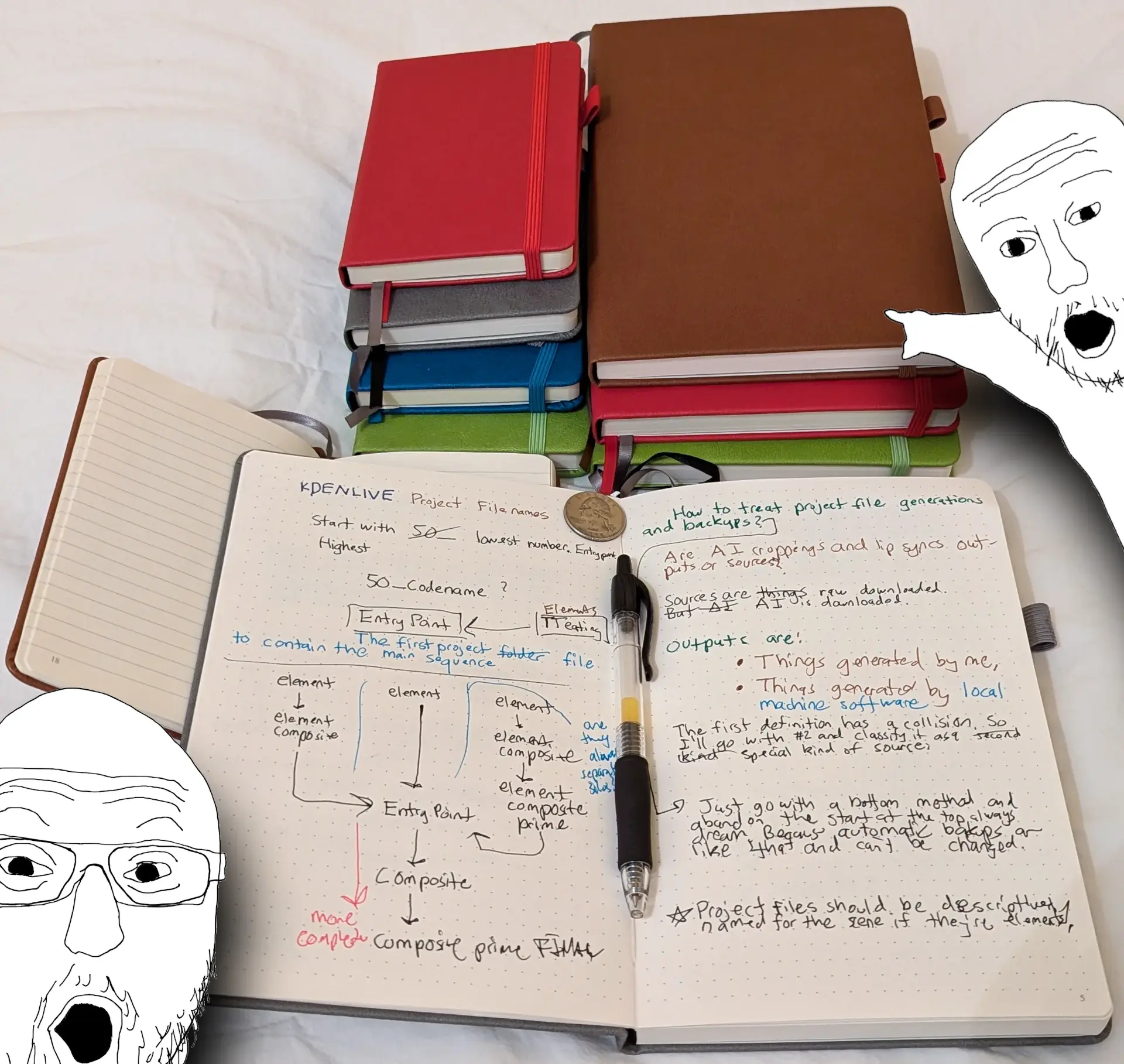
Perhaps not the answer you’re looking for, but I’ve gotten into hardback A5 notebooks the past few years. Quality ones are affordable (~$6/each) and writing in them feels really good. The physical media complements my digital life well. It’s difficult to accidentally delete a notebook. I have one dedicated to taking notes from stuff I read and watch.
It’s difficult to 🮖🮖🮖🮖🮖🮖🮖🮖🮖🮖🮖🮖🮖🮖🮖🮖🮖🮖🮖🮖🮖🮖🮖🮖 notebook.
Sounds like what someone says just before.
I use StoryGraph. It’s like Goodreads but not owned by Amazon.
StoryGraph seems to only be for books? Not quite it then. But thanks for the rec
ⓘ This user is suspected of being a cat. Please report any suspicious behavior.
I should’ve read the post closer

Zotero is much closer to what you’re looking for
I use an emacs org-mode setup and will switch to the Denote package soon to do exactly this! Org-Roam is another more ‘plug-and-play’ option.
I use Libib. Its library software, but I find it super intuitive for my personal reading list. People also recommend storygraph, it’s more like goodreads in experience.
i have a file cabinet for physical stuff i accumulated in school and a section if a bookshelf for associated books.
however, i am working on a setup for my servarr system that runs a readarr server where i can integrate it with something like calibre to aggregate digital copies of all kinds of materials into an indexed library that i can use an e-ink reader to search and make my own notes/highlight.
thats the goal anyway. ive had a bunch of irl shit get in the way of me figuring it all out, and only have some basic progress (readarr running and aggregating ebooks).
i have a reader that is fine (kobo), but im still working out the kinks of making it all play together smoothly. it doesn’t help that the readarr api situation is a little janky, so my library needs more attention to organize it properly. and calibre seems to work fine, but i don’t exactly know what im doing yet.
I believe readarr is no longer maintained! And I think you need their server to do anything so its like totally kaput.
Good news is that you didn’t get to it sooner, and get everything going only to have the rug pulled out. Smart of you to have waited. :)
yeah its no longer maintained, but there is a fork for the API issues using “rreading glasses”.
for better or worse, my readarr server is up on a community fork, running and steadily aggregating ebooks.
short of a real alternative coming out, im OK with it for now. most of the shortfall between me and my goal (of a self-hosted, indexed library of fiction, history and teference material) is setting up a smoother process for connecting and using my e-reader to connect/checkout/return materials on its own without having to tinker with the server side. i want to put it all in a shoebox on a closet shelf.
What is readarr (or fork) contributing if you have calibre?
I had it set up for a while but it was mostly because I was trying to avoid calibre (which has foiled me many times in the past).
Obsidian? But it’s been a while since I’ve used it. I just use files and folders…
Zotero. Then just get a markdown editor with compatibility. You can usually @ the source at the top of the notes.
How about something like Obsidian? Seems like it would be up your alley:
Another option is a physical/binder and printing stuff out. Can print out some charts for writing stuff down for the books entries in it too, maybe. I’m tempted to start doing this for internet articles because all of it seems destined to disappear from the internet at some point.
I am starting to feel like it is my destiny to become one of those people whose whole home is full of filing cabinets and bankers boxes.
I thought computers would save me but now seeing the err in that.
I use a libre office excel sheet for horror movies I’ve watched. (The names make it so hard to remember)
I simply read it again and then halfway through i go wough i read this already
This has always happrned to me, even whrn iwas in middle and high school, i’d read tbe first 2 books of the inherentence cycle, get dkstracted or be unablr to reaf the last 2, then i forget where i left off, read some of 1, realize i rea dit already, go to 2 and then read halfway, et cetera
How were the first two books of the inheritance cycle?
I also have this memory issue. Its great because I can reread my favorites and they’re brand new.
Theyre okay
It’s geared towards a teen/YA audience clearly written by a young author, but it’s charming in that way
The fact that one of the main characters is a sapient dragon means that it instantly goes up like 5 tiers of quality in my head because of that one fact