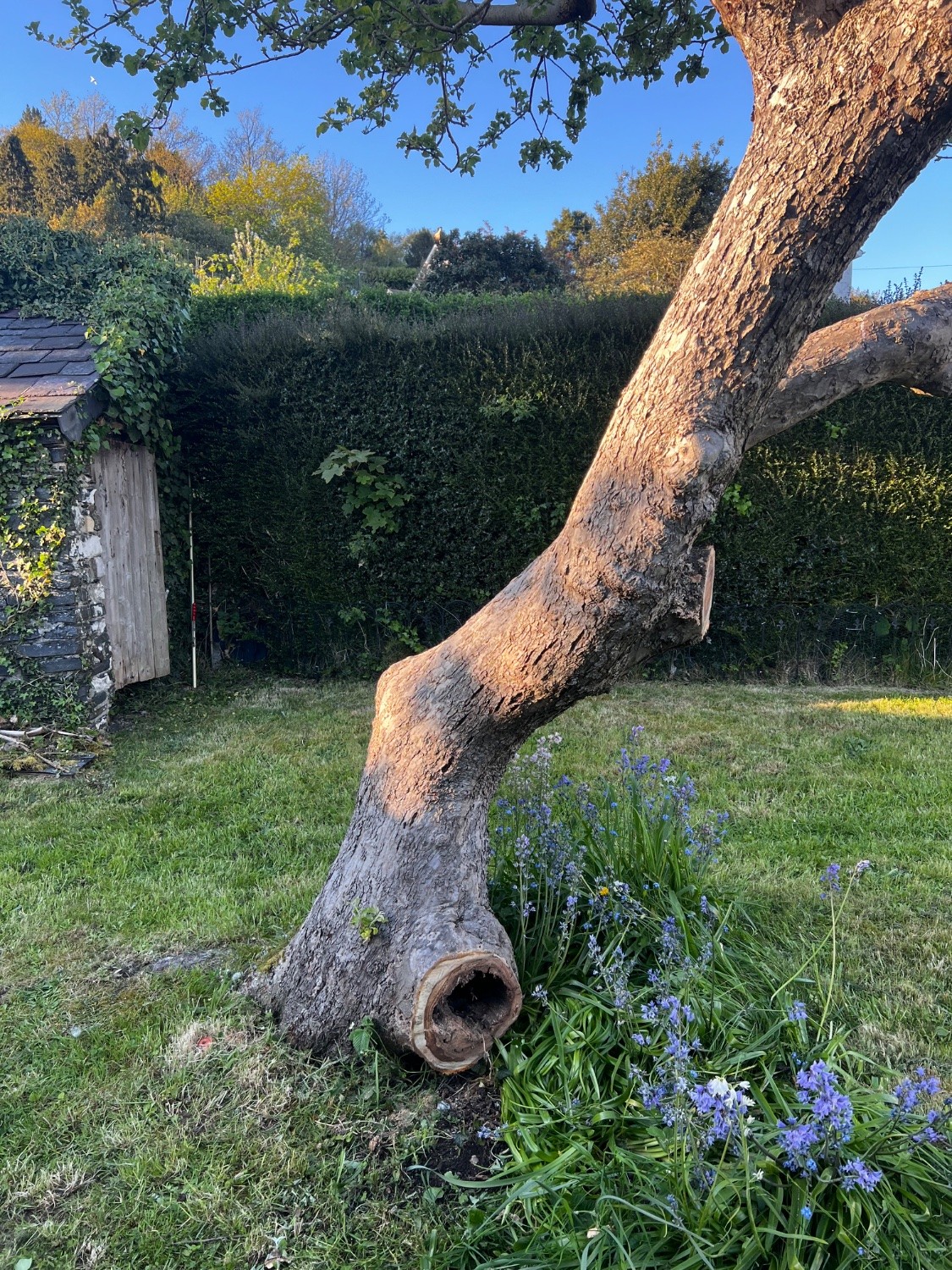
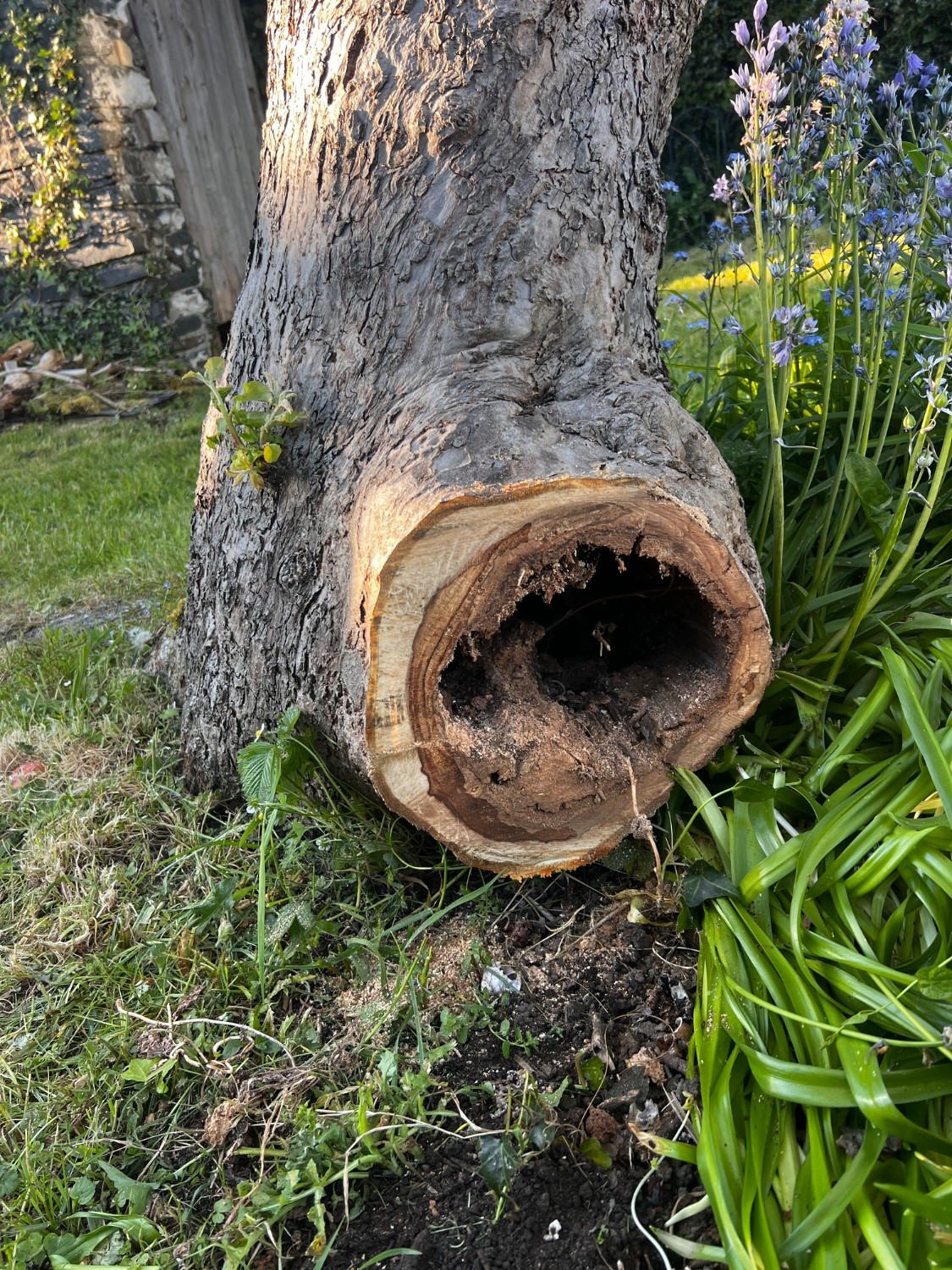
Pretty old apple tree in the garden which produces hundreds of not-great-tasting apples every year looks like it’s in a bit of a state. I had to cut back a weird branch that had been cut before, presumably because it shot out horizontally, and there’s a ton of rot.
It’s not in danger of hitting any buildings if it ever does fall, although could maybe take out a distracted child or two if I’m lucky.
Is there anything I can do to save it?
Certified arborist here. Fruit trees are often precious, if I’m being generous. They are short lived, prone to disease, and take a lot more work than almost any other tree to keep healthy. It’s not really a bad thing, just part of what they are. If there are no target and the tree isn’t too big I would just let it do its thing. Yes the tree is going to fail. Yes it is dying. Enjoy it while it lasts. Now is a good time to think about replanting. Get another tree lined up and planted, by knowledgeable people please. No buried root flares or mulch volcanos. If you play your cards right you could have another tree producing by the time this one is gone.
My (dwarf) apple tree had mast years every year and I just gave it a bit of potash and water every now and then. It wasn’t difficult in any shape or form. Still sad I had to leave it when I moved.
Sometimes we get really lucky and a new tree really loves where it’s planted. Love to see it.
As an amateur planter of trees myself, could you elaborate on what “mulch volcano” or “buried root flares” are?
Sure. It is really common to see trees planted too deep. If the trunk looks like a telephone pole it is probably planted too deep. The base of the tree should flare out visibly. Unfortunately a lot of trees are too deep when you buy them. This makes tree selection at the nursery very important.
“Mulch volcanos” are a common way you see landscapers apply mulch to trees. The mulch piled up the sides of the tree. When mulching a tree you should use 2"-3" of mulch out to the drip line (edge of the leaves). No deeper than this, and the mulch can’t touch the bark of the tree. Wet mulch on the bark encourages fungal growth and pests.
These are both really important for tree health because tree roots need access to oxygen. Being planted too deep or adding too much mulch will starve the roots of oxygen and ultimately lead to tree decline. It won’t be a fast death. It could be five years before you start seeing your tree struggle. I have a pamphlet I was gonna take a picture of, but I’m in the middle of a move so it’s packed away.
Very much appreciated!
Are you saying that on a nursery tree, if the flare is buried it is already a lost cause? (As in, there’s no way to excavate it out and leave it exposed when transplanting into the soil that will actually work?)
Not at all. You can gently excavate down until the root flare is exposed in most cases. It is, however, a red flag for how the tree has been taken care of and if you can find a better looking one it’s easier to just go with that one.
That makes a ton of sense!
EDIT: Final question: do you know if there is something similar that applies to more “vine-y” fruit plants like raspberries and grapes?
The same principles should apply to any woody perennial plant, but maybe not exactly. You still don’t want them planted too deep, but they might not have a visible root flare. Since they are smaller, faster growing plants than trees I think they adapt better to inconveniences. But don’t quote me on that. They are technically covered by arboriculture but I do 95% of my work with trees. Vines and brambles aren’t really my area of expertise.

I’ll take a guess at the second! If the tree is planted too deep (with the bit where the trunk flares out under the soil level) then it’ll be constrained/ might rot.
I wonder if the mulch volcano is over-mulching?
Ok! That’s super helpful. Your explanation also makes sense for them both being flavors of the same thing (apparently it’s important that the flare is exposed to open air)
Yikes. I’m no tree expert, but it will probably continue to rot all the way through. I would have it taken down.
But! If you want to continue having a lousy tree produce crappy apples, you can take cuttings or do air layering and start one or more whole new yucky apple trees!
Not the question you’re asking, but if it’s going to stick around for a while you can graft material from any tasty apple tree onto any other apple tree and that branch will give you tasty apples.
There are companies that go through and change over entire grown orchards to a new kind of apple, lopping off all branches and shoving in a few inches of scion material from the desired variety into each branch stump. They grow to full sized branches shockingly quickly and produce the next year.
I’d say the rot at the base makes it not worth the effort of trying to save it. Anything around the base of the tree like that is a bad sign.
Talk to an arborist to be 100% sure.
Some species of tree can lose up to 70% of their interior and still be structurally stable, but in almost all cases, rot has to be caught a lot earlier than that to have a chance of recovering. The tree probably isn’t on its last legs, but it will most likely die of this eventually.
A certified arborist would be able to advise on treatment options, if any, and give you an estimate of how long you’re looking at before it needs to be removed.
I knew an old apple tree something like that. The rotten cut limb was a few feet higher though. The thing looked bad, with a gaping hole, but somehow it just kept going. Mostly it didn’t produce hardly any apples, but every 4 or 5 years or so for some reason it would be loaded with big decent enough cooking apples. It was always covered in ants. It was a great tree for climbing too, despite the ants.andnl caterpillars. Hard to imagine anything killing that tree, even if it was mostly useless and a bit on the ugly side, and looked like it might die every year. Eventually the property was sold to some rich people. They blasted away the outcropping of granite close by, and razed the old house, cleared a bunch more of the land to make room for a monstrous “cottage” just where that big old apple tree always had been. So it goes.
Anyhow don’t listen to me. Take the advice of the arborist and plant some new trees, and let that one go when the time is right if it doesn’t leave you first. But also don’t underestimate a tree’s ability sometimes to deal with crazy circumstances and keep going perhaps longer than they should have.
You’re not wrong. I’ve lived in this house a good while now. It was previously owned by the family of a kid I went to school with. The family had long since moved and had been renting out the house for years before I bought it.
I showed the guy a photo of the garden shortly after I’d bought it about 15 years ago, because I’d cleared it after the previous tenants had let it get wildly overgrown. Even then, his first response was “I can’t believe that apple tree is still standing”.
If you do save the tree, hard apple cider turns out great if you use a good grade champagne yeast.
This 100%, and a cider press is pretty easy to DIY.
Every year I think about doing it, and never do.
Yes to the Champaign yeast. It’s also good to mix about 10% crab apple in too. It gives it that just bitter tang to offset the sweetness
Sounds like the perfect excuse to plant a great tasting apple tree instead!
You could try grafting or air layering propagation. There are plenty of tutorials available.
🌳->🌱->🌳
You could try pollarding or coppicing it in the late winter.
During the winter all the sap drops to the roots for storage. If you cut it all off a few inches from the ground you’ll get rid of the rotten bits and in the spring the tree will just start over, but with a bunch of root.
There’s some resources you can google if you use coppicing as a keyword.
This is a layperson’s advice, so grain of salt and all that. An arborist would probably know better.
If the little bit of greenery at the bottom is saved, it’ll probably stand a better chance in the spring, but it’ll be tough to cut out all the rot and leave just that.
I own about ten apple trees. From experience: just leave it as it is.