You must log in or # to comment.
Only the US gives the US all the credit. The narcissism runs deep.
Story time: I watched Independence Day in the cinema in the UK and there’s a scene where theyve just destroyed the first ship and it cuts to the UK and someone says “the Americans have worked out how to beat them” or something like that, and the British officer says “about bloody time” and everyone in the cinema cheered.
The US doesn’t give the US all the credit. People that don’t pay attention in class give the US all the credit.
If there’s a flaw in how it’s taught I’d say it’s the over focus on the the US, UK, and Soviets implied by the literally famous phrase “American steel, British intelligence/grit, and Russian blood.” For one thing it conflates Soviet blood with Russian which is it’s whole own thing.
For another, as an Australian and ANZAC day around the corner, it was British Empire blood, not just those from Britain - Indians, Canadians, Aussies and Kiwis plus all the other countries the UK had under its yoke.
But I do think you’re probably statistically to the right on the bell curve in knowing that. Alas the majority of USians would struggle to find the US on a world map, let alone know world history. The propaganda also runs strong.
Canada wasn’t under the UK yoke. The Statute of Westminster gave Canada full control of its foreign policy in 1931. We chose to fight the Nazis of our own volition.
And Australia was federated in 1901 so neither were we. But we were all still under Empire mentally and felt obliged to help mum out. It was the 2 wars which really killed that final Empire connection and we drifted away mentally from them. And government Acts soon followed, for example, it was 1947 when Brits were no longer automatically Canadians too, the 1950s when they dropped the “Dominion” part of their name and 1977 when Canadians stopped being Brits automatically and 1980 when “O Canada” officially became Canada’s national anthem - Australia had similar Acts under a similar timeline. So whilst yes, I agree in principle, we all had a choice to not go to war, and we had our own self-governing countries, there was no chance we weren’t going because we had an obligation, if not ordered (a la India who were still under direct control).
The Dominion system, its phasing out and the subsequent formation of the British Commonwealth are part of our joint histories. Apologies for the wiki page but it’s a good starting point if nothing else.
If you asked today’s average American who were the Soviets, I doubt you’d get a correct answer.
It’s media that gives credit and that’s all there is these days. Too many people: “Have you ever heard of anyone else at Omaha and Utah Beach? No.”
Um that’s not about WWII
That’s about narcissism.
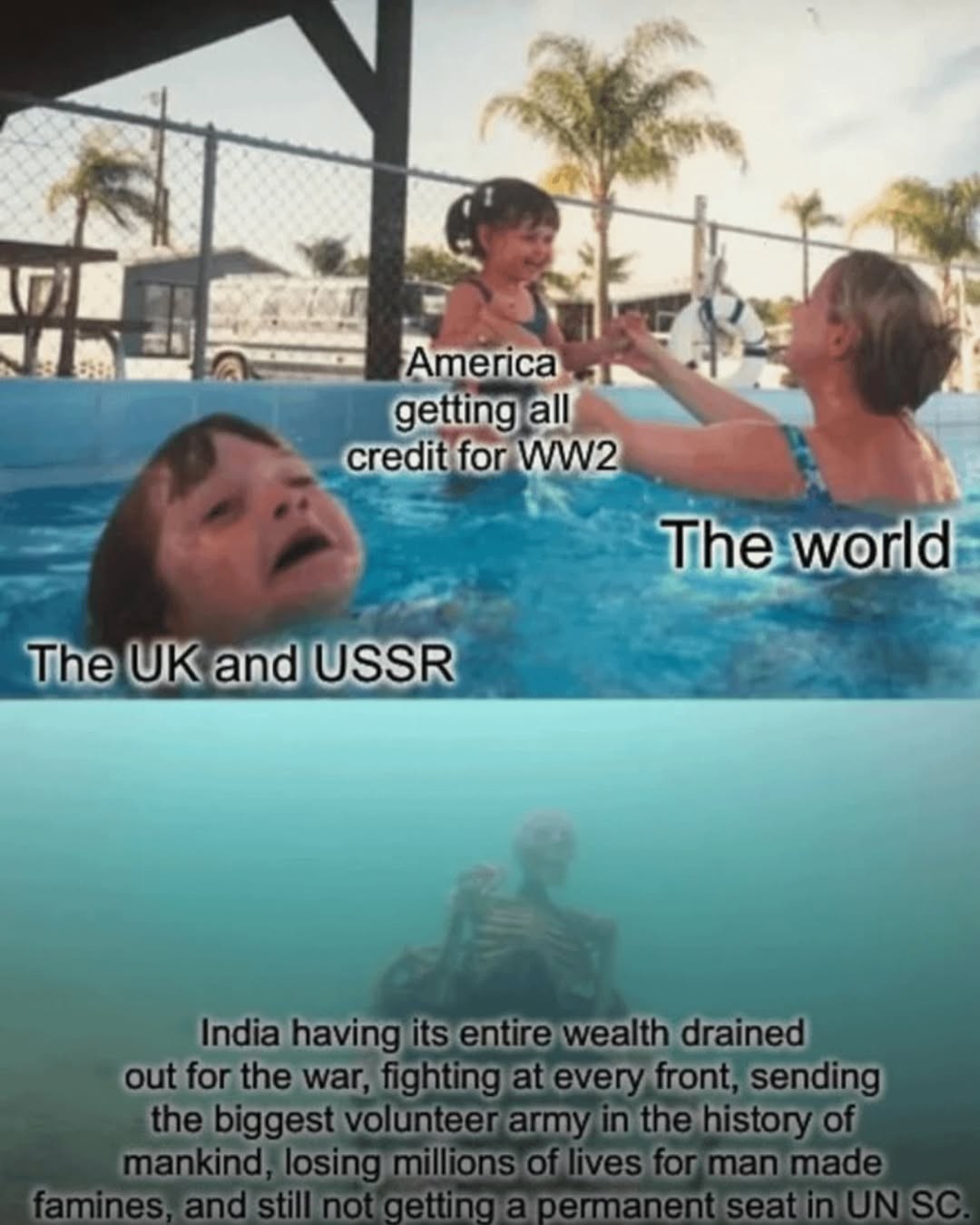
America getting all credit for WW2
That is not how it is taught here
Yeah, if you’re in eastern Europe I assume the soviets get all the credit, despite them admitting that without lend lease they wouldn’t have won as readily?
soviets get all the credit
That is also not how it is taught here
Don’t leave us hanging
America and soviet union did play important parts, but there’s also, yknow, europe itself. A combined effort of multiple countries. UK wasn’t forgotten, and I remember french resistance being talked about, and more.
So the message we got was really not “[insert nation here] came in and saved the day on their own”
America also teaches about that?
I’d say if we overlook anyone it’s China, because then Americans might realize the Japanese had bled themselves dry before Pearl Harbor, and the Balkan fronts/resistances.
And obviously India as the meme mentions.
I can’t remember what was said of India, so I guess the submerged skeleton part checks out. Though it could also be me not paying attention.
Because India didn’t do it. it didn’t chose to provide resources to the war. Britain did
it is colonisation. and the reason The British went to war with Germany is not to liberale it from Nazis. but because Hitler was doing colonization in Europe. Colonisation is only bad when done on Europeans, except the Irish.
This does not capture the full picture. India already had elected authorities and provincial autonomy through the Government of India Act 1935 at this point. Indian freedom fighters had effectively rubbed the hipocrisy of claiming to be stewards of democracy while depriving colonies of it in the faces of British colonial authorities so they had capitulated this much.
When the war broke out in September 1939, the Viceroy, Lord Linlithgow, declared India to be at war with Germany without consulting any of elected Indian provincial governments. This led to significant discontent and civil unrest.
For this reason, in order to maintain the cooperation of Indian businesses during the war, they “purchased” goods and services from these businesses.
They printed Indian rupees to pay for goods and credited the equivalent value in British pounds to an account in London. These were known as Sterling Balances.
During the war, as the Indian economy became a massive exporter and Britain became a massive debtor, the “market value” of the rupee should have naturally risen.
By keeping the exchange rate artificially low and fixed, Britain was able to “buy” Indian resources much more cheaply than they would have in a free market.
This massive printing of rupees also triggered hyperinflation within India, leading to a soaring cost of living for the local population.
By the end of the war, India had transitioned from a debtor nation to one of Britain’s largest creditors, holding nearly £1.3 billion in debt.
Even though India technically “owned” over £1.3 billion by the end of the war, they weren’t allowed to spend it freely.
Britain forced India to remain within the “Sterling Area.” This meant India could only spend its credits on goods from Britain or other British colonies.
India desperately needed American machinery and technology to industrialize after the war. However, Britain refused to let India convert its Sterling Balances into U.S. Dollars, effectively forcing India to wait until British industry recovered enough to sell them goods (often at higher prices).
After the war, Britain was nearly bankrupt. John Maynard Keynes and other British officials argued that the Sterling Balances should be “scaled down” or even canceled.
They argued that since Britain had “saved” India from Japanese invasion, India should consider the debt a contribution to the common cause of the war.
Indian leaders, including those in the interim government before independence, fiercely resisted this. They argued that the debt represented the “blood and sweat” of the Indian people, pointing to the Bengal Famine as the price already paid.
In 1949, shortly after Indian independence, Britain devalued the Pound Sterling.
Because India’s credits were held in Pounds, the purchasing power of those balances on the international market (specifically for buying goods from the U.S. or Europe) dropped overnight.
This effectively wiped out a significant portion of the real value of the debt Britain owed to India (between 30 to 50%).
During the war, the British government explicitly agreed to the terms of these “purchases.” They used Indian grain, steel, and labor to win a global war that in part saved Britain itself from Nazi invasion. To later suggest that the debt should be canceled because they “protected” those that they borrowed from is often viewed by economists as an attempt to retroactively change the terms of a loan because the borrower went broke.
So, this contribution was not made entirely without the consent of the Indian people. It was an arrangement with the Empire based on the understanding that they would eventually pay back their debt. They did not.
fuck the Brits. Churchill statues belong in the river.
And I like how the part of Ireland that didn’t give up is far better off today!
That’s wonderful. I’m thrilled to see India breaking the shackles of colonialism and rapidly developing and I’m optimistic towards seeing the same happen in Africa. I’m all for seeing people thrive after surviving imperialism.
In the Netherlands Canada gets all the credit
Here in the US, we learned quite a bit about the UK & USSR’s roles in WWII in school, also, but granted this was back in the 90s. We learned nothing about that other country
Churchill gave us such bangers as :
I am strongly in favour of using poisoned gas against uncivilised tribes […] gasses can be used which cause great inconvenience and would spread a lively terror
The Respect the Dead podcast did an episode on Churchill’s famine. It’s a good episode.
Churchill was a monster of a man and the world is better with him dead.
But hey, at least they got their independence because of their bravery and not because Britain was too broke and exhausted to stop them
Or because Britain was too moral to let one old dude starve himself in protest and respectfully left, after they starved millions with nary a night’s sleep lost.
Onto Pakistan next, tally ho!
Not before partitioning the country by religion which would kill a few million and displace tens of millions, and which would lead to multiple wars and the violent repression of bangladesh as it sought independence. It would also facilitate the creation of two more nuclear armed states and perpetuate the religious tension and conflict that still persists to this day…
Britain: “i don’t like that version”
India had both militant (Bhagat Singh, Bose) and nonmilitant freedom fighters (Gandhi).
It had effectively fought for and acquired democratic representation and provincial autonomy, which was not the norm among Crown colonies (those that had indigineous non-white populations).
This was in contrast to settler colonies (like Canada, Australia) which were predominantly white and permitted self representation as much as a century earlier.
It was the first non-white colony to achieve this which effectively wore away at the those brown/black people are savages and don’t deserve agency worldview which was the British/European norm at the time.
Jamaica and Ghana were the first Carribean and African colonies to get suffrage and self rule around ten years after the Government of India act in 1935.
The leader of the Indian nonmilitant movement went on to inspire the likes of MLK Jr and Nelson Mandela who effectively ended the residual post colonial apartheid states of the US and South Africa.
In my view, the global relevance of Indian independence cannot be understated as a first step in restoring the humanity and dignity of those exploited by colonialism.
In germany we credit all fighters that freed us. From NZ to Britain. From canada to brazil. Especially the resistance fighters. Soviets arent credited in a well meaning way since they then also occupied us and did many war crimes on us too
Didn’t america also occupy Germany, iirc we still have a lot of bases there to this day. I guess it was just a more friendly occupation with far less oppression.
Yes, but unlike the soviets they didnt strip the industry bare as reparations and didnt put us under a totalitarian survailance state that when you protested brought out the tanks. Ofc old east germans will say “it wasnt all that bad”. yes Oskar however it was STILL A FUCKING DICTATORSHIP WHERE ⅓ OF ITS POPULATION WAS SPYING ON THE OTHER ⅔!! Yes Oskar the reunification was a robery, unjust and more an annexation rather than fusion of two equals.
Also from what i got told, you barely knew there was an american occupation until the founding of the german republic, while in the east you defenetly saw and felt it
WW2 India is a hero of the free world in this house o7
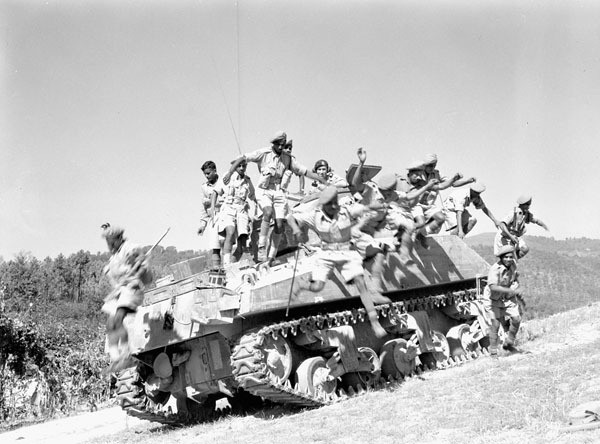
Lol, india thinks a bit much of themselves dont they
I would advise against basing what you think a whole nation thinks on a silly meme.