Try reading Flatland, besides the social commentary, it’s an illustration of how dimensions work, and by analogy how higher ones would.
It’s well out of copyright, so there are also a bunch of audiobook versions on YouTube and such.
I can’t but Carl Sagan can https://www.youtube.com/watch?v=UnURElCzGc0
So, I don’t really understand this stuff, but someone who does told me: When they hear “dimensions” some people think about time being our 4th dimension, or like Marvel style alternate dimensions, forget all that. Completely unrelated to math dimensions.
Didn’t get me to understand what came after that, but it helped me not think about it in a completely wrong way.
I am by no means an expert (closer to the opposite, actually), but I always considered Time as the 4th dimension to be a bit of a fallacy that inhibits further thinking on the subject.
Sure, time can be considered a fourth dimension when looking at it from a perspective of trying to determine possible states of a system, as it adds one more axis in which an object can move. However, when it comes down to mathematics and physics, I consider it more like a property that is applied to a system and objects in it, regardless how many axis of movement is applied to it.
And just to be clear: I don’t understand it fully either, and I don’t know if it is correct. it’s just how I prefer to look at it, and it holds true in most circumstances I stumble across. I have no idea how a tesseract would look to a four dimensional eye.
You’re more right than you might have expected, but not because it’s a fallacy or misleading. You noticed something important in how it all works: time is a dimension, but it doesn’t act like “up” or “forwards”.
This doesn’t make it less of a dimension or a hindrance to understanding, it’s an observation that leads to: there are different types of dimensions.
Typically called time like and space like, they can also be thought of as “one directional” and “two directional”, although a physicist somewhere is (correctly) coughing politely and glaring at some of the shit photons get up to at the thought of one directional time.You’re thinking of time as a parameter, which is how it is in classical mechanics. It’s a different category of thing, but it technically makes the system 4d.
When you start looking at how light moves and relativity you find that you actually need time to act much more like another direction because it no longer defined an order or sequence, and you get stuff like “time slows down when move faster in space because acceleration shifts your movement vector in space time”.It’s even simpler in math, because a dimension is simply a number required to specify a point in a space. If you cared to you could use “left” as your parameter and talk about how a thrown ball changes position in time, up, and forward as a function of left.
Then you could do some real math and use that function as a point in some space and talk about how the different components are different dimensional aspects of the infinite dimensional polynomial function space.
Something I see a lot that I think blocks understanding is “the dimensions”, “the 3rd dimension”, “the 4th dimension”, etc. This is wrong.
Dimensionality is a property of something. It is a number which describes some aspect of a thing. As others have said, it corresponds to the number of “independent directions” needed to describe a thing, but these directions need not be uniquely definable in any way, and most certainly you cannot say “this is the first one, this is the second one”, etc.
As a small example, just as you can say North and East are two independent directions on a map, you can also say South and North North East are as well; either of these facts on their own imply that a map is at least two dimensional. The fact that you cannot find a third independent direction means a map is two dimensional.
A dimension is “simply” a direction that can be changed without changing any of the other directions.
What people often mean is a spatial dimension in “normal” geometry, where “up” is independent from “left” and “forward”.A square is a two dimensional shape. It can have points on it specified in two coordinates.
When you hold a block, you’re holding a 3 dimensional shape. It takes 3 coordinates to specify a point in it.
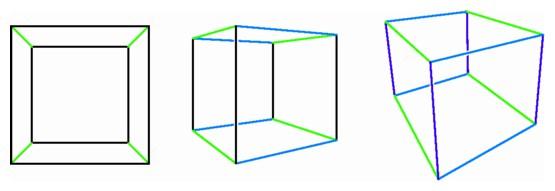
When you draw a 3d cube, you’re drawing the 2d “shadow”, or projection, of that 3d shape into 2d.A tesseract has the same relationship with a cube as the cube has to the square. What we often see represented is the 2d shadow of the 3d shadow of the 4d object.
On it’s own it doesn’t tell you much about the shape. What tells you more is seeing how the lines and points change as you rotate in 4d.https://www.geogebra.org/m/mzycqzgt
This seems like a fine little tool for seeing stuff.
The 3d shadow of the tesseract isn’t the tesseract though. We can’t actually see them, only the shadow. Thinking hard and looking at the shadows changes as we move the 4d points can let’s us intuit how they work though.
So a tesseract is a term for a specific geometric shape that exists in 4 dimensions. Specifically it refers to a 4-d version of a cube, in the same way you could say that a cube is a 3-d version of a square. It is a shape with 16 corners and and all right-angles.
You may have seen a tesseract represented as two cubes, one inside the other, with their corners connected (example: https://upload.wikimedia.org/wikipedia/commons/a/a2/Schlegel_wireframe_8-cell.png). This is best understood as a drawing of a tesseract. Just as you can draw representations of 3-dimensional shapes onto a 2-dimensional piece of paper, you can also draw representations of 4-dimensional shapes onto a 3-dimensional space. The “cube within a cube” representation is kind of like drawing a cube as a square within a square, with the corners connected (left image here: https://www.math.brown.edu/tbanchof/Beyond3d/Images/chapter6/image01.jpg). It is a perspective drawing of the cube in wire-frame, viewed end-on. The outer square is the near face of the cube and the inner square is the far face of the cube, smaller because it is farther away. The other four faces are depicted as the four trapezoids formed between the inner and outer squares; these actually represent square faces but they are distorted into trapezoids by the perspective.
So the cube-within-a-cube drawing of the tesseract is just the next-dimensional version of this. It is a tesseract viewed end-on, with the outer cube being the near cell (in 4-d geometry, the 3-d shapes that make the outer surface of a 4-d shape are called “cells” - kind of like how the 3-d shapes that make the outer surface of a 3-d shape are called faces; a cube is made of six square-shaped faces, while a tesseract is made of eight cube-shaped cells), while the inner cube is the far cell, smaller because it is farther away (in the extra, 4th dimension), while the other six cells are the six “3d trapezoid” (a “frustum” is the technical term for this shape) spaces formed between the two cubes; these actually represent cube-shaped cells but they are distorted into frustums by the perspective.
4-d is hard to visualize. We live in a world of 3 spatial dimensions so visualizing that comes naturally to us, but we have to strain to understand higher dimensions beause our visual system can’t help us in the same way. Analogy to 3-d is one way, in particular looking at how we represent 3-d objects using a 2-d image (a common thing for us to do), and trying to do similar things to represent 4-d objects using a 3-d “image”.
This video was what taught me how to visualize the 4th dimension. This video goes onto to explain 6 more, so feel free to stop after 4 lol.
I’ve never been great at visualizing a “4D cube” or tesseract, but here’s another visual that might shed some light on it: https://youtu.be/0t4aKJuKP0Q
This lady does videos about how to understand the 4th dimension. She’s also written a very good book that gently explains the concept. This video is about translating the “impossible triangle” into a 4d version.
If this one is too heady, her short videos are more digestible.
A point must exist on a 1 d line.
A 1d line must exist on a 2d plane.
A 2d plane must exist in a 3d space
A 3d space must exist in a 4d time.
Basically every dimension must exist within a higher dimension.
Think of a tennis ball bouncing in front of you. Now freeze time. The ball can be placed at x,y,z position (basically). But the same ball exists at a different x,y,z if we include t for the 4th dimensional measurement. The xyz changes position as the ball bounces, but only if t changes indicating movement through 4d time.
You are mixing spatial dimensions with a temporal dimension. A 3D space does not require time. A 3D space exists in a 4D space though is “flat” in the 4th just like a 2D plane is flat in the 3rd.
deleted by creator
What does the Christian Cross have to do with it? lol
I was trying to put a gif of how to make a tesseract dimension by dimension but it wasn’t working XD