I’m literally so stupid that I pictured a regular family accidentally making too many sandwiches in their kitchen one afternoon and then calling the fire department. Didn’t even remotely cross my mind that it was a sandwich shop.
As the a restaurant manager who has looked at the date of an event, looked at the actual date, then looked at the date of the event again, looked at the sheet he gave the kitchen, looked at the extra servers on the schedule who were about to come in, looked back at the date, looked back at the email, realized that its the 25th and not the 18th, then had to go into the kitchen where several people are prepping for that event and have to lie to everyone “hey, they had to cancel and move it to next week. Don’t worry we can just do whatever with the food, they understand and are basically paying twice”
Not to bitch about free food – free food is good food – but I’ve noticed the workforce uses food as a bandaid to cover more glaring absences like pay and benefits.
I’ve worked in a small handful of different industries prior to settling in healthcare, and it was (and still is) a recurring pattern: the jobs that had the best fringe benefits had the worst actual benefits. I’m positive there are exceptions to this on both ends of the spectrum, but it does prompt the question: are you not getting shit because your corp compensates you well enough that they don’t need to bother with fringe shit? Or are you not getting shit because they fall on that worst-of-both-worlds end of the spectrum?
For what it’s worth, I’ve found totally the opposite. Way better respect given to me when I’m paid better. Much better flexibility, acceptance of arriving late/early/needing to step out for an hour or two for something. Nicer food at lunch, free food even, well stocked break rooms, the lot.
What I believe the real answer is, is that the restaurant is likely trying to beat the JIT (Just In Time) production system. For example: If you are a restaurant themed around southern comfort, some of that food can take quite a while to prepare. To get ahead of the curve, you avoid making food in response to each order, and instead opt to make food in bulk at several points along the day, knowing you get X orders on average every few hours. For a sandwich joint, it probably has some additional nuance to it since its not quite as time intensive to make one, but I believe this to be the general answer.
Edit: this works better for some restaurants than others. It brings a higher production cost to cover the waste that went unused, but cuts out costs for labor. And for some joints like a Taco Bell, it can be optimized well enough that it’ll hardly make a difference whether they make it on the fly, or in advance.


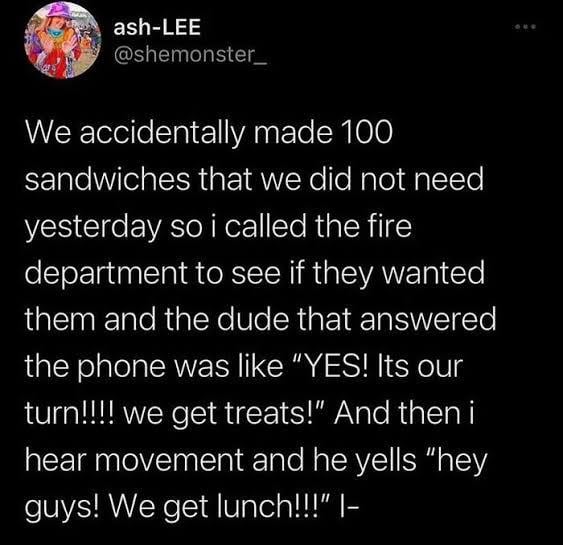
More context, please! How does one accidentally make 100 sandwiches too many?
Sandwich shops are a super popular option for corporate catering, bosses will order a few platters to dull the pain of an all-hands meeting.
I’m literally so stupid that I pictured a regular family accidentally making too many sandwiches in their kitchen one afternoon and then calling the fire department. Didn’t even remotely cross my mind that it was a sandwich shop.
Hell, I think the big wigs where I work call meetings just so they can comp the lunch.
Still doesn’t explain how you accidentally make 100 too many.
As the a restaurant manager who has looked at the date of an event, looked at the actual date, then looked at the date of the event again, looked at the sheet he gave the kitchen, looked at the extra servers on the schedule who were about to come in, looked back at the date, looked back at the email, realized that its the 25th and not the 18th, then had to go into the kitchen where several people are prepping for that event and have to lie to everyone “hey, they had to cancel and move it to next week. Don’t worry we can just do whatever with the food, they understand and are basically paying twice”
Y’all are getting sandwiches? We don’t get shit
Not to bitch about free food – free food is good food – but I’ve noticed the workforce uses food as a bandaid to cover more glaring absences like pay and benefits.
I’ve worked in a small handful of different industries prior to settling in healthcare, and it was (and still is) a recurring pattern: the jobs that had the best fringe benefits had the worst actual benefits. I’m positive there are exceptions to this on both ends of the spectrum, but it does prompt the question: are you not getting shit because your corp compensates you well enough that they don’t need to bother with fringe shit? Or are you not getting shit because they fall on that worst-of-both-worlds end of the spectrum?
If it’s the latter, start updating that resume.
For what it’s worth, I’ve found totally the opposite. Way better respect given to me when I’m paid better. Much better flexibility, acceptance of arriving late/early/needing to step out for an hour or two for something. Nicer food at lunch, free food even, well stocked break rooms, the lot.
Hang on to that shit - you caught a unicorn!
…that said, my own employment history isn’t exactly a noteworthy sample size, so take my comments here with a hefty grain of salt.
Way ahead of you. I’ve been reaching out everywhere lol
Well, fuck. You have my empathy - that’s a shitty process, and by the sound of it, an even shittier status quo.
Keep your eyes on the prize, and good luck.
Make a 100 sandwich order on the wrong day.
Work at a sandwich shop and some dickhead cancels a big order?
Maybe they accidentally made the order a day early
That’s not an accident. That’s a crappy former customer.
What I believe the real answer is, is that the restaurant is likely trying to beat the JIT (Just In Time) production system. For example: If you are a restaurant themed around southern comfort, some of that food can take quite a while to prepare. To get ahead of the curve, you avoid making food in response to each order, and instead opt to make food in bulk at several points along the day, knowing you get X orders on average every few hours. For a sandwich joint, it probably has some additional nuance to it since its not quite as time intensive to make one, but I believe this to be the general answer.
Edit: this works better for some restaurants than others. It brings a higher production cost to cover the waste that went unused, but cuts out costs for labor. And for some joints like a Taco Bell, it can be optimized well enough that it’ll hardly make a difference whether they make it on the fly, or in advance.
Or they got a catering order and just made it on the wrong day
Similarly to how one might accidentally build a jeep.