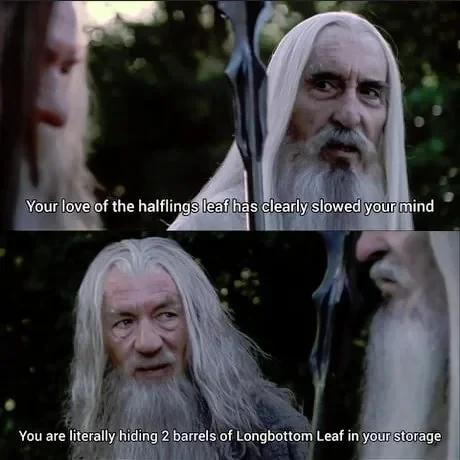
At this point of the story, Saruman probably doesn’t have longbottom leaf, as in the book, its presence in Orthanc is what gives Sam and Frodo Aragorn an inkling that he might’ve been up to something in the shire while they were gone…
You sure? I thought he didn’t take up the “Sharkey” identity until after he fled Orthanc, and the leaf was just part of the general supplies for himself and the human guards he kept.
I had to take my book out to check a few things. Here’s the end of The Two Towers, Book 3 chapter IX Flotsam and Jetsam:
‘We understand it all perfectly now,’ said Gimli.
‘All except one thing,’ said Aragorn: ‘leaf from the Southfarthing in Isengard. The more I consider it, the more curious I find it. […]’
Then in The Return of The King, book 6 chapter VIII The Scouring of the Shire:
‘There isn’t no pipe weed now,’ said Hob; ‘at least only for the Chief’s men. All the stocks seem to have gone. We do hear that waggon-loads of it went away down the old road out of the South-farthing, over Sarn Ford way. That would be the end o’ that year, after you left. But it had been going away quietly before that, in a small way. That Lotho—’
So I use this chronology to see where that places us. The closest event to the end of the last year is the fellowship of the ring leaving Rivendel on december 25th. The ents reach Isengard on March 2nd, so most of Saruman’s weed stash must have arrived in this roughly three months interval. Though as Hob says, he may have started building his supply lines earlier…
you don’t have to do this much guesswork, it’s directly in the text, just a few sentences after the part you quoted.
[Aragorn] “Neither goods nor folk have passed that way for many a long year, not openly. Saruman had secret dealings with someone in the Shire, I guess. Wormtongues may be found in other houses than King Théoden’s. Was there a date on the barrels?” “Yes,” said Pippin. “It was the 1417 crop, that is last year’s; no, the year before, of course, now: a good year.”
Gandalf doesn’t arrive at Orthanc until mid-1418, the leaf was already there, unless it takes several months to transport
This is the year of the crop, not necessarily the year it was shipped. Pippin’s remark “a good year” seems to imply it is commonplace to store some leaf for several years and distinguish the yields of good and bad years, as is done for wine.
maybe, but also consider Tolkien’s intent while writing the scene. the characters, and also therefore the reader, are explicitly questioning how this happened, and how long it’s been going on. Tolkien then gives an explicit date. that date would have been before anyone had noticed it happening, and he has multiple characters independently theorize that it may have been happening before anyone realized. do you think those are attempts by Tolkien to mislead the reader or raise unanswered questions about the subtleties of the pipeweed production and delivery timeline, or is it more likely that he’s trying to tell the reader that this has been going on for a while, when the only means he has of communicating with the reader is through characters who are not aware of the information he’s trying to convey? is it more thematically appropriate for Tolkien to make a point about the similarities between pipeweed and wine, or to make a point about how the type of evil he’s portraying is insidious, and can begin to take hold without anybody noticing?


Uhm akchually…
At this point of the story, Saruman probably doesn’t have longbottom leaf, as in the book, its presence in Orthanc is what gives
Sam and FrodoAragorn an inkling that he might’ve been up to something in the shire while they were gone…You sure? I thought he didn’t take up the “Sharkey” identity until after he fled Orthanc, and the leaf was just part of the general supplies for himself and the human guards he kept.
I had to take my book out to check a few things. Here’s the end of The Two Towers, Book 3 chapter IX Flotsam and Jetsam:
Then in The Return of The King, book 6 chapter VIII The Scouring of the Shire:
So I use this chronology to see where that places us. The closest event to the end of the last year is the fellowship of the ring leaving Rivendel on december 25th. The ents reach Isengard on March 2nd, so most of Saruman’s weed stash must have arrived in this roughly three months interval. Though as Hob says, he may have started building his supply lines earlier…
you don’t have to do this much guesswork, it’s directly in the text, just a few sentences after the part you quoted.
Gandalf doesn’t arrive at Orthanc until mid-1418, the leaf was already there, unless it takes several months to transport
This is the year of the crop, not necessarily the year it was shipped. Pippin’s remark “a good year” seems to imply it is commonplace to store some leaf for several years and distinguish the yields of good and bad years, as is done for wine.
maybe, but also consider Tolkien’s intent while writing the scene. the characters, and also therefore the reader, are explicitly questioning how this happened, and how long it’s been going on. Tolkien then gives an explicit date. that date would have been before anyone had noticed it happening, and he has multiple characters independently theorize that it may have been happening before anyone realized. do you think those are attempts by Tolkien to mislead the reader or raise unanswered questions about the subtleties of the pipeweed production and delivery timeline, or is it more likely that he’s trying to tell the reader that this has been going on for a while, when the only means he has of communicating with the reader is through characters who are not aware of the information he’s trying to convey? is it more thematically appropriate for Tolkien to make a point about the similarities between pipeweed and wine, or to make a point about how the type of evil he’s portraying is insidious, and can begin to take hold without anybody noticing?