
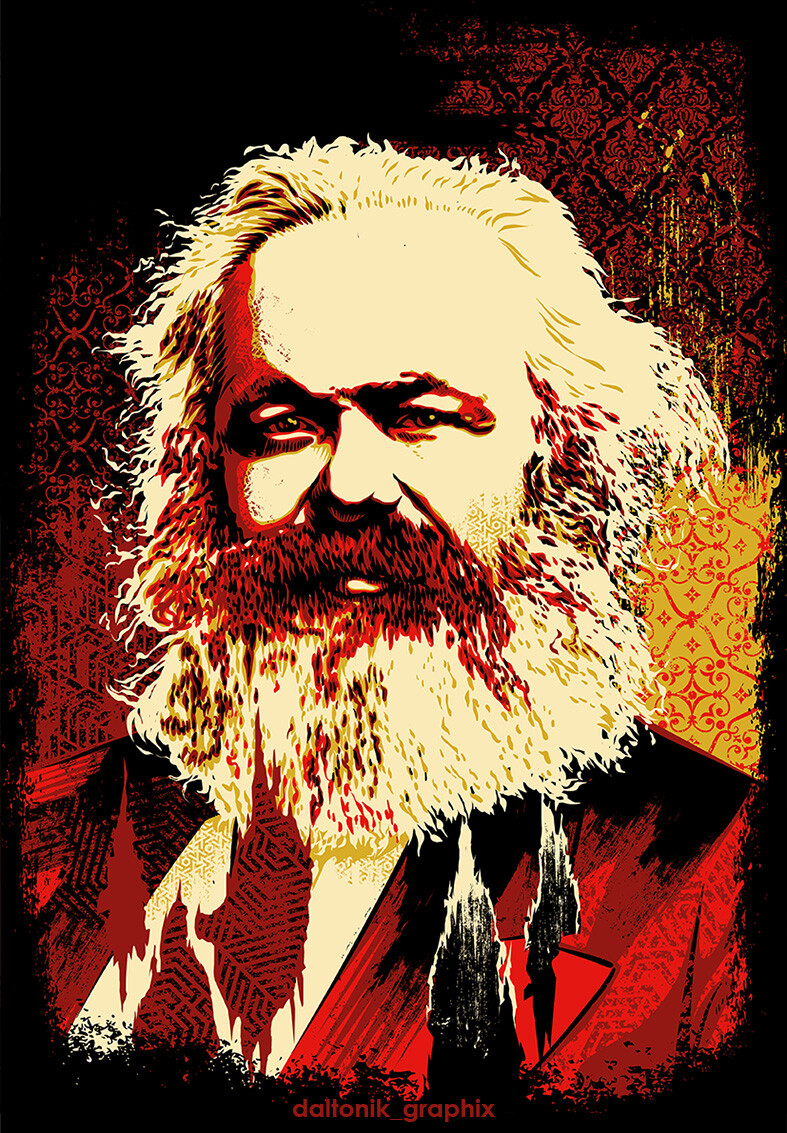
Fuller quote due to title limit: source
Mankind thus inevitably sets itself only such tasks as it is able to solve, since closer examination will always show that the problem itself arises only when the material conditions for its solution are already present or at least in the course of formation.
I think about this one quite often from the positive side. However: there is another, negative side of the medal that I will briefly discuss.
The positive aspect is that socialism becomes reality in proportion as capitalism establishes the conditions for socialism. For example, the capitalist tendency to centralize and monopolize production makes revolution easier because when production is owned by fewer capitalists, who of course have a purely nominal entitlement to swathes of the entire social product — when it becomes commonsense to even the least radical person that one or two billionaires are all that separates society from progress — that is when revolution becomes inevitable. It requires barely a spark or education because reality is the educator.
Now for the negative aspect. This tendency, which draws from the psychology of the masses, is fraught with all forms of automatic, intuitive, or “commonsense” knowledge. Compared with revolutionary socialist ideas, reactionary and vulgar ideas are equally ripe for deployment in pivotal historical moments when the old society has reached its limits.
An obvious example of this negative tendency is imperialism. Starting practically in its infancy, capitalism in Europe began to exceed the political-economic and ecological limits of the continent; colonialism presented itself as an immediate solution, not only for the ruling capitalists, but for a population in which racism is an accepted social fact. In the Americas the concepts of Manifest Destiny, et many ceteras, take root in the common population because, already in the prejudiced minds of even the White working population, the nonwhite indigenous peoples and Black slaves are not on the same social stratum. Imperialism was and is a collective effort to genocide and displace millions of people as a remedy for the contradictions of capitalism.
it’s kinda dialectically obvious. imperialism is a solution, but more to the point the nation-state was the chosen solution everywhere.
also i dunno if monopolies are that structurally advantageous for marxists, as they manage to protect (violently) their profits and thus their power, it’s certainly seems simpler to overtake them, but you can’t generate enough power to do so compared to scattered oligopolies, nor do they do their capitalist role of competing and fucking up profit rates
To your second point I don’t agree that Marxists should look elsewhere for advantage. It’s not really an advantage to gain but merely a fact about what monopoly does to society. (Edited below for clarity)
I agree that monopoly does not destroy itself immediately, but only sets the foundation for eventual destruction as its very operation is parasitical to the capitalist economy. Monopoly capital is very powerful at the moment because we are still on the upswing. From the perspective of the transition from early capitalism to industrial capitalism, the centralization of workers into association in fewer, larger workplaces was the revolutionary property of the proletariat above all other classes. I do think that Lenin’s elaboration on imperialism complicates this picture, but the basic principle is still essentially true in the imperialist countries.
I refer to the last few paragraphs from Capital chapter 32. The footnote 2 from the Manifesto is also worth reading:
Centralisation of the means of production and socialisation of labour at last reach a point where they become incompatible with their capitalist integument. This integument is burst asunder. The knell of capitalist private property sounds. The expropriators are expropriated.
The capitalist mode of appropriation, the result of the capitalist mode of production, produces capitalist private property. This is the first negation of individual private property, as founded on the labour of the proprietor. But capitalist production begets, with the inexorability of a law of Nature, its own negation. It is the negation of negation. This does not re-establish private property for the producer, but gives him individual property based on the acquisition of the capitalist era: i.e., on cooperation and the possession in common of the land and of the means of production.
The transformation of scattered private property, arising from individual labour, into capitalist private property is, naturally, a process, incomparably more protracted, violent, and difficult, than the transformation of capitalistic private property, already practically resting on socialised production, into socialised property. In the former case, we had the expropriation of the mass of the people by a few usurpers; in the latter, we have the expropriation of a few usurpers by the mass of the people. [2]
but due to nation states mediating conflicts elsewhere we arrive at current monopoly condition: apple makes margins of 35-40% while all the suppliers scattered around the world sit on 4-10% and compete between each other on price to be a supplier for apple. it somewhat parallels logic of imperialism, but because contradiction are completely outsourced - its not phillipino worker screwing apple 1 in california, its nameless conglomerates making screens in guandong (or whereever), the workers of apple inc don’t ever interface with those, and those workers don’t meet violence of american capital, but rather chinese one.
more over it’s parasitical on the whole world scale, but not so much for the people of usa, despite them exploiting local workers, it’s still on the net probably brings more monetary goods than losses.
amazon fits those descriptors, apple or nvidia not so much.
The argument is not that monopoly is by itself sufficient for revolution. It is only to point out that capitalism produces a socialized form of production which is more easily convertible into a socialist economy compared with scattered small producers. But you are totally right about the separation of imperial workers from global workforce, no argument there. There is not a strong basis for international worker solidarity from within the core to without.
Imperialism buys time for capital, but we see already today the rapid decline of western capital as this extra time runs out.
You are correct that we already have a high degree of monopolization in some key industries. Not just Silicon Valley firms, but looking at east Asia you have huge corporations like Samsung or TSMC or BYD. If the goal is to build a socialist economy, much of the work has inadvertently been done, by the capitalists, in terms of the formal organization of production. Labor has already a high degree of socialization and centralization which will be needed in a socialist society.
but the problem is - its centralization is mediated by the splitting of the bottom and further away via transnationality of it all. As i’ve said, amazon perfectly fits those descriptions, if for some reason left congress socialized it, it will be immediately net good. not so much with ip-dependent companies, iphone without software key is a useless brick. If we talking worldwide revolution than sure, but the most we can hope for is continent wide revolution for a time being.
the point i’m making is rather that ip-locks and monopoly in general creates a situation without competition, thus rate of profit doesn’t fall, thus monopoly (and state) have additional money power to leverage over the others (be it pensioners, or taxes for drones or treats for locals)
What im saying is, i believe more and more that actually shattering biggest corpos via anti trust might bring more net good for socialism (as in socialism, not socdemery) than alleged efficiency of monopolies being easier to subordinate, we can’t subordinate fucking leftists creators from opportunism, we have no shot at subordinating some beast corporations earning multiple countries military budgets in a year