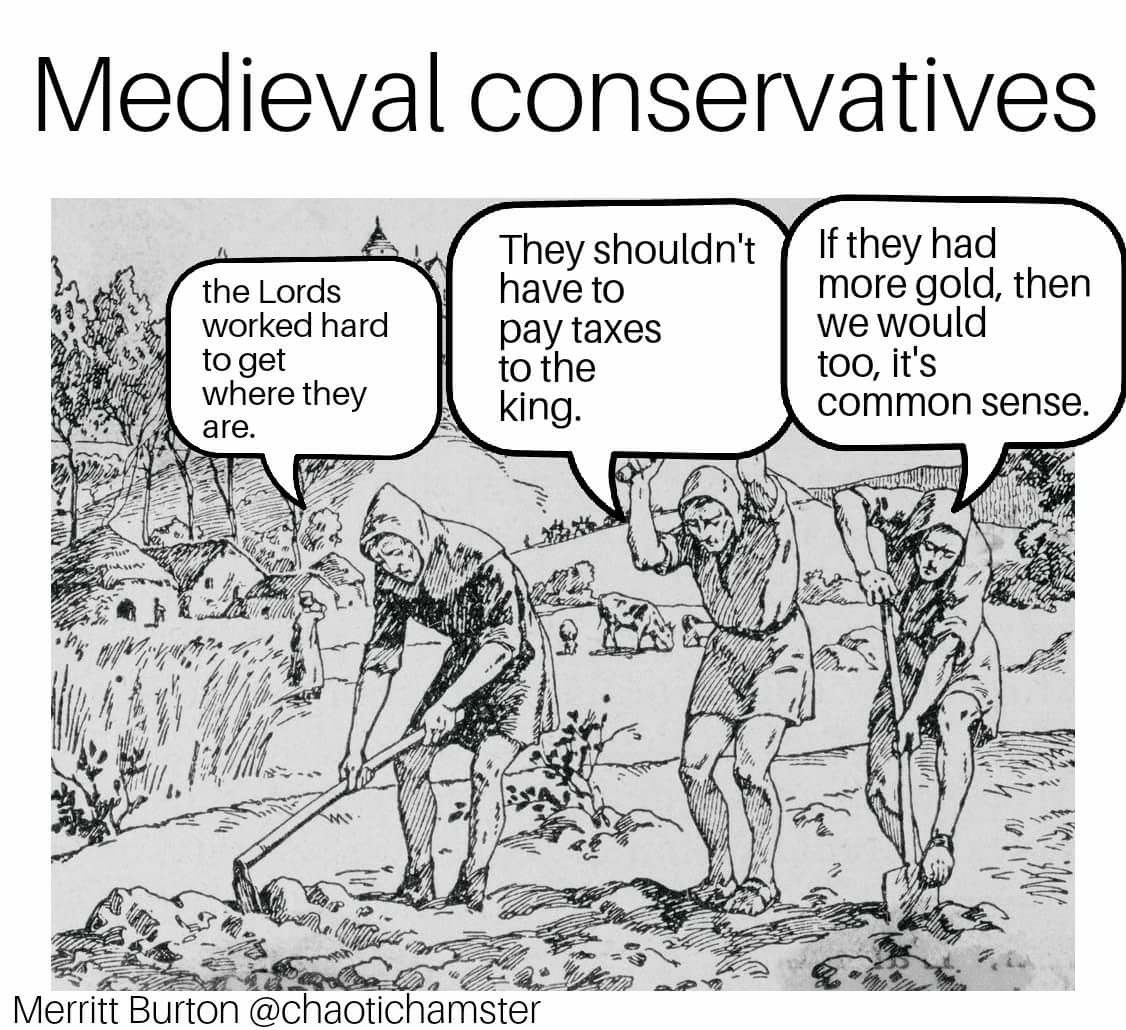
Mandatory note: Medieval feudalism did not actually believe in trickle-down economics. In medieval feudalism, the laboratores (‘those who work’, the vast majority of medieval society) were supposed to STAY poor and humble in order to provide for the other two castes, the bellatores (‘those who fight’, the nobility) and the oratores (‘those who speak’, the priesthood).
Upward mobility was not unheard of, but it was not meant to be aspirational. You would seek higher station in this SINFUL, EARTHLY realm instead of being content with your lot?! If anything, you should seek to be poorer and more ascetic, to become closer to God! Perhaps some time fasting will purge the devil’s whispers from your ears…
Lemmy has taught me that the problem with this is capitalism.
Ehh, everyone likes to think that markets are a feature of capitalism, when they naturally occur everywhere since the first shiny rock was traded for a berry.
See, this reverse position isn’t really true either. Markets are extremely complex things which are only really created and sustained by state authority - namely, by contract enforcement. No contract enforcement, no market. Without a central mediator (state authority) for contract enforcement, what results is generally either an attempt to minimize moral hazard by personal relationships - thus gift economies and customary economies of various sorts (especially clientistic systems) - or simple ‘might-makes-right’ tribute systems of unequal exchange.
Nonono, you see, anything involving money is capitalism and capitalism is bad and is the cause for all suffering in the world. I’m on Lemmy.
now hold on i’m working on a cult and currently the cause of all suffering in the world is my little brother dave. i was going to blame popes or maybe cholesterol but dave is just so much more fun for a cult. tell me why i should blame this “capitalism”
i asked him if he wanted to be the cause of all suffering and he was honored, so there’s that.
Pretty sure this exact scenario led to the French Revolution
The lords are divinely ordained or course. The lords pay tribute to the king in various ways. If the lord doesn’t fulfill his obligations to the king, the king might lend the land to someone else. Conflict with other lords wasn’t rare and required not only martial prowess, but good diplomacy and political maneuvering.
The peasants don’t pay taxes, they provide part of their harvest and labor to the lord. Typically one tenth of the harvest was taken from the peasants. A quite moderate tax rate, I would say. During times with low workload in agriculture peasants would work for the lord to do things like build and maintain infrastructure.
A lords couldn’t squeeze a lot of wealth from his peasants. The real money was in taxing trade and charging for crossing bridges. The really wealthy lords owned and operated mines for metal or salt. Working conditions were dangerous and life worse than as a peasant.
The lords are divinely ordained or course.
Feudalism was based pretty firmly on a secular hierarchy - the position of the Church was no more than that the structure was divinely ordained - the lords themselves were no one special by the estimation of the Church. Various medieval polities reacted to that in… various ways. But even where the Church and secular authorities were most integrated, in the Byzantine Empire, the aristocracy was not considered divinely ordained.
If the lord doesn’t fulfill his obligations to the king, the king might lend the land to someone else.
In theory, in extreme circumstances. In practice, even in extreme circumstances, that rarely happened. The core function of military service meant that any attempt to revoke land meant that the response was generally along the lines of “Come and take it.”
The peasants don’t pay taxes, they provide part of their harvest
Tax in-kind is the oldest form of taxation, and even highly monetized economies allow for it. Hell, we still allow for tax in-kind.
Typically one tenth of the harvest was taken from the peasants. A quite moderate tax rate, I would say.
10% for the Church. The amount of the harvest extracted by the secular authorities (which could also be the Church) was typically double or triple that. On top of that, fees were extracted by the local lord for everything from grinding your grain (and querns were, in many places, outlawed to force use of a mill for bread, unless you fancied nothing but porridge) and the bakery, to fishing and hunting rights, market rights, marriage rights, fees for dying, and then the monarch might impose an irregular fee on you before the 13th-14th century, just for funsies.
The ‘upside’ is that the lord was expected to ‘care’ for you in hard times - that is to say, some of that tax you might get some of back during hard years so you didn’t starve.
During times with low workload in agriculture peasants would work for the lord to do things like build and maintain infrastructure.
There’s not much low-workload times in subsistence farming other than winter, and labor in winter can be more trouble than its worth. Even in fairly well-regimented medieval polities like the Byzantine Empire, even keeping main highways open - not in good repair, but simply visible and not overgrown so as to facilitate the movement of armies - was an arduous task that was not always completed.
More often, the period of corvee - which could be a third of the days of the year for a peasant - was labor on their lord’s farmland to sow and harvest his crops for him - for which you would generally not be reimbursed.
my lord is fancier, yay so much fancier than thy lord