In this case the movie version is closer to reality than your “realistic” version. Castles were not just built for defensibility. They have a strong representative aspect. Of course they made them as nice to live in as possible. The walls were covered in tapestries or wood panelling and many rooms were heated. For unheated rooms there were movable heaters (basically small portable fire pits).
Castles were overwhelmingly built for defensibility until the 16th century, at which point you see more of a mixture of elements; and then fortresses emerging as predominantly military again in the 17th century. Royal lodgings and other such estates which would have had more amenities were generally not seriously fortified, and thus are not castles in any traditional sense.
You gave it exactly backwards. The castle is by definition the combination of residence and fortification. The purely military fortress only really developed after the medieval period.
Not at all. The notion of a purely military fortress in the sense of being primarily for the permanent garrisoning of troops only really developed after the medieval period.
Castles were overwhelmingly and in many polities exclusively built for defensive purposes, with the ability to reside in them being only an extension of that insofar as you can’t hold out against a siege if you can’t live there for at least a few nights. It’s why permission to build a castle in the first place is so often restricted by medieval law, requiring the direct assent of the monarch in most medieval polities.


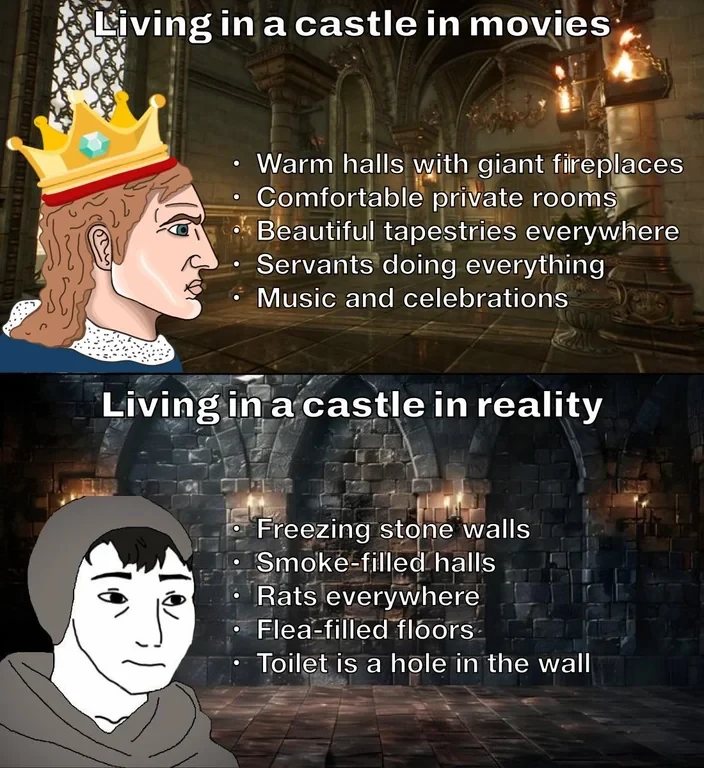
In this case the movie version is closer to reality than your “realistic” version. Castles were not just built for defensibility. They have a strong representative aspect. Of course they made them as nice to live in as possible. The walls were covered in tapestries or wood panelling and many rooms were heated. For unheated rooms there were movable heaters (basically small portable fire pits).
Heres an example of a hall in a castle: https://de.wikipedia.org/wiki/Très_Riches_Heures#/media/Datei:Les_Très_Riches_Heures_du_duc_de_Berry_Janvier.jpg
Castles were overwhelmingly built for defensibility until the 16th century, at which point you see more of a mixture of elements; and then fortresses emerging as predominantly military again in the 17th century. Royal lodgings and other such estates which would have had more amenities were generally not seriously fortified, and thus are not castles in any traditional sense.
You gave it exactly backwards. The castle is by definition the combination of residence and fortification. The purely military fortress only really developed after the medieval period.
Not at all. The notion of a purely military fortress in the sense of being primarily for the permanent garrisoning of troops only really developed after the medieval period.
Castles were overwhelmingly and in many polities exclusively built for defensive purposes, with the ability to reside in them being only an extension of that insofar as you can’t hold out against a siege if you can’t live there for at least a few nights. It’s why permission to build a castle in the first place is so often restricted by medieval law, requiring the direct assent of the monarch in most medieval polities.