Explanation: During the Islamic Golden Age, significant advancements were made in the field of mathematics, surpassing the Classical authors Muslim scholars cited, which in no small part laid the foundation for the advanced mathematics of the modern era…
… in part motivated because calculating the exact direction of Mecca from one’s current position is religiously important for pious Muslims, who pray towards Mecca.
The ONE friggin time being an extremist and interpreting religious texts literally has paid off bigtime.
Same goes for knowing when to pray, you get calendars with all the calculations on the exact time, down to the minute on when the sun is going to be in five precise locations in the sky.
The Virgin Christian abbots :
Noo, it’s middday when I ring my bells, it doesn’t matter how bright it is outside!
The Chad Muslim Imam:
Yes, I had the most mathematically capable brother calculate for us that Zuhr is exactly 12:03 today, MashAllah
You believe that praying at a certain time and direction is extremism?
praying at precise times and precise directions.
Hypothetically, you could interpret the prayers and directions as North, Northwest etc and “five times a day, roughly spaced apart”. But the calculations are extremely precise.
Yes to the former, kinda no to the latter. In Islamic jurisprudence just vaguely pointing towards the Kaaba is fine if you can’t see it, based on among other things a hadith saying “anything between east and west is the qibla” in Medina where the qibla (direction of prayer) was southward. The prayer times are a bit more strict, but they’re also ranges rather than precise timings so for example afternoon (Zuhr) prayer can/must be done anywhere between midday to mid-afternoon, while night (Isha) prayer can/must be prayed between nightfall and dawn. Prayer times also rely on obvious visual cues, so while you absolutely have to do the prayer within its time range, you’ll see it before it ends. That said, you’re ultimately correct in that they went a lot further than they had to in terms of Islamic doctrine, because Islam specifically addresses the possibility of not knowing precise prayer times and directions in ways other than “revolutionize mathematics.”
Copy pasting my reply to them because it’s relevant.
Yes to the former, kinda no to the latter. In Islamic jurisprudence just vaguely pointing towards the Kaaba is fine if you can’t see it, based on among other things a hadith saying “anything between east and west is the qibla” in Medina where the qibla (direction of prayer) was southward. The prayer times are a bit more strict, but they’re also ranges rather than precise timings so for example afternoon (Zuhr) prayer can/must be done anywhere between midday to mid-afternoon, while night (Isha) prayer can/must be prayed between nightfall and dawn. Prayer times also rely on obvious visual cues (nightfall, dawn, etc), so while you absolutely have to do the prayer within its time range, you’ll see it before it ends. That said, you’re ultimately correct in that they went a lot further than they had to in terms of Islamic doctrine, because Islam specifically addresses the possibility of not knowing precise prayer times and directions in ways other than “revolutionize mathematics.”


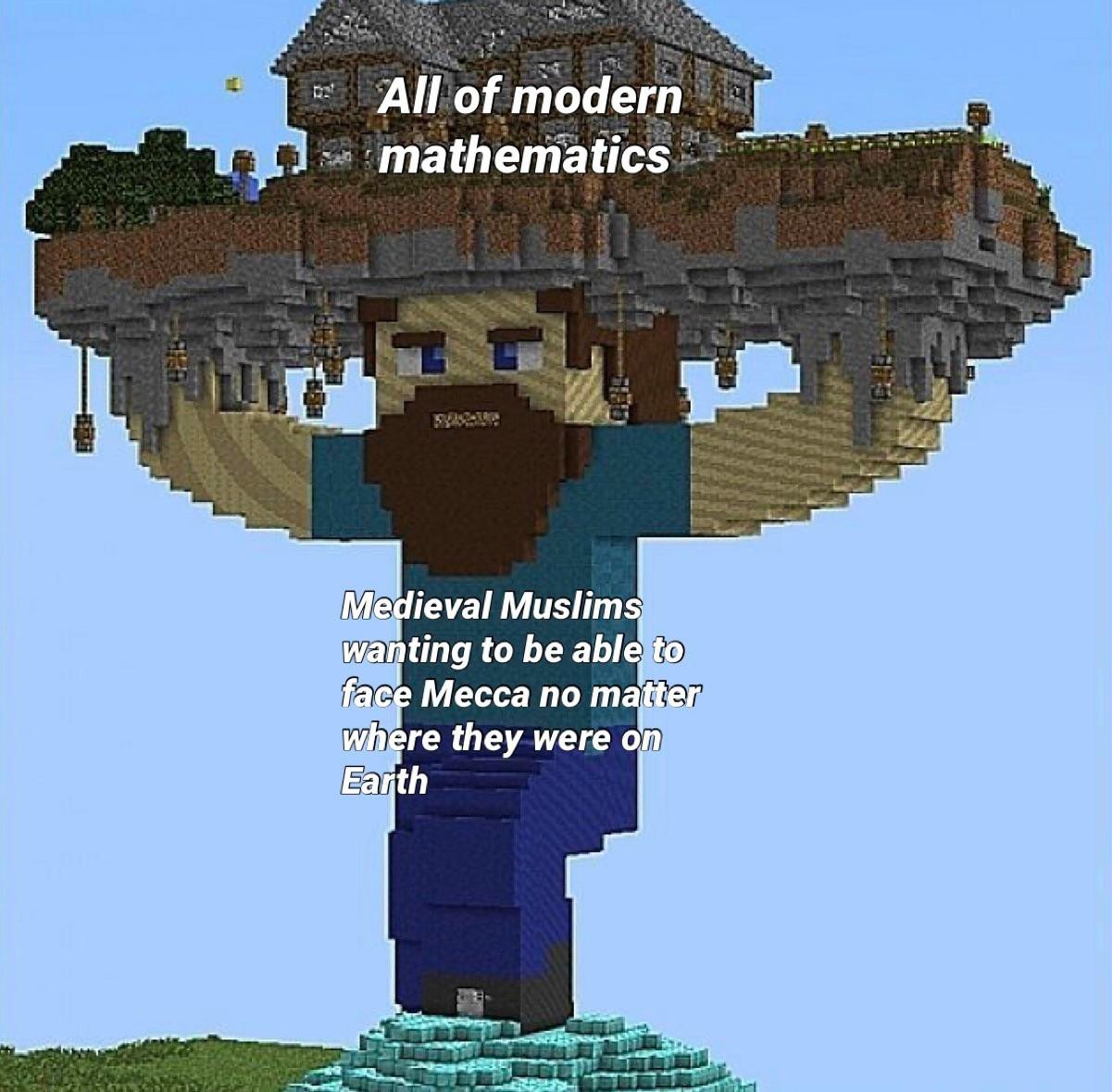
Explanation: During the Islamic Golden Age, significant advancements were made in the field of mathematics, surpassing the Classical authors Muslim scholars cited, which in no small part laid the foundation for the advanced mathematics of the modern era…
… in part motivated because calculating the exact direction of Mecca from one’s current position is religiously important for pious Muslims, who pray towards Mecca.
The ONE friggin time being an extremist and interpreting religious texts literally has paid off bigtime.
Same goes for knowing when to pray, you get calendars with all the calculations on the exact time, down to the minute on when the sun is going to be in five precise locations in the sky.
The Virgin Christian abbots :
Noo, it’s middday when I ring my bells, it doesn’t matter how bright it is outside!
The Chad Muslim Imam:
Yes, I had the most mathematically capable brother calculate for us that Zuhr is exactly 12:03 today, MashAllah
You believe that praying at a certain time and direction is extremism?
praying at precise times and precise directions.
Hypothetically, you could interpret the prayers and directions as North, Northwest etc and “five times a day, roughly spaced apart”. But the calculations are extremely precise.
Yes to the former, kinda no to the latter. In Islamic jurisprudence just vaguely pointing towards the Kaaba is fine if you can’t see it, based on among other things a hadith saying “anything between east and west is the qibla” in Medina where the qibla (direction of prayer) was southward. The prayer times are a bit more strict, but they’re also ranges rather than precise timings so for example afternoon (Zuhr) prayer can/must be done anywhere between midday to mid-afternoon, while night (Isha) prayer can/must be prayed between nightfall and dawn. Prayer times also rely on obvious visual cues, so while you absolutely have to do the prayer within its time range, you’ll see it before it ends. That said, you’re ultimately correct in that they went a lot further than they had to in terms of Islamic doctrine, because Islam specifically addresses the possibility of not knowing precise prayer times and directions in ways other than “revolutionize mathematics.”
Copy pasting my reply to them because it’s relevant.
Yes to the former, kinda no to the latter. In Islamic jurisprudence just vaguely pointing towards the Kaaba is fine if you can’t see it, based on among other things a hadith saying “anything between east and west is the qibla” in Medina where the qibla (direction of prayer) was southward. The prayer times are a bit more strict, but they’re also ranges rather than precise timings so for example afternoon (Zuhr) prayer can/must be done anywhere between midday to mid-afternoon, while night (Isha) prayer can/must be prayed between nightfall and dawn. Prayer times also rely on obvious visual cues (nightfall, dawn, etc), so while you absolutely have to do the prayer within its time range, you’ll see it before it ends. That said, you’re ultimately correct in that they went a lot further than they had to in terms of Islamic doctrine, because Islam specifically addresses the possibility of not knowing precise prayer times and directions in ways other than “revolutionize mathematics.”