

Want to wade into the sandy surf of the abyss? Have a sneer percolating in your system but not enough time/energy to make a whole post about it? Go forth and be mid: Welcome to the Stubsack, your first port of call for learning fresh Awful you’ll near-instantly regret.
Any awful.systems sub may be subsneered in this subthread, techtakes or no.
If your sneer seems higher quality than you thought, feel free to cut’n’paste it into its own post — there’s no quota for posting and the bar really isn’t that high.
The post Xitter web has spawned soo many “esoteric” right wing freaks, but there’s no appropriate sneer-space for them. I’m talking redscare-ish, reality challenged “culture critics” who write about everything but understand nothing. I’m talking about reply-guys who make the same 6 tweets about the same 3 subjects. They’re inescapable at this point, yet I don’t see them mocked (as much as they should be)
Like, there was one dude a while back who insisted that women couldn’t be surgeons because they didn’t believe in the moon or in stars? I think each and every one of these guys is uniquely fucked up and if I can’t escape them, I would love to sneer at them.
(Credit and/or blame to David Gerard for starting this.)
I’m being shuffled sideways into a software architecture role at work, presumably because my whiteboard output is valued more than my code 😭 and I thought I’d try and find out what the rest of the world thought that meant.
Turns out there’s almost no way of telling anymore, because the internet is filled with genai listicles on random subjects, some of which even have the same goddamn title. Finding anything from the beforetimes basically involves searching reddit and hoping for the best.
Anyway, I eventually found some non-obviously-ai-generated work and books, and it turns out that even before llms flooded the zone with shit no-one knew what software architecture was, and the people who opined on it were basically in the business of creating bespoke hammers and declaring everything else to be the specific kind of nails that they were best at smashing.
Guess I’ll be expensing a nice set of rainbow whiteboard markers for my personal use, and making it up as I go along.
Guess I’ll be expensing a nice set of rainbow whiteboard markers for my personal use, and making it up as I go along.
Congratulations, you figured it out! Read Clean Architecture and then ignore the parts you don’t like and you’ll make it
Ugh OK I have to vent:
I’m getting pushed into more of a design role because oops my company accidentally fired or drove away all of a team of a dozen people except for me after forgetting for a few years that the code I work on is actually mission critical.
I do my best at designing stuff and delegating the implementation to my coworkers. It’s not one of my strengths but there’s enough technical debt from when I was solo-maintaining everything for a few years that I know what needs improving and how to improve it.
But none of my coworkers are domain experts, they haven’t been given enough free time for me to train them into domain experts, there’s only one of me, and the higher ups are continuously surprised that stuff is going so slow. It’s frustrating for everyone involved.
I actually wouldn’t mind architecture or design work in better circumstances since I love to chat with people; but it feels like my employer has put me in an impossible position. At the moment I’m just trying to hang in there for some health insurance reasons; but in a few years I plan to leave for greener pastures where I can go a day without hearing the word “agentic”.
The zone has indeed always been flooded, especially since its a title that collides with “integration architect” and other similar titles whose jobs are completely different. That being said, it’s a title I’ve held before, and I really enjoyed the work I got to do. My perspective will be a little skewed here because I specifically do security architecture work, which is mostly consulting-style “hey come look at this design we made is it bad?” rather than developing systems from scratch, but here’s my take:
Architecture is mostly about systems thinking-- you’re not as responsible for whether each individual feature, service, component etc is implemented exactly to spec or perfectly correctly, but you are responsible for understanding how they’ll fit together, what parts are dangerous and DO need extra attention, and catching features/design elements early on that need to be cut because they’re impossible or create tons of unneeded tech debt. Speaking of tech debt, making the call about where its okay to have a component be awful and hacky, versus where v1 absolutely still needs to be bulletproof probably falls into the purvey of architecture work too. You’re also probably the person who will end up creating the system diagrams and at least the skeleton of the internal docs for your system, because you’re responsible for making sure people who interact with it understand its limitations as well.
I think the reason so much of the advice on this sort of work is bad or nonexistent is that when you try to boil the above down to a set of concrete practices or checklists, they get utterly massive, because so much of the work (in my experience) is knowing what NOT to focus on, where you can get away with really general abstractions, etc, while still being technically capable enough to dive into the parts that really do deserve the attention.
In addition to the nice markers and whiteboard, I’d plug getting comfortable with some sort of diagramming software, if you aren’t already. There’s tons of options, they’re all pretty much Fine IMO.
For reading, I’d suggest at least checking out the first few chapters of Engineering A Safer World , as it definitely had a big influence on how I practice architecture.
(edit: advance warning that clicking these links might cause eyestrain and trigger rage)
so for a while now sheer outrageous ludicrous nonsense of the trumpist-era USA politics has been making a bit of an impact on the local ZA racists (and, weirdly, not only the white nationalists but also the black nationalists - some of it has shone through in EFF and BFLF propaganda strains), and I knew that with the orange godawful-king ascension to his hoped-throne it was only a matter of time before shit here escalated
anyway, it’s happened. the same organisation also put up some ads along the main highway ahead of the G20 summit
(upside: some of those have already been pulled down. downside: the org put up some more. don’t know what’s happened with the latest yet)
fuck these people
Gerard and Torres get namedropped in the same breath as Ziz as people who have done damage to the rationalist movement from within
LMAOU congrats David.
what’s the
u?French, perhaps.
🇫🇷 En passant 🥖
computers were a mistake
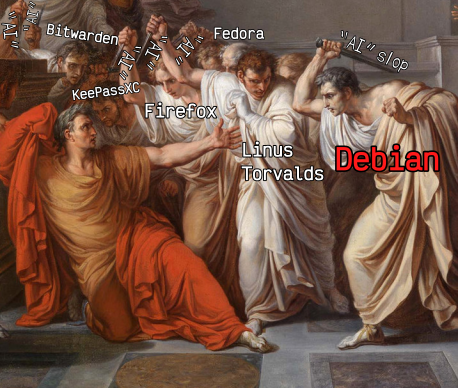
Gentoo is firmly against AI contributions as well. NetBSD calls AI code “tainted”, while FreeBSD hasn’t been as direct yet but isn’t accepting anything major.
QEMU, while not an OS, has rejected AI slop too. Curl also famously is against AI gen. So we have some hope in the systems world with these few major pieces of software.
I’m actually tempted to move to NetBSD on those grounds alone, though I did notice their “AI” policy is
Code generated by a large language model or similar technology, such as GitHub/Microsoft’s Copilot, OpenAI’s ChatGPT, or Facebook/Meta’s Code Llama, is presumed to be tainted code, and must not be committed without prior written approval by core. [emphasis mine]
and I really don’t like the energy of that fine print clause, but still, better than what Debian is going with, and I always had a soft spot for NetBSD anyway…
I generally read stuff like that netbsd policy as “please ask one of our ancient, grumpy, busy and impatient grognards, who hate people in general and you in particular, to say nice things about your code”.
I guess you can only draw useful conclusions if anyone actually clears that particular obstacle.
Linus: All those years of screaming at developers for subpar code quality and yet doesn’t use that energy for literal slop
lemmy.ml by way of hexbear’s technology comm: The Economist is pushing phrenology. Everything old is new again!

cross-posted from: https://lemmy.ml/post/38830374

[…]

Reminds me of the “tech-bro invents revolutionary new personal transport solution: a train!” meme, but with racism. I’ll be over in the angry dome.
What does it tell about a scientist that they see a wide world of mysteries to dive into and the research topic they pick is “are we maybe missing out on a way we could justify discriminating against people for their innate characteristics?”
“For people without access to credit, that could be a blessing” fuck off no one is this naive.
I remember back before I realized just how full of shit Siskind was I used to buy into some of the narrative re: “credentialism” so I understand the way they’re trying to sell it here. But even extending far more benefit than mere doubt can justify we’re still looking at yet another case of trying to create a (pseudo)scientific solution to a socially constructed problem. Like, if the problem is that bosses and owners are trying to find the best candidate we don’t need new and exciting ways to discriminate; they could just actually invest in a process for doing that, but trying to actually solve that problem would inconvenience the owning/managing classes and doesn’t create opportunities to further entrench racial biases in the system. Clearly using an AI-powered version of the punchline for “how racist were the old times” commentary is better.
That fucker’s going on the bitin’ list.
What in the sweet fuck happened here, does this count as vandalism?
Fix0red
None of those are well defined “problems”. An entire applied research field is not a “problem” akin to other items on this list lik P vs NP.
Thank you for your service o7
To be clear, I can’t edit Wikipedia to save my life. Editor in this case was Elestrophe.
One thing I’ve heard repeated about OpenAI is that “the engineers don’t even know how it works!” and I’m wondering what the rebuttal to that point is.
While it is possible to write near-incomprehensible code and make an extremely complex environment, there is no reason to think there is absolutely no way to derive a theory of operation especially since any part of the whole runs on deterministic machines. And yet I’ve heard this repeated at least twice (one was on the Panic World pod, the other QAA).
I would believe that it’s possible to build a system so complex and with so little documentation that on its surface is incomprehensible but the context in which the claim is made is not that of technical incompetence, rather the claim is often hung as bait to draw one towards thinking that maybe we could bootstrap consciousness.
It seems like magical thinking to me, and a way of saying one or both of “we didn’t write shit down and therefore have no idea how the functionality works” and “we do not practically have a way to determine how a specific output was arrived at from any given prompt.” The first might be in part or on a whole unlikely as the system would need to be comprehensible enough so that new features could get added and thus engineers would have to grok things enough to do that. The second is a side effect of not being able to observe all actual input at the time a prompt was made (eg training data, user context, system context could all be viewed as implicit inputs to a function whose output is, say, 2 seconds of Coke Ad slop).
Anybody else have thoughts on countering the magic “the engineers don’t know how it works!”?
I mean if you ever toyed around with neural networks or similar ML models you know it’s basically impossible to divine what the hell is going on inside by just looking at the weights, even if you try to plot them or visualise in other ways.
There’s a whole branch of ML about explainable or white-box models because it turns out you need to put extra care and design the system around being explainable in the first place to be able to reason about its internals. There’s no evidence OpenAI put any effort towards this, instead focusing on cool-looking outputs they can shove into a presser.
In other words, “engineers don’t know how it works” can have two meanings - that they’re hitting computers with wrenches hoping for the best with no rhyme or reason; or that they don’t have a good model of what makes the chatbot produce certain outputs, i.e. just by looking at the output it’s not really possible to figure out what specific training data it comes from or how to stop it from producing that output on a fundamental level. The former is demonstrably false and almost a strawman, I don’t know who believes that, a lot of people that work on OpenAI are misguided but otherwise incredibly clever programmers and ML researchers, the sheer fact that this thing hasn’t collapsed under its own weight is a great engineering feat even if externalities it produces are horrifying. The latter is, as far as I’m aware, largely true, or at least I haven’t seen any hints that would falsify that. If OpenAI satisfyingly solved the explainability problem it’d be a major achievement everyone would be talking about.
well, I can’t counter it because I don’t think they do know how it works. the theory is shallow and the outputs of, say, an LLM are of remarkably high quality in an area (language) that is impossibly baroque. the lack of theory and fundamental understanding is a huge problem for them because it means “improvements” can only come about by throwing money and conventional engineering at their systems. this is what I’ve heard from people in the field for at least ten years.
to me that also means it isn’t something that needs to be countered. it’s something the context of which needs to be explained. it’s bad for the ai industry that they don’t know what they’re doing
EDIT: also, when i say the outputs are of high quality, what i mean is that they produce coherent and correct prose. im not suggesting anything about the utility of the outputs
I think I heard a good analogy for this in Well There’s Your Problem #164.
One topic of the episode was how people didn’t really understand how boilers worked, from a thermal mechanics point if view. Still steam power was widely used (e.g. on river boats), but much of the engineering was guesswork or based on patently false assumptions with sometimes disastrous effects.
another analogy might be an ancient builder who gets really good at building pyramids, and by pouring enormous amounts of money and resources into a project manages to build a stunningly large pyramid. “im now going to build something as tall as what will be called the empire state building,” he says.
problem: he has no idea how to do this. clearly some new building concepts are needed. but maybe he can figure those out. in the meantime he’s going to continue with this pyramid design but make them even bigger and bigger, even as the amount of stone required and the cost scales quadratically, and just say he’s working up to the reallyyyyy big building…
Another ironic point… Lesswronger’s actually do care about ML interpretability (to the extent they care about real ML at all; and as a solution to making their God AI serve their whims not for anything practical). A lack of interpretability is a major problem (like irl problem, not just scifi skynet problem) in ML, you can models with racism or other bias buried in them and not be able to tell except by manually experimenting with your model with data from outside the training set. But Sam Altman has turned it from a problem into a humble brag intended to imply their LLM is so powerful and mysterious and bordering on AGI.
Not gonna lie, I didn’t entirely get it either until someone pointed me at a relevant xkcd that I had missed.
Also I was somewhat disappointed in the QAA team’s credulity towards the AI hype, but their latest episode was an interview with the writer of that “AGI as conspiracy theory” piece from last(?) week and seemed much more grounded.
the mention in QAA came during that episode and I think there it was more illustrative about how a person can progress to conspiratorial thinking about AI. The mention in Panic World was from an interview with Ed Zitron’s biggest fan, Casey Newton if I recall correctly.
A lesswronger wrote an blog post about avoiding being overly deferential, using Eliezer as an example of someone that gets overly deferred to. Of course, they can’t resist glazing him, even in the context of an blog post on not being too deferential:
Yudkowsky, being the best strategic thinker on the topic of existential risk from AGI
Another lesswronger pushes back on that and is highly upvoted (even among the doomer’s that think Eliezer is a genius, mostly still think he screwed up in inadvertently helping LLM companies get to where they are): https://www.lesswrong.com/posts/jzy5qqRuqA9iY7Jxu/the-problem-of-graceful-deference-1?commentId=MSAkbpgWLsXAiRN6w
The OP gets mad because this is off topic from what they wanted to talk about (they still don’t acknowledge the irony).
A few days later they write an entire post, ostensibly about communication norms, but actually aimed at slamming the person that went off topic: https://www.lesswrong.com/posts/uJ89ffXrKfDyuHBzg/the-charge-of-the-hobby-horse
And of course the person they are slamming comes back in for another round of drama: https://www.lesswrong.com/posts/uJ89ffXrKfDyuHBzg/the-charge-of-the-hobby-horse?commentId=s4GPm9tNmG6AvAAjo
No big point to this, just a microcosm of lesswronger being blind to irony, sucking up to Eliezer, and using long winded posts about meta-norms and communication as a means of fighting out their petty forum drama. (At least sneerclubers are direct and come out and say what they mean on the rare occasions they have beef.)
Oh look at that, another report on the economics of ai datacenter buildouts https://publicenterprise.org/report/bubble-or-nothing/
A fact-generative AI, you say? https://aphyr.com/posts/398-the-future-of-fact-checking-is-lies-i-guess
TIHI
I reiterate the hope that AI slop, will eventually push us towards better sourcing of resources/articles as a society going forwards, but yikes in the meantime.
new zitron: ed picks up calculator and goes through docs from microsoft and some others, and concludes that openai has less revenue than thought previously (probably?, ms or openai didn’t comment), spends more on inference than thought previously, openai revenue inferred from microsoft share is consistently well under inference costs https://www.wheresyoured.at/oai_docs/
Before publishing, I discussed the data with a Financial Times reporter. Microsoft and OpenAI both declined to comment to the FT.
If you ever want to share something with me in confidence, my signal is ezitron.76, and I’d love to hear from you.
also on ft (alphaville) https://www.ft.com/content/fce77ba4-6231-4920-9e99-693a6c38e7d5
ed notes that there might be other revenue, but that’s only inference with azure, and then there are training costs wherever it is filed under, debts, commitments, salaries, marketing, and so on and so on
e: fast news day today eh?
Stupid chatbots marketed at gullible christians aren’t new,
The app Text With Jesus uses artificial intelligence and chatbots to offer spiritual guidance to users who are looking to connect with a higher power.
bit this is certainly an unusual USP:
Premium users can also converse with Satan.
https://www.nbcphiladelphia.com/news/tech/religious-chatbot-apps/4302361/
(via parker molloy’s bluesky)
The satan thing makes a certain kind of sense. Probably catering to a bunch of different flavours of repressed: grindr republicans, covenant eyes users, speaking-in-tongues enthusiasts, etc.
The Alex Jones set makes fighting with satanists trying to seduce you to darkness look real fun and satisfying, but for some reason they only seem to approach high-profile assholes who lie about everything and never ordinary Christians! Thankfully we now have LLMs to fill the gap.
Third episode of Odium Symposium is out (that’s the podcast I cohost). We talk about Cato the Elder and his struggle against militant feminist action in the roman republic. You can listen to the episode at https://www.patreon.com/posts/crack-sucking-143019155 or through any of the sources on our website, www.odiumsymposium.com
further things: one, that’s the first website I’ve made where I wasn’t just plugging into a template, and I’m a little proud of it even though it’s almost nothing. I would appreciate feedback and suggestions
two, a future episode idea I have is to examine what I’m thinking of as “the trustless society.” it’s about the replacing of social relations with legal or financial intermediaries. Those of you who are long time buttcoiners will be familiar with this process. if any of you have specific readings to recommend I would love to hear it. I’ll probably mostly focus on balaji but anyone or anything will help
New site looks good! I think Let’sEncrypt is still the easiest and cheapest way to set up a decent cert but I’ve been away from IT for over a year now and someone else here can probably help point you in the right direction. At least for now the site probably doesn’t actually have security concerns it would address, but it pops up a browser alert on first hit so it’s probably a good idea?
Also I just started listening to the latest episode while writing this up and had forgotten how great that opening medley is.
+1 to letsencrypt for https. certbot can even auto-configure your webserver for you, taking it from http base to https-with-redirect, no terrible advice from shitty exist-for-volume blogs required
superquick tldr:
- install
certbotand the applicable plugin package for your webserver; if you don’t know the name use p.d.o (or your distro’s own) to find the package name - run
certbot; there’s extra flags you can pass if you want to automate, but ootb it’ll ask you questions and start the process for cert + config (iirc - I mostly run it automated and non-interactive)
it’s probably better for my development as a human being to learn this properly, but it turns out github pages hosting does the letsencrypt process if you check a box in the page settings
The eternal debate over whether the veggies you had to eat contained moral fiber.
- install
Synergies!
Tech companies are betting big on nuclear energy to meet AIs massive power demands and they’re using that AI to speed up the construction of new nuclear power plants.
Reactor licensing is a simple mechanisable form filling exercise, y’know.
“Please draft a full Environmental Review for new project with these details,” Microsoft’s presentation imagines as a possible prompt for an AI licensing program. The AI would then send the completed draft to a human for review, who would use Copilot in a Word doc for “review and refinement.” At the end of Microsoft’s imagined process, it would have “Licensing documents created with reduced cost and time.”
https://www.404media.co/power-companies-are-using-ai-to-build-nuclear-power-plants/
(Paywalled, at least for me)
Ther’s a much longer, dryer and more detailed (but unpaywalled) document here that 404 references:
https://ainowinstitute.org/publications/fission-for-algorithms
Rolling Stone on the emergence of the ai chatbot psychosis religion
What if we turned a markov chain containing two decades of internet fan fiction into an oracle. Just spitballing here…