• 9 Posts
  • 4.16K Comments
Joined 3 years ago
cake
Cake day: July 2nd, 2023

help-circle


  • The best way I can explain this to a layman will only work if you watch american football.

    What is a “catch”?

    We can call a catch a catch, but unless we go further and state things like “must have control of the ball”, “must have one foot inbounds” etc etc etc, we have an incomplete rule that will allow for things we did not intend. So we narrow the existing rule, because ostensibly it is what we meant, but we need to be more specific to communicate the full idea than we originally believed.

    In basketball… What is a travel? Seems straightforward…


  • In short, Plato’s Allegory of the Cave imagines people who have spent their entire lives chained inside a cave, able to see only shadows projected on a wall. Because the shadows are all they have ever known, they mistake them for reality itself.

    One prisoner escapes and discovers the outside world, realizing that what everyone in the cave took to be reality was only a limited representation of it.

    The core idea is that our perspective can constrain what we think is real or knowable. We may be interpreting appearances without access to the fuller reality that produces them.


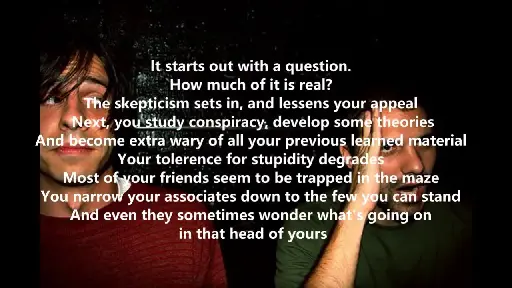
  • So thas exactly why I brought up Plato. And I think the song and lyrics do an excellent job summarizing,

    Your title asks whether we can infer intelligence. Verbatim. The answer to that is, again, yes. We do it constantly.

    You cannot directly observe my intelligence or thoughts. You observe my behavior, language, problem-solving, etc., and infer intelligence from those outputs. The same applies to a machine.

    The Chinese Room raises a different question: whether apparently intelligent behavior is sufficient to establish understanding or semantic content. That is not the same as asking whether intelligence can be inferred.

    Saying “it’s just following rules” doesn’t setkle that question either. Humans are also physical systems whose cognition is implemented through mechanisms. The existence of rules or mechanisms does not itself show that intelligence is absent.

    So becaus your question is specifically “can we infer intelligence?”, yes.

    Now, If the question is “does intelligent-looking behavior prove semantic understanding or consciousness?”, that’s a different and much harder question. But most importantly, it’s not the question you asked.


  • How is this thought experiment different from Platos allegory of the cave?

    I.e. “if someone grew up in a cubicle…”

    So the answer is, perhaps surprisingly to some, yes.

    I can directly observe my own thought processes because I am inside the system generating them. You cannot; you can only infer my intelligence from my behavior. Likewise, an intelligence instantiated inside a machine may have first-person access to its own cognition, while an outside observer can only infer intelligence from its outputs and mechanisms.