Skip Navigation

InitialsDiceBearhttps://github.com/dicebear/dicebearhttps://creativecommons.org/publicdomain/zero/1.0/„Initials” (https://github.com/dicebear/dicebear) by „DiceBear”, licensed under „CC0 1.0” (https://creativecommons.org/publicdomain/zero/1.0/)W
Posts
8
Comments
2441
Joined
2 yr. ago

Just a smol with big opinions about AFVs and data science. The onlyfans link is a rickroll.

$|>>> Onlyfans! <<<|$

  • The statistic is also total B.S.

    The original source, a research org called the Jenkins Group, say it was misattributed to them. Nobody knows of a legitimate study that claims that value.

  • That's absolutely not the conclusion from PIAAC, around 1/50th of the us population in 2013 (320 million) was functionality illiterate:

    Four in five U.S. adults (79 percent) have English literacy skills sufficient to complete tasks that require comparing and contrasting information, paraphrasing, or making low-level inferences—literacy skills at level 2 or above in PIAAC (OECD 2013). In contrast, one in five U.S. adults (21 percent) has difficulty completing these tasks (figure 1). This translates into 43.0 million U.S. adults who possess low literacy skills: 26.5 million at level 1 and 8.4 million below level 1

    Level 1 – 176 – 225 Most of the tasks at this level require the respondent to read relatively short digital or print continuous, non-continuous, or mixed texts to locate a single piece of information that is identical to or synonymous with the information given in the question or directive. Some tasks, such as those involving non-continuous texts, may require the respondent to enter personal information onto a document. Little, if any, competing information is present. Some tasks may require simple cycling through more than one piece of information. Knowledge and skill in recognizing basic vocabulary determining the meaning of sentences, and reading paragraphs of text is expected.[6]

    Adults classified as below level 1 may be considered functionally illiterate in English: i.e., unable to successfully determine the meaning of sentences, read relatively short texts to locate a single piece of information, or complete simple forms (OECD 2013).

  • Hey just FYI, that statistic is bullshit

    Even Brewer, the author of the infographic, publicly admitted in 2012 that he couldn’t back up any of the statistics and asked people to stop sharing it. Brewer claims to have used statistics from a survey by an organization called the Jenkins Group, though the group itself says the statistics were incorrectly attributed to them. Brewer has never been able to provide any other source of the numbers he used in the infographic.

    The questionable statistics seem to have originally come from a 2011 Mental Floss article, which claimed to have taken them from a Jenkins survey from 2003. Mental Floss has updated the original article saying they have no idea where the statistics came from, either.

  • Not to rain on the anti-US sentiment here, but this isn't far off from most other western/developed/colonial/whatever (aka members of OECD) countries. I don't know what study they're talking about in the article, since they never cite their source, but here's the results from a similar survey from 2013 (PIAAC study).

    In terms of literacy, only 6/24 countries are reading at Level 3 (roughly equivalent to what other studies describe as "above a 6th grade level", it does not track 1:1 since again I don't know which study they're using initially) and the remainder are reading at Level 2 (I feel comfortable describing it as "at or below a 6th grade reading level" based off the criteria used in other studies).

    The US for sure has an education problem, but it's not as dire as this article makes it sound. In the above PIAAC study, the difference in literacy is only ~20% between the top score of 296.2 (Japan) and the bottom of 250.5 (Italy), and at 269.8 (USA) is only ~10% behind Japan in terms of mean score. We should absolutely be doing better, we're among the worst for non-starters and < Level 1 (illiterate and partially illiterate respectively), but when looking at the values in context we're not really doing all that egregiously compared to other OECD countries.

    (edit: spelling)

    I question the relevancy of the < Level 1 statistics, as the controls for partial literacy do not appear to have been robust for non-native speakers of the survey languages. This may have been by design, but given the high rate of invalidation due to language incompatibilities seen in other studies, I am hesitant to draw conclusions from that value without a clearer understanding of the methodology. Partial literacy due to language incompatibility is extremely easy to mask for basic questions, but imho should differentiated better from partial literacy among native speakers.

  • Generally the reason not to put knives in the dishwasher is because the mild abrasives used in some detergents, and more importantly the agitation which bonks them around, can dull the edge (and damage the coating on the racks that prevents your dishwasher from rusting, if you have one that isn't full plastic) (also not promptly drying the knife will lead to rusting if you have carbon steel instead of cres knives).

  • Does the splash screen not still explicitly explain that it doesn't make you invisible, it just means your browsing history is clear??

  • Autistic chicks need body image issues too...! Jesus, while it's good there's more inclusiveness it'd be nice if that inclusiveness was real and not a transparent cash grab from the incredibly sexist doll company...

  • ... christ, I have no idea if this is legit or not. Maybe... No? Just because he'd have to admit defeat?

  • Reversible by the parent, I admit that was pretty unclear. Cartlidge damage like that will eventually close in many cases, but it can take years if it's been left long enough. However the good news is that the surgery to correct it is incredibly minimal, so if you're ever looking for that...!

  • I still see that pretty frequently, but I think part of the reduction in frequency is that the community of transcribers has dwindled.

  • I mean... Zero?

    But fuck that would be pretty sweet.

  • Yeah, no idea why Active is still the default.

  • Maybe take a deep breath here:

    First, I've never claimed the federal government and the state governments aren't distinct groups, hence the quote from wikipedia that expressly outlines that concept. So I'm just going to ignore everything you said in support of that, since... I agree.

    Second, and please correct me if I'm wrong, it seems like you're honestly trying to make a case that state governments are not a part of the US government, based on a semantic argument that the specific term "the US government" refers exclusively to the US federal government. That seems... like you're going to need a whole lot more to support that position if that's the case. Again, I've never argued that they are a part of the federal government, just that they are a part of the governmental system of the united states and thereby the government of the US.

    If this is indeed just about the specific language used instead of, say, the concepts in a discussion about people being unfamiliar with a topic thus getting the specifics wrong, then I do not care even slightly enough to keep arguing about this.

  • To quote wikipedia:

    In the United States, state governments are institutional units exercising functions of government within the country’s federal system, alongside the federal government.

    The idea that state governments, or county governments, aren't aspects of the US government is pretty absurd. They aren't part of the federal system, sure, but they are part of the government of the united states.

    also gonna need a real big citation for this claim:

    The US government refers specifically to the federal government.

    People might sometimes use it to mean that, but the words themselves refer to the government of the united states, of which state governments are a big part.

    ... Honestly, are you american? Because one or the other of us has an excellent point about national identities and their role in understanding the US government, and I'm leaning towards your interpretation right now.

  • Eeh, people from europe fail to understand the distinction between state and federal government in the US all the time - because why should they know, despite the nuance both systems at their heart are aspects of the US government. Broadly the same deal as the distinction between council and central government in the UK (assuming the express isn't making stuff up again)

  • An ear piercing is fully reversible, though. Still shouldn't be done to an infant, but it's very much not two equivalent actions.

  • Yeah, even in my so-shitty-sometimes-cows-wandered-in highschool we learned about this (and a whole lot more about Russian-american cooperation post space race.)

  • I honestly cannot tell if this is satire, but if it is A+ job

  • I really fail to see how that's relevant to the source being a satire news site.

  • FoodPorn @lemmy.world

    First time making Liege waffles - stuck a little bit but turned out wonderful in spite of that!

  • Shitty Food Porn @lemmy.ca

    May I offer m'lady a chalice of the finest Dew?

  • FoodPorn @lemmy.world

    It's basic, but is there anything in the world more satisfying to dice than green onions?

  • Lemmy Shitpost @lemmy.world

    Mental health? In this economy?

  • FoodPorn @lemmy.world

    Fresh loaf of Foccia! (Turned out beautifully, if I do say so myself)

  • FoodPorn @lemmy.world

    Garlic knots (from leftover sourdough pizza dough)

  • FoodPorn @lemmy.world

    Chicken, spinach and parmesan omelette!

  • FoodPorn @lemmy.world

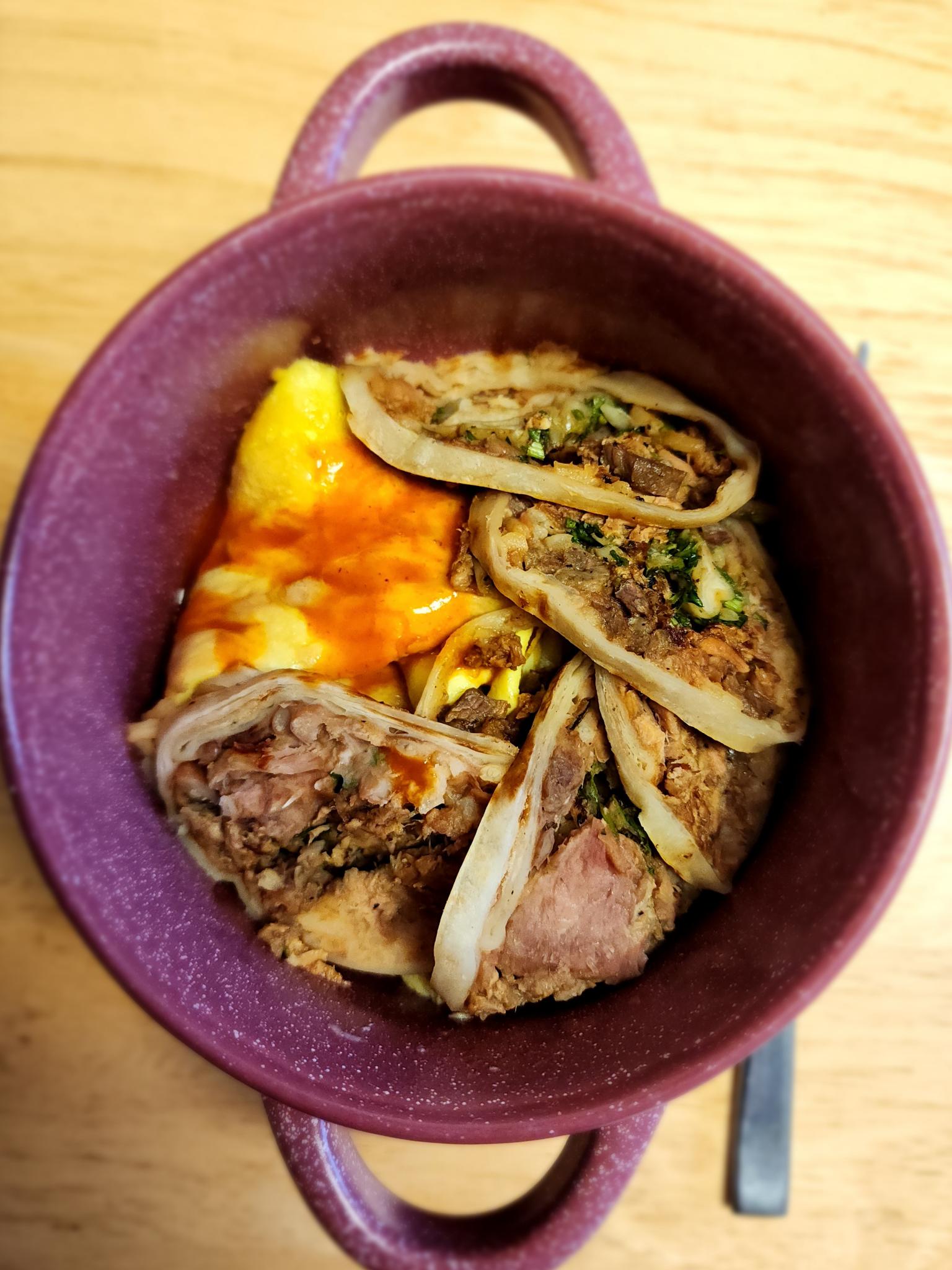
    Today in "stupid food I made" I give you: Thin-sliced, pan fried burrito with Tamagoyaki eggs and a sweet chili vinaigrette.