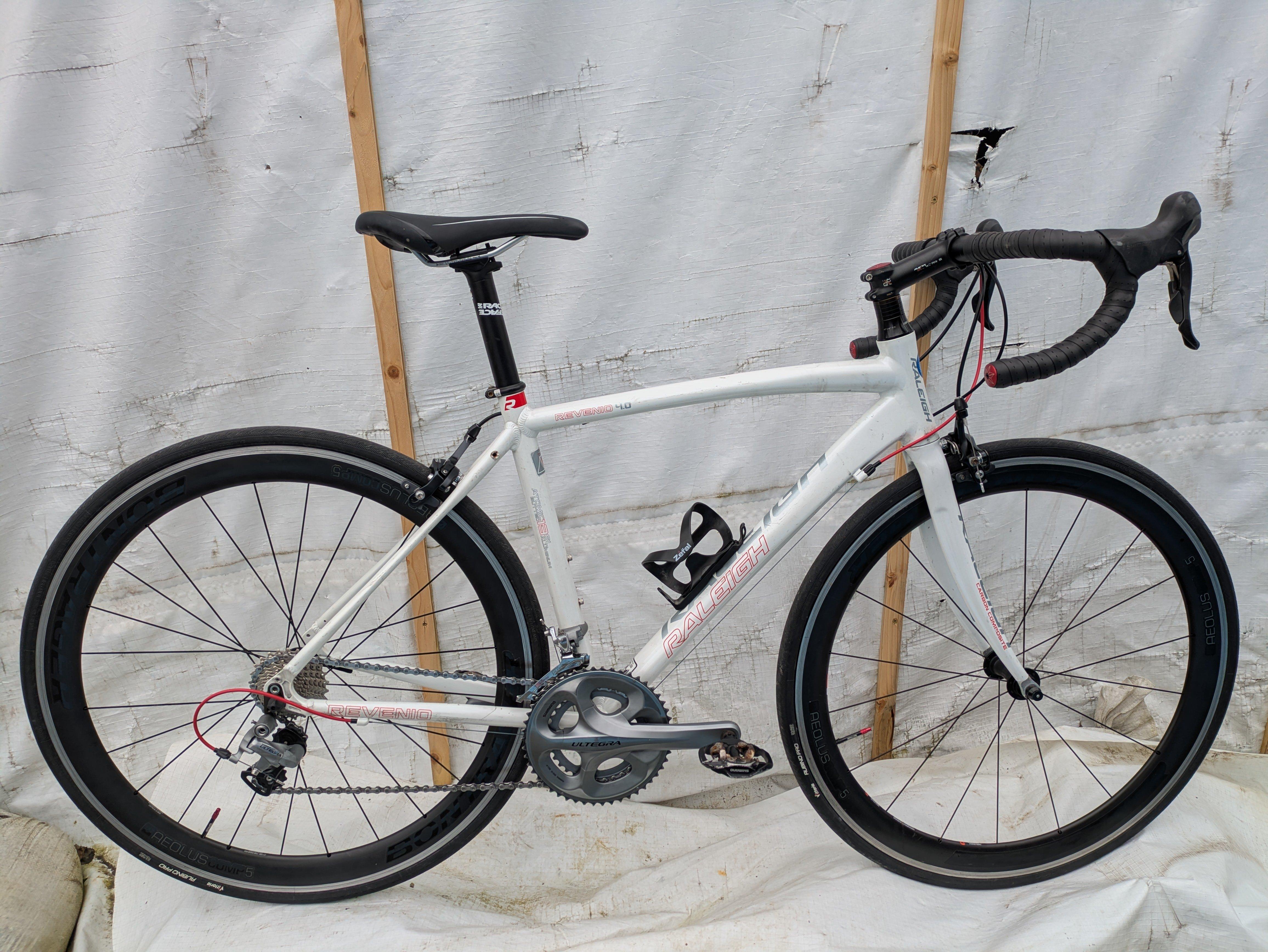
What is the benefit of tubeless bicycle tires anyways?
Tubeless tires can be run at lower pressures without risk of pinch flats, also called snakebites because of the distinctive double hole in the tube. The wider working range of tire pressures allows riders to dial their tire pressure to the riding conditions, whereas clinchers (standard bicycle tires + tube) have much narrower pressure ranges. Varying the tire pressure has all kinds of benefits, especially with multi-surface tires, allowing the cornering blocks to bite into the surface earlier in turns. On gnarly chipseal pavement, the lower pressure means less fatigue, which quickly adds up over some miles. Failing to notice, or being unable to avoid, a pothole won't cause a pinch flat. You can still dent your rim, but that's mostly a non-issue with the ubiquity of disc brakes on bikes. On a clincher, you're guaranteed a pinch flat if you hit something hard enough to dent the rim.
Tubeless tires provide the feel and higher traction of tubular tires (also called glue-ons, sew-ups) with greater durability, easier maintenance, and easier repairability.
For regions with goatheads and blackberries, tubeless is pretty much the only way to go farther afield. Tire strips can help, but they deaden the feel, mess with tire dynamics, increase rotational weight, and very rarely protect sidewalls. They are also (usually) horrible to install and can chafe tubes unless installed very carefully.
In regions without regular street-cleaning, with less frequent tire replacement, and with higher use of tire chains, it's very common to encounter tire belting and fragments of tire chains. Tubeless bicycle tires are a day-saver. In my own experience, I can now ride those roads where it was previously common to get multiple flats. Before I switched to tubeless, one ride in particular in rural Oregon resulted in 8 flats in 40 miles. And then I was out of patches and spare tubes; day is over, call for a ride. All the flats were caused by tiny pieces of tire belting. I now check my tires once a week to pick out the tire belting I picked up, but I get zero flats.
Oh, I forgot to mention, it did not clog the valve at all, and it’s also tire sensor safe.
Our direct experiences are very different. And bicycles don't have TPS.
If FaF was actually superlative for bicycles on any metric, we would all have switched long ago. At the very least, some pioneering shadetree bike mechanic would be singing its praises far and wide. I resisted the tubeless tire trend until late 2025 despite having worked on other's bikes with tubeless, in part because I didn't feel like building up new wheels. "Meh, everything I have is just fine." I kick myself for having hesitated. It's just so much better on all counts.

Sure, but if you're suffering from radiculopathy (pinched spinal nerve root), the sleep deprivation and increased stress make those interventions more difficult. The article failed to mention inexpensive and free physical therapy interventions.
If you are suffering from lumbar or cervical radiculopathy (or a slew of other joint pains), check out McKenzie Method therapy. It's free/freely available, designed to be within reach of anyone, and can be done just about anywhere. Bob and Brad are prolific in providing exercises to get you back into fighting form. Robin McKenzie's book "Treat Your Own Back" is also excellent.
Edit to add: a lot of radiculopathies manifest as referred pain, e.g. a pinched nerve in C4-C5 might feel like tightness or pain in the trapezius, under the scapula, in the elbow, or at the extremes, pain and tingling in first and second digits. Sciatica is the the most "famous" of radiculopathies.
Anecdote: I had a C4-C5 radiculopathy, and it was pushing me into disability territory. The orthopedist wanted to do all kinds of stupid, expensive, invasive shit. I stumbled on McKenzie's back book and was back at work in two days. I also suffered from piriformis pain for over a decade. It was an L4-S3 radiculopathy. A few minutes of basic McKenzie stretches, and it goes away.