Yes, but this text was not written in Egypt. In Israel and Judah, were the tale was written, the king is always named, between other causes because the principle of the divine monarchy is heavily criticized. But there are other problems with names, like the name of the parted sea (the Yam Suph is not the Red Sea), which would clearly put the story in a fantastical setting for a subject of Israel and Judah. And the structures and events are topos of ancient near east mythology (the reluctant leader, for example). Ancient people did not believed in their myths in the modern sense of the word, as Paul Veyne proved with the Greeks. It was the same for the Hebrews.
Yes, but this text was not written in Egypt. In Israel and Judah, were the tale was written, the king is always named, between other causes because the principle of the divine monarchy is heavily criticized.
The New Testament only refers to the reigning Emperor as Caesar - is this because the notion of a divine monarchy is now accepted in Jewish-Christian culture of the 1st century AD?
But there are other problems with names, like the name of the parted sea (the Yam Suph is not the Red Sea), which would clearly put the story in a fantastical setting for a subject of Israel and Judah.
Aren’t there a number of actual locations that are regarded as fitting the Yam Suph?
Ancient people did not believed in their myths in the modern sense of the word, as Paul Veyne proved with the Greeks. It was the same for the Hebrews.
I feel like that’s a dangerous level of cross-cultural equivocation, especially considering the vast differences in both philosophical and religious attitudes between the two peoples. You never see Temple or Rabbinical Judaism, for example, discussing the possibility of changing the founding mythology of their faith the way that Greeks openly did.
The New Testament only refers to the reigning Emperor as Caesar - is this because the notion of a divine monarchy is now accepted in Jewish-Christian culture of the 1st century AD?
No, there is at least two named emperors, August (Luke 2:1) and Tiberius (Luke 3:1). Most of the usages of Caesar in the New Testament is about the function, not an Emperor in particular.
Aren’t there a number of actual locations that are regarded as fitting the Yam Suph?
Quite a few, but none is clear. It’s not a particular location, not one knew by the people of the time.
You never see Temple or Rabbinical Judaism, for example, discussing the possibility of changing the founding mythology of their faith the way that Greeks openly did.
No, but we see the result of these changes. Just look at Genesis 1 and Genesis 2; the first one clearly is a rewriting of the second. Or both books of Chronicles, which are rewritings of the books ot the Kings.
No, there is at least two named emperors, August (Luke 2:1) and Tiberius (Luke 3:1).
You’re right about that, I concede that point. It’s been a long time since I’ve read the New Testament.
Most of the usages of Caesar in the New Testament is about the function, not an Emperor in particular.
Do you think most provincials and Hellenized citizens of the East would have made that distinction clearly?
Quite a few, but none is clear. It’s not a particular location, not one knew by the people of the time.
How can it be asserted to not be a particular location if there are several possible locations that fit?
We don’t know where the Rubicon River was, yet it’s certain that it was a particular location.
No, but we see the result of these changes. Just look at Genesis 1 and Genesis 2; the first one clearly is a rewriting of the second. Or both books of Chronicles, which are rewritings of the books ot the Kings.
Results are very different from proposals. I can remake all the myths I want simply by retelling them in the way that I desire without further comment; but proposing to do so can lead to very different reactions according to culture and context. Proposing to rewrite a myth necessitates either supremacy of human needs or perceptions over the myth - something which was controversial but not unthinkable for Greeks, but near-unthinkable for Judaism and subsequent Abrahamic religions.
Do you think most provincials and Hellenized citizens of the East would have made that distinction clearly?
The distinction between a function and someone occupying it is not one hard to make.
How can it be asserted to not be a particular location if there are several possible locations that fit?
Because when authors wanted to be precise, they can. If they don’t, it’s a choice. Millenia after, religious archeologists who read this text literally looked for the place, and the fact that they did not found one and disagree is more telling than anything else.
near-unthinkable for Judaism
The fact that they did not keep tracks of their discussions doesn’t mean they did not occur. And the extent of the biblical rewriting, with discernable schools like the deuteronomist one, is the proof that this rewriting was conscious, organized and debated. We also have signs of this kind of work in Qumran. You seem to see Judaism as an ahistorical reality; the truth is that it evolved a lot; rewriting propositions were common until at least the fall of Jerusalem in 71. And after that, this work continued differently in the Midrashim, without changing the text but changing its interpretation extensively, with comparable results as the rewriting of the text.
The distinction between a function and someone occupying it is not one hard to make.
That’s a very fucking modernist point of view.
Because when authors wanted to be precise, they can. If they don’t, it’s a choice.
what.
Do you… do you think they were going to give a coordinate grid reference if they wanted to be precise?
Do you have any idea how many place names are incredibly generic, and only have any manner of uniqueness because of the adoption of the practice of not translating foreign toponyms? Itself a very recent development in most languages?
They gave the name of what they called the place. How much more precision are you looking for?
Millenia after, religious archeologists who read this text literally looked for the place, and the fact that they did not found one and disagree is more telling than anything else.
… you literally already conceded that there are several places that fit the description by archeologists’ estimates.
The fact that they did not keep tracks of their discussions doesn’t mean they did not occur.
“You can’t prove that they didn’t” isn’t very fucking compelling from an academic standpoint, especially when the argument presupposes the existence of the discussions to begin with.
And the extent of the biblical rewriting, with discernable schools like the deuteronomist one, is the proof that this rewriting was conscious, organized and debated.
How does that follow at all?
You seem to see Judaism as an ahistorical reality;
… what is that even supposed to mean?
the truth is that it evolved a lot; rewriting propositions were common until at least the fall of Jerusalem in 71.
…
And after that, this work continued differently in the Midrashim, without changing the text but changing its interpretation extensively, with comparable results as the rewriting of the text.
Changing interpretations and changing the text are so fucking distant from each other in an Abrahamic religious context that it’s bizarre that you even bring it up.
13 Then they sent to him some Pharisees and some Herodians to trap him in what he said. 14 And they came and said to him, “Teacher, we know that you are sincere and show deference to no one, for you do not regard people with partiality but teach the way of God in accordance with truth. Is it lawful to pay taxes to Caesar or not? 15 Should we pay them, or should we not?” But knowing their hypocrisy, he said to them, “Why are you putting me to the test? Bring me a denarius and let me see it.” 16 And they brought one. Then he said to them, “Whose head is this and whose title?” They answered, “Caesar’s.” 17 Jesus said to them, “Give to Caesar the things that are Caesar’s and to God the things that are God’s.” And they were utterly amazed at him. [Mark 12:13/17]
Jesus is speaking about the function of Emperor, representing the Empire, not an Emperor in particular.
Do you have any idea how many place names are incredibly generic
What I try to say is that this name is not generic.
… you literally already conceded that there are several places that fit the description by archeologists’ estimates.
Only because there’s no clear description, just as the forest in Little Red Riding Hood can be any temperate forest.
“You can’t prove that they didn’t” isn’t very fucking compelling from an academic standpoint, especially when the argument presupposes the existence of the discussions to begin with.
Absence of proof is never in history the proof of absence. It’s a quite common assertion in academia as we rarely have proofs… But you clearly here truncate my reasoning. It’s not compelling from an academic standpoint either.
How does that follow at all?
If someone is found dead with a knife in their heart, it’s probably because they died from being stabbed in the heart. The current state of the biblical text is best explained by the fact that successive schools of thought have rewritten their myths generation after generation, which presupposes a detached relationship to the historicity of the narratives. There is no proof, but no explanation that passes Occam’s razor any better either.
… what is that even supposed to mean?
There’s not much common between Judaism today, in which indeed any rewriting of the texts would be impossible, and a loose continuum of apparented traditions 3000 years ago. It’s an anachronism.
Changing interpretations and changing the text are so fucking distant from each other in an Abrahamic religious context that it’s bizarre that you even bring it up.
That’s why I said differently. There’s no need of Midrashim before 71 because they rewrote the texts. When they couldn’t anymore, they did something different.
/
But listen, you’re clearly becoming angry, and I don’t understand why. I’ll stop here, it’s not worth it. Thanks for the beginning of this exchange, and the other one about Paul Veyne and bestiaries.
It really fucking is. Even outside of the context of divine rulership or even elite status, it is incredibly common for people in pre-modern societies to be identified overwhelmingly by their position or profession rather than their name even in daily interactions. Individualism is an extremely recent development in human culture.
Jesus is speaking about the function of Emperor, representing the Empire, not an Emperor in particular.
“Whose head is this and whose title?” They answered, “Caesar’s.”
“Whose head”
I can launch into a lecture about the importance of individual Imperial portraiture and the departure from the norms of coinage of the near-east of the period if you like.
What I try to say is that this name is not generic.
… do you not know what “Yam Suph” means?
“Reed Sea.”
Only because there’s no clear description, just as the forest in Little Red Riding Hood can be any temperate forest.
The Rubicon lacks a clear description as well. Is the Rubicon also a fictional place in the context of Caesar’s Civil War?
Absence of proof is never in history the proof of absence. It’s a quite common assertion in academia as we rarely have proofs…
It is incredibly unusual in historical academia for positions to be advanced without evidence, and even over-reading into solid, extant evidence is often viciously ripped apart.
If someone is found dead with a knife in their heart, it’s probably because they died from being stabbed in the heart. The current state of the biblical text is best explained by the fact that successive schools of thought have rewritten their myths generation after generation, which presupposes a detached relationship to the historicity of the narratives. There is no proof, but no explanation that passes Occam’s razor any better either.
So the best explanation of games of religious telephone in a religious tradition that posits the defiance of the objective truth of YHWH to be a cause for society-wide destruction and divine wrath, between numerous warring tribes who went through extensive societal trauma, including the exile and then return of their elites to a distant land, is that the oral tradition was… consciously and in an organized fashion rewritten by dedicated Bronze Age cynics without any notable pushback from the common believers.
… one might suggest the difficulties of unwritten oral transmission even within one language, in one generation, much less a nonstandardized language family over the course of hundreds of years, given the vagaries of human memory and prejudice, might suggest a different, much less convoluted route that doesn’t contradict what we know about the society of the ancient Israelites.
There’s not much common between Judaism today, in which indeed any rewriting of the texts would be impossible, and a loose continuum of apparented traditions 3000 years ago. It’s an anachronism.
I suppose there’s not much in common between Judaism in the 1st century AD and Judaism in the 10th century BCE either? Or much in common between Judaism in the 2nd century BCE and the 10 century BCE? Or Judaism in any period wherein the facts and reflections of the ethnoreligion can be studied, and your convenient tabula rasa view of Judaism unburdened by evidence?
That’s why I said differently. There’s no need of Midrashim before 71 because they rewrote the texts. When they couldn’t anymore, they did something different.
It’s funny that they should be so secretive as to obliterate all whisper of rewriting their own holy texts, even from hostile, non-Hebrew sources, but be so open about re-interpreting it, despite both of those supposedly serving the same purpose and the re-interpretation tradition only arising because they, in some vague sense, ‘could not’ rewrite the texts any longer, despite the fact that the widespread Jewish diaspora which long-predated the destruction of the Second Temple would have had to coordinate and agree upon such rewrites over the entire Mediterranean and part of Central Asia.
But listen, you’re clearly becoming angry, and I don’t understand why. I’ll stop here, it’s not worth it.
I’m frustrated because your arguments are not simply disagreeable, but outright incoherent (as with the assertion about precision and the location of the Yam Suph), contradictory (as with your agreement that archeologists have several places that the Yam Suph could be, and then arguing that the fact that archeologists did not have any such locations was proof that it was fake), and borderline axiomatic (as with your arguments regarding how little worth actual evidence and proof are in comparison to an assertion based on what my rural relatives would unintuitively call “common sense”).
Okay, I may have understood why we can’t understand each other (beside my poor English, which is I presume a big part of the problem). The idea that these texts come from oral traditions from the bronze age was abandoned decades ago… they are far more recent than that. The book of Exodus, for example, was written in its first form in the 7th century BCE (exactly when Egypt regains power in the Middle East, and it’s not a coincidence), and rewritten again and again; we still find (small) variations on the text in the 10th century CE! But it’s more or less finished by the period of Alexander the Great. It may contain traces of oral tradition, but nothing very older; it was a written document Does it make more sense to you in this timeframe?
If not, I’ll just say thank you for your memes that Iove and stop bothering you.
Thank you for the reference to Paul Veyne. I’ve been reading quite a lot of history, most recently a summary of Egyptian history and I might have to skim Veynes work.
Veyne is great. I don’t know how his work is treated by nowadays historians, but it was a revelation for me. My passion is more medieval history, but we find the same kind of things: just read medieval bestiaries, you’ll find a lot of unbelievable things about very common animals like rabbits. People who wrote that knew that they were not real things, but they still thought that they were true. We lost a lot when we begun to think that real = true. It was the same things for mythologies, and biblical ones too: people knew they weren’t real things of the past, but they were true things of their present.
It’s more complicated than that of course (there are more than just two “modes of truth” to use Veyne’s terminology), and I’m sure most people believed that Moses actually existed (he probably didn’t). Moreover, an intellectual and a peasant probably didn’t judge these things in the same way. But the fact that truth ≠ reality for most people before the Enlightenment (and in fact, it’s still true today but in a hidden way) helps understand a lot of historical texts.
Veyne is great. I don’t know how his work is treated by nowadays historians, but it was a revelation for me. My passion is more medieval history, but we find the same kind of things: just read medieval bestiaries, you’ll find a lot of unbelievable things about very common animals like rabbits. People who wrote that knew that they were not real things, but they still thought that they were true. We lost a lot when we begun to think that real = true. It was the same things for mythologies, and biblical ones too: people knew they weren’t real things of the past, but they were true things of their present.
I haven’t read the book, but that seems a very curious assertion given the widespread expressed beliefs of medieval societies with regards to the fantastic creatures they recorded which would be very difficult to reconcile with the notion that their belief was purely a metaphorical truth.
Bestiaries didn’t propose fantastic creatures as something mixing metaphor and truth, but rather envisioned the natural order of the world as itself having heavy elements of symbolism. That is to say, metaphor was still separate from reality precisely because metaphor was acknowledged as an abstract, fictional, theoretical literary device.
The fantastic creatures described in medieval bestiaries are described in the same tones as verifiably true animals are - snakes and deer and rabbits having symbolism which reflects their (perceived) real existence, just as fantastic creatures are described with symbolism which reflects their (perceived) real existence. Fantastic creatures are not being put in a superposition between real and unreal; they are being described as real creatures in the same way that verifiably, modern real creatures are being described. It’s that the mode of description and view of an intrinsic ordering of the universe, as comprehensible to human values, being used is alien.
Medieval peoples often believed these creatures were real. That they had symbolism in their existence was reinforcement that they were real, not a separation from it, as all creatures had a natural, intrinsic reflection of a natural/divine order.
I wasn’t speaking about fantastic creatures. Your message is right, but it’s not complete. We could say that reality and truth are two extreme parts of a continuum, some things being only real, some other things being only true (we could say, metaphorical but it’s not exactly that, it exists but in an other way of existence, sorry my English is not good enough to be clear enough) but most things are in the middle, but not at the same place.
I’ll give an example: according to many bestiaries, weasels give birth through their ears. In the Middle Ages, as in ancient Rome, weasels were domesticated animals, much like cats in the countryside today. So there’s no chance that medieval people didn’t know how weasels gave birth… and yet they repeated this story without hesitation because reality (which they did know) was less important than the truth.


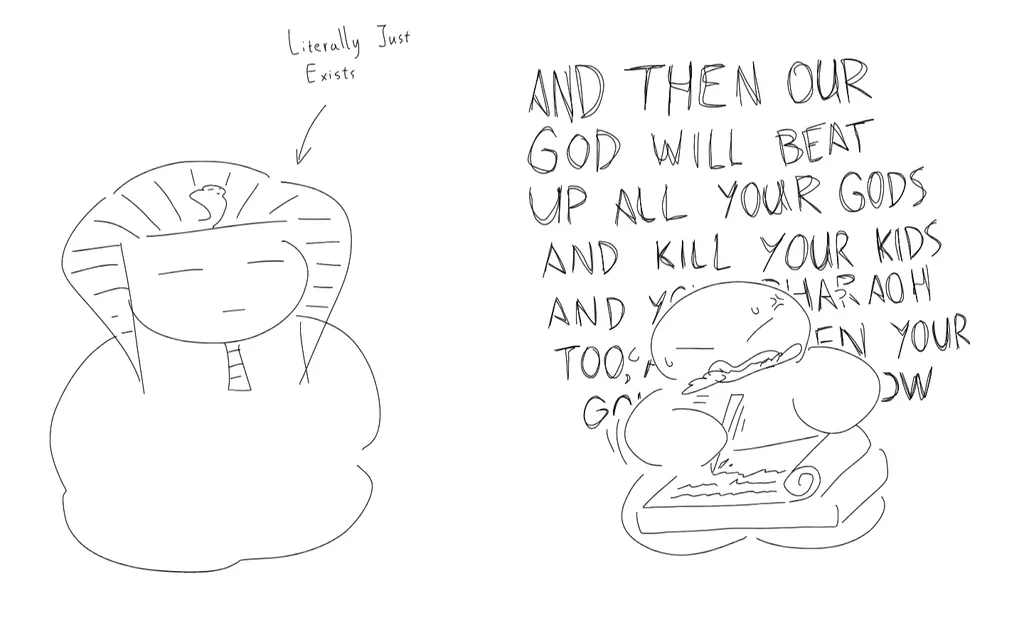
Yes, but this text was not written in Egypt. In Israel and Judah, were the tale was written, the king is always named, between other causes because the principle of the divine monarchy is heavily criticized. But there are other problems with names, like the name of the parted sea (the Yam Suph is not the Red Sea), which would clearly put the story in a fantastical setting for a subject of Israel and Judah. And the structures and events are topos of ancient near east mythology (the reluctant leader, for example). Ancient people did not believed in their myths in the modern sense of the word, as Paul Veyne proved with the Greeks. It was the same for the Hebrews.
The New Testament only refers to the reigning Emperor as Caesar - is this because the notion of a divine monarchy is now accepted in Jewish-Christian culture of the 1st century AD?
Aren’t there a number of actual locations that are regarded as fitting the Yam Suph?
I feel like that’s a dangerous level of cross-cultural equivocation, especially considering the vast differences in both philosophical and religious attitudes between the two peoples. You never see Temple or Rabbinical Judaism, for example, discussing the possibility of changing the founding mythology of their faith the way that Greeks openly did.
No, there is at least two named emperors, August (Luke 2:1) and Tiberius (Luke 3:1). Most of the usages of Caesar in the New Testament is about the function, not an Emperor in particular.
Quite a few, but none is clear. It’s not a particular location, not one knew by the people of the time.
No, but we see the result of these changes. Just look at Genesis 1 and Genesis 2; the first one clearly is a rewriting of the second. Or both books of Chronicles, which are rewritings of the books ot the Kings.
You’re right about that, I concede that point. It’s been a long time since I’ve read the New Testament.
Do you think most provincials and Hellenized citizens of the East would have made that distinction clearly?
How can it be asserted to not be a particular location if there are several possible locations that fit?
We don’t know where the Rubicon River was, yet it’s certain that it was a particular location.
Results are very different from proposals. I can remake all the myths I want simply by retelling them in the way that I desire without further comment; but proposing to do so can lead to very different reactions according to culture and context. Proposing to rewrite a myth necessitates either supremacy of human needs or perceptions over the myth - something which was controversial but not unthinkable for Greeks, but near-unthinkable for Judaism and subsequent Abrahamic religions.
The distinction between a function and someone occupying it is not one hard to make.
Because when authors wanted to be precise, they can. If they don’t, it’s a choice. Millenia after, religious archeologists who read this text literally looked for the place, and the fact that they did not found one and disagree is more telling than anything else.
The fact that they did not keep tracks of their discussions doesn’t mean they did not occur. And the extent of the biblical rewriting, with discernable schools like the deuteronomist one, is the proof that this rewriting was conscious, organized and debated. We also have signs of this kind of work in Qumran. You seem to see Judaism as an ahistorical reality; the truth is that it evolved a lot; rewriting propositions were common until at least the fall of Jerusalem in 71. And after that, this work continued differently in the Midrashim, without changing the text but changing its interpretation extensively, with comparable results as the rewriting of the text.
That’s a very fucking modernist point of view.
what.
Do you… do you think they were going to give a coordinate grid reference if they wanted to be precise?
Do you have any idea how many place names are incredibly generic, and only have any manner of uniqueness because of the adoption of the practice of not translating foreign toponyms? Itself a very recent development in most languages?
They gave the name of what they called the place. How much more precision are you looking for?
… you literally already conceded that there are several places that fit the description by archeologists’ estimates.
“You can’t prove that they didn’t” isn’t very fucking compelling from an academic standpoint, especially when the argument presupposes the existence of the discussions to begin with.
How does that follow at all?
… what is that even supposed to mean?
…
Changing interpretations and changing the text are so fucking distant from each other in an Abrahamic religious context that it’s bizarre that you even bring it up.
No it’s not. Let’s take an example:
Jesus is speaking about the function of Emperor, representing the Empire, not an Emperor in particular.
What I try to say is that this name is not generic.
Only because there’s no clear description, just as the forest in Little Red Riding Hood can be any temperate forest.
Absence of proof is never in history the proof of absence. It’s a quite common assertion in academia as we rarely have proofs… But you clearly here truncate my reasoning. It’s not compelling from an academic standpoint either.
If someone is found dead with a knife in their heart, it’s probably because they died from being stabbed in the heart. The current state of the biblical text is best explained by the fact that successive schools of thought have rewritten their myths generation after generation, which presupposes a detached relationship to the historicity of the narratives. There is no proof, but no explanation that passes Occam’s razor any better either.
There’s not much common between Judaism today, in which indeed any rewriting of the texts would be impossible, and a loose continuum of apparented traditions 3000 years ago. It’s an anachronism.
That’s why I said differently. There’s no need of Midrashim before 71 because they rewrote the texts. When they couldn’t anymore, they did something different.
/
But listen, you’re clearly becoming angry, and I don’t understand why. I’ll stop here, it’s not worth it. Thanks for the beginning of this exchange, and the other one about Paul Veyne and bestiaries.
It really fucking is. Even outside of the context of divine rulership or even elite status, it is incredibly common for people in pre-modern societies to be identified overwhelmingly by their position or profession rather than their name even in daily interactions. Individualism is an extremely recent development in human culture.
I can launch into a lecture about the importance of individual Imperial portraiture and the departure from the norms of coinage of the near-east of the period if you like.
… do you not know what “Yam Suph” means?
“Reed Sea.”
The Rubicon lacks a clear description as well. Is the Rubicon also a fictional place in the context of Caesar’s Civil War?
It is incredibly unusual in historical academia for positions to be advanced without evidence, and even over-reading into solid, extant evidence is often viciously ripped apart.
So the best explanation of games of religious telephone in a religious tradition that posits the defiance of the objective truth of YHWH to be a cause for society-wide destruction and divine wrath, between numerous warring tribes who went through extensive societal trauma, including the exile and then return of their elites to a distant land, is that the oral tradition was… consciously and in an organized fashion rewritten by dedicated Bronze Age cynics without any notable pushback from the common believers.
… one might suggest the difficulties of unwritten oral transmission even within one language, in one generation, much less a nonstandardized language family over the course of hundreds of years, given the vagaries of human memory and prejudice, might suggest a different, much less convoluted route that doesn’t contradict what we know about the society of the ancient Israelites.
I suppose there’s not much in common between Judaism in the 1st century AD and Judaism in the 10th century BCE either? Or much in common between Judaism in the 2nd century BCE and the 10 century BCE? Or Judaism in any period wherein the facts and reflections of the ethnoreligion can be studied, and your convenient tabula rasa view of Judaism unburdened by evidence?
It’s funny that they should be so secretive as to obliterate all whisper of rewriting their own holy texts, even from hostile, non-Hebrew sources, but be so open about re-interpreting it, despite both of those supposedly serving the same purpose and the re-interpretation tradition only arising because they, in some vague sense, ‘could not’ rewrite the texts any longer, despite the fact that the widespread Jewish diaspora which long-predated the destruction of the Second Temple would have had to coordinate and agree upon such rewrites over the entire Mediterranean and part of Central Asia.
I’m frustrated because your arguments are not simply disagreeable, but outright incoherent (as with the assertion about precision and the location of the Yam Suph), contradictory (as with your agreement that archeologists have several places that the Yam Suph could be, and then arguing that the fact that archeologists did not have any such locations was proof that it was fake), and borderline axiomatic (as with your arguments regarding how little worth actual evidence and proof are in comparison to an assertion based on what my rural relatives would unintuitively call “common sense”).
Okay, I may have understood why we can’t understand each other (beside my poor English, which is I presume a big part of the problem). The idea that these texts come from oral traditions from the bronze age was abandoned decades ago… they are far more recent than that. The book of Exodus, for example, was written in its first form in the 7th century BCE (exactly when Egypt regains power in the Middle East, and it’s not a coincidence), and rewritten again and again; we still find (small) variations on the text in the 10th century CE! But it’s more or less finished by the period of Alexander the Great. It may contain traces of oral tradition, but nothing very older; it was a written document Does it make more sense to you in this timeframe?
If not, I’ll just say thank you for your memes that Iove and stop bothering you.
Thank you for the reference to Paul Veyne. I’ve been reading quite a lot of history, most recently a summary of Egyptian history and I might have to skim Veynes work.
Veyne is great. I don’t know how his work is treated by nowadays historians, but it was a revelation for me. My passion is more medieval history, but we find the same kind of things: just read medieval bestiaries, you’ll find a lot of unbelievable things about very common animals like rabbits. People who wrote that knew that they were not real things, but they still thought that they were true. We lost a lot when we begun to think that real = true. It was the same things for mythologies, and biblical ones too: people knew they weren’t real things of the past, but they were true things of their present.
It’s more complicated than that of course (there are more than just two “modes of truth” to use Veyne’s terminology), and I’m sure most people believed that Moses actually existed (he probably didn’t). Moreover, an intellectual and a peasant probably didn’t judge these things in the same way. But the fact that truth ≠ reality for most people before the Enlightenment (and in fact, it’s still true today but in a hidden way) helps understand a lot of historical texts.
I haven’t read the book, but that seems a very curious assertion given the widespread expressed beliefs of medieval societies with regards to the fantastic creatures they recorded which would be very difficult to reconcile with the notion that their belief was purely a metaphorical truth.
No Veyne spoke only about Greek mythology. The part about bestiaries is influenced by an other historian, Michel Pastoureau.
Not purely metaphorical. The strict opposition between metaphor and real stories is modern.
That sounds like a leap to separate metaphor and the notion of an intrinsic natural order.
I’m sorry, I don’t understand.
Bestiaries didn’t propose fantastic creatures as something mixing metaphor and truth, but rather envisioned the natural order of the world as itself having heavy elements of symbolism. That is to say, metaphor was still separate from reality precisely because metaphor was acknowledged as an abstract, fictional, theoretical literary device.
The fantastic creatures described in medieval bestiaries are described in the same tones as verifiably true animals are - snakes and deer and rabbits having symbolism which reflects their (perceived) real existence, just as fantastic creatures are described with symbolism which reflects their (perceived) real existence. Fantastic creatures are not being put in a superposition between real and unreal; they are being described as real creatures in the same way that verifiably, modern real creatures are being described. It’s that the mode of description and view of an intrinsic ordering of the universe, as comprehensible to human values, being used is alien.
Medieval peoples often believed these creatures were real. That they had symbolism in their existence was reinforcement that they were real, not a separation from it, as all creatures had a natural, intrinsic reflection of a natural/divine order.
Thanks for your clarification.
I wasn’t speaking about fantastic creatures. Your message is right, but it’s not complete. We could say that reality and truth are two extreme parts of a continuum, some things being only real, some other things being only true (we could say, metaphorical but it’s not exactly that, it exists but in an other way of existence, sorry my English is not good enough to be clear enough) but most things are in the middle, but not at the same place.
I’ll give an example: according to many bestiaries, weasels give birth through their ears. In the Middle Ages, as in ancient Rome, weasels were domesticated animals, much like cats in the countryside today. So there’s no chance that medieval people didn’t know how weasels gave birth… and yet they repeated this story without hesitation because reality (which they did know) was less important than the truth.