

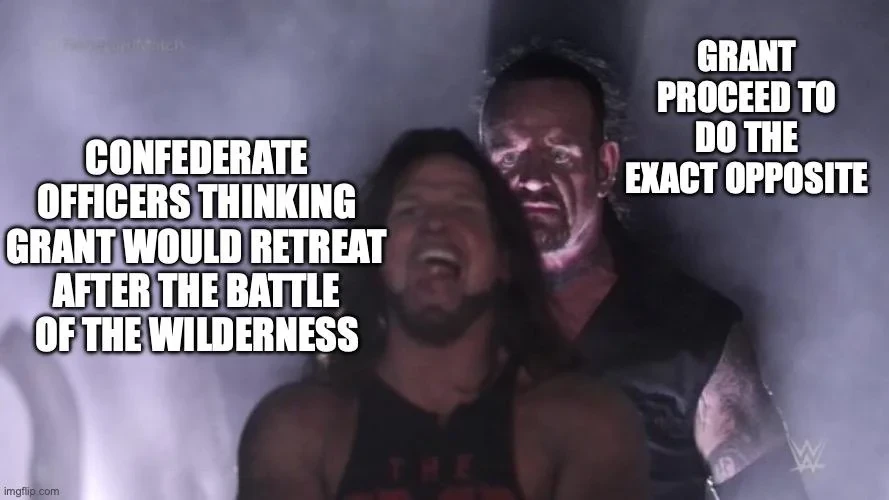
Explanation: During the US Civil War, the great general Ulysses S. Grant would be placed in command of the Union’s armies during the later period of the war, fighting against the pro-slavery secessionist Confederacy. General Grant has sometimes been maligned as a butcher by postwar slaver apologists peddling what has come to be known as the “Lost Cause” in historical academia, but the truth is very far from that. Grant’s losses were not greater than any other Union general’s, but his victories were far greater - because when he failed to take a position, he would simply attempt it from another angle.
This sounds simple, perhaps even deceptively intuitive, but it was also a risky strategy insofar as it required the morale and organization of the soldiery to remain high. Grant, who was attentive to the needs and feelings of the enlisted man, judged them correctly. After an especially brutal draw at the Battle of the Wilderness, the Union troops, having penetrated into Confederate-held land, were downhearted and convinced that, like after every other setback under other Union generals, they were going to give up their hard-earned gains and retreat to lick their wounds.
When it became apparent that Grant had given the order to penetrate deeper into Confederate territory instead (by a different route), the men cheered. They sang. They praised Grant’s name. By all accounts, they were thrilled after the brutal bloodletting to be led into more fighting - because it means that they and their comrades had not fought and died in vain.
Men do not want to die, generally. But perhaps even more than that, they do not want to die for nothing. Keeping up the fight even after heavy casualties is, paradoxically, sometimes better for morale than attempting to stem the losses.