
You must log in or # to comment.
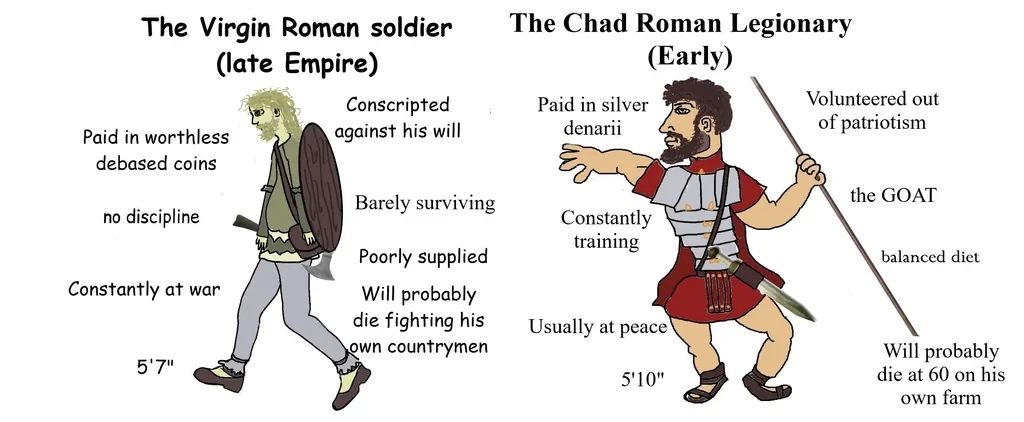
Notes: Legionaries of the Early Roman Empire were supposed to be 5’10… in Roman feet, which is around 5’7 (174cm). Archeology supports that shorter men were regularly accepted.
Legionaries of the Late Empire were often not regularly paid in coinage at all, but reimbursed in-kind - that is to say, supplied with food and equipment. Bonuses were still distributed in coin, but were irregularly received and not always easy to spend anyway, on account of the whole “Empire falling apart” bit.
Estimating the lifespan of an average legionary (if there could be said to be such a thing) is incredibly difficult with most records being obliterated by time. ANY estimates offered will always be DEEPLY contentious. However, one article I read posited, acknowledging the shortcomings of the available evidence, that the average lifespan of a legionary in the Early Empire was about the same as the average man of the Early Empire. That is to say, whatever dangers Roman military life offered, they were about equally offset (in this proposed interpretation of the limited data) by recruitment preferences for healthy men, reliable access to a robust and healthy diet, and free top-of-the-line medical care. Estimates of lifespans in the Late Empire, military and civilian, are generally accepted to be… worse.
“Patriotism” is an old Latin term meaning “a steady paycheck”, at least in this context.
I can’t eat silver, pay me salt and promises of farmland
“Silver can buy many grains of salt.”
“Explain.”
“Money can be exchanged for goods and services.”
“Woohoo!”
In the Early Empire, the retirement bonus received by legionaries at the end of enlistment was a bonus equivalent to ~12 years pay, with your pay grade affecting that payment. Enough to buy a nice little farm in the provinces!
Do you mistake me for a mercator?
I might trust Caesar to lead me to battle, but it’s well known he has fewer denarii than hairs on his head.
is this NPC dialogue?
I just made it up, so yes.