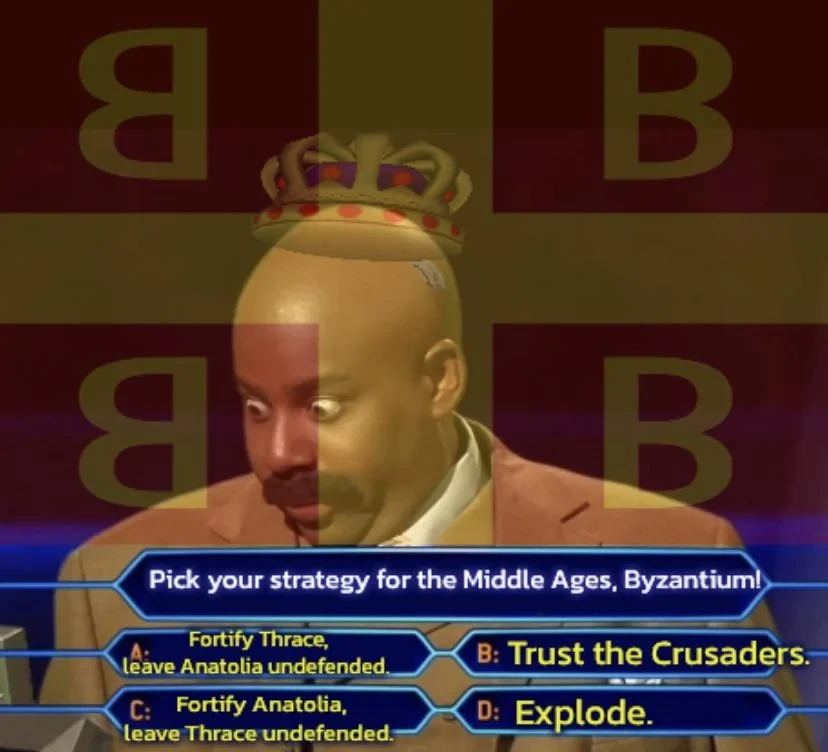

Explanation: The Byzantine Empire, the successor state to the Roman Empire of old, centered in Greece, did not have an easy time of things.
As the medieval period wore on, the Byzantines were caught in the unenviable position of pressure from the north (by Slavic peoples attacking Thrace), the east (by Muslim polities attacking Anatolia), and the west (by Catholic adventurers seeking loot and land, but claiming to be coreligionists). And they did not have enough resources to address all those issues at once. That’s not even getting into internal struggles.
Pretty invariably, whichever decision was made by the reigning Emperor in this period could only address one issue at the cost of the others, leading to a slow, painful decline as the Byzantine Empire fell apart piece-by-piece, over the course of hundreds of years.
So I know the root cause of what happened to western Rome is still debated, but what about Byzantium? What theories are there for why they started to have these problems after a few more centuries of prosperity?
Honestly, it’s less “A few centuries of prosperity” and more “The fall was super-slow motion.” The Eastern Empire went from bad, after the Western Empire fell, to worse. Justinian’s attempted reconquests in the 6th century AD were expensive, unsustainable, and made Italy run red with blood. The final Byzantine-Sassanid War exhausted both polities in the early 7th century, and then the Byzantine Empire was cut down to half its previous size with the Rashidun Caliphate’s invasions. In the 8th century they struggled against Slavic polities, and in the 9th century they lost their nominal claim to the Empire in the West due to Charlemagne and the Pope.
Come the 10th and 11th century, their recurring civil wars had let new contenders take further bites out of the Empire, then the advance of the Seljuk Turks, and then conflict with the Crusader States in the 12th century… and then in 1204, Constantinople is captured and sacked by the 4th Crusade. After that, it’s just an old dog limping behind the shed to die. There’s not much left of Byzantine glory when they recapture Constantinople some 60 years later. Just desperately clinging to a few strongholds (and performing palace coups and civil wars, As Is Tradition) as the Turks steadily ate away at their remaining holdings, until the final siege in 1453, which was just finishing off what had become not much more than a city-state.
Administratively, it was, likewise, all chaos. Despite an attempt to codify Roman law under Justinian, the entire project was very much trying to fit square pegs into round holes, for multiple reasons (religious and ideological changes in the ruling powers, the inadequate state of Roman criminal law to begin with, ~900 years of conflicting jurisprudence and legislature, etc).
The Byzies constantly went back-and-forth on the issue of centralization vs. decentralization, with periods of proto-feudalism pretty invariably reversed by civil wars, resulting in periods of naked despotism (by the victor either wanting to stave off another attempt, or prevent anyone from rising to power the same way they did). The bureaucracy became more muddled and confused, and tax income steadily reduced even in periods when the tax burden increased.
The military likewise suffered from this yo-yo treatment, with expensive centralized military units (and their manifold divisions in a vain attempt to prevent coups and civil wars) rarely lasting long enough to develop robust institutions before some fucking palace intrigue would result in them being sidelined (rarely disbanded) in favor of a different unit. My personal favorite is the Byzantine navy being repeatedly reduced and denigrated despite being the only consistent fucking saving grace of the Empire (even without ‘Greek fire’), and eventually disbanded. Then reformed. Then disbanded again.
And the Byzantine military, for that matter, was not a particularly fearsome machine. While well-developed on theory (as seen in numerous Byzantine military manuals), the Byzantine forces consistently lacked practical cohesion and efficacy, and the leadership, like that of all regimes without an independent officer corps, inevitably hit-or-miss, even insofar as understanding of said military manuals is concerned.
When well-led, the understanding of tactics and maneuver could result in very stunning victories. Not only that, but (again, as seen in their military manuals) they did also genuinely understand the versatility and variety of their enemies, and how to combat individual ethno-cultural groups both tactically and strategically.
But the forces themselves of the Byzantines were mediocre, lacking professionalism or strong native warrior traditions, and the recognition of this by the Byzantines themselves led them to increasingly rely on foreign mercenaries to make up the bulk of their army - which was not innately more dangerous than native troops, contrary to popular belief, but was significantly more expensive, from a polity that suffered decreasing tax revenues and whose core legitimizing factor of the autocrat was patronage and ‘majesty’, both very expensive and, by the iron law of institutions, difficult to reduce.
At the same time, the Byzantine distrust of anyone with any power in their system of “Whose Imperial Throne Is It Anyway?” meant that local forces were also distrusted and intentionally divided into penny-packets which had trouble responding to large-scale threats. But those local forces often had little loyalty to the Byzantine state, outside of religion, precisely because they were so distrusted - their own local elites were generally marginalized and subordinated to apparatchiks from the capitol, who were, themselves, generally just imperial toadies given sinecures, without any particular virtues other than, potentially, loyalty to the current ruler. Or professed loyalty to the current ruler.
And the intensive Caesaropapism of the Byzantine state also meant that a great deal of hostility (though less than in Catholic Europe) was leveled towards religious minorities, including Christian schismatics. By contrast, the relatively tolerant core system of neighboring Muslim polities meant that Muslim polities could retain the loyalties, or at least acquiescence, of elites of multiple faiths, not just their own majority religion.
The Byzantines, with neither a strong sense of cultural pluralism or cultural assimilationism or expansionism, ran a regime that effectively evoked (and displayed) indifference from the many provincial ethnicities which still made up the Empire. The loyalty of Byzantine Orthodox Christians was, to some degree, assured by the puppeteering of the Patriarch of Constantinople, but they made neither cultural friends nor colonies in the provinces - they failed to make allies OR Greeks out of the locals. So when the ruling power changed, there was neither desperation to retain the old (Byzantine) power, nor particular interest in resisting the new power. It was all the same to the provinces - and potentially better, considering the chaos of Byzantine governance.
Less “what theory is there for why they started to have these problems?” and “what theory is there for them lasting so fucking long despite all of their problems being around from the start?”
If I had a coin for each time the sick man of Europe was in Anatolia, I’d have two coins, which isn’t much but it is weird that it happened twice