
You must log in or # to comment.
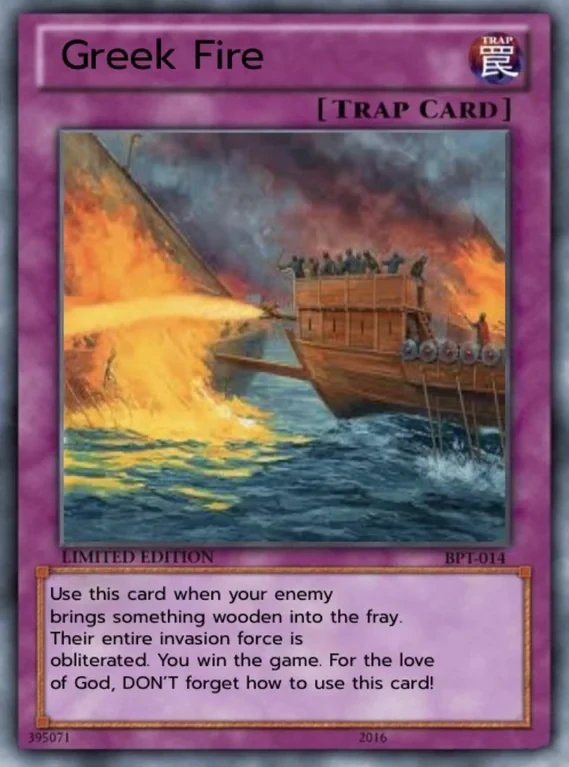
Explanation: The medieval Byzantine Empire, centered in modern Greece, had a curious incendiary concoction known as ‘Greek Fire’. Launched in pots (as kind of proto-grenades) and by hand-pumped siphons (as flamethrowers - not much ‘proto’ about it) aboard ships, it was… devastatingly effective in naval warfare. Since ships were pretty universally made of highly flammable materials (and sometimes also reinforced with highly flammable materials, like pine tar), anything burning was a significant risk - but Greek Fire was infamously difficult to put out, and, exceptionally, burned even on water, not unlike napalm. While the exact concoction is unknown, it’s generally agreed to be a recipe probably pretty close to uh… literal napalm.
After the sack and conquest of Constantinople by Western European Crusaders in 1204 AD, the Byzantine Empire would struggle to reform itself over the next few decades, and when it was re-established, had apparently lost the art of making ‘Greek Fire’. As the recipe and process was a closely-guarded state secret, they may have quite literally forgot it - or they may simply have lost access to the necessary labor or natural resources needed, as the Byzantine Empire was little-more than a rump state at that time.
… the loss of Greek Fire would not bode well for their naval endeavors from that point on, and the Byzantines would be conquered once-and-for-all in 1453 AD by the Ottoman Turks, who, probably not coincidentally, operated with near-naval-impunity during the siege.
I remember reading a while back that this could be solved now. As it turns out a particular type of crude oil exhibits all of these same properties and happens to be in an area controlled by the Byzantines. Sadly I can’t give more details to which type of crude, but with just the oil from that specific area, they were able to recreate all the cool effects Greek fire was infamous for.
I’m definitely not an authority on anything about it, but it passes the sniff test as to why no one was able to reproduce it for so long, had to be that specific crude which no one else had and by the time other civilizations had control of it, people were already fantasizing about what strange process must be involved in creating it.