It appears from Issue #1631 that non-Thumb-Key ideas are acceptable. If this is not an appropriate place to discuss such a keyboard, please ignore.
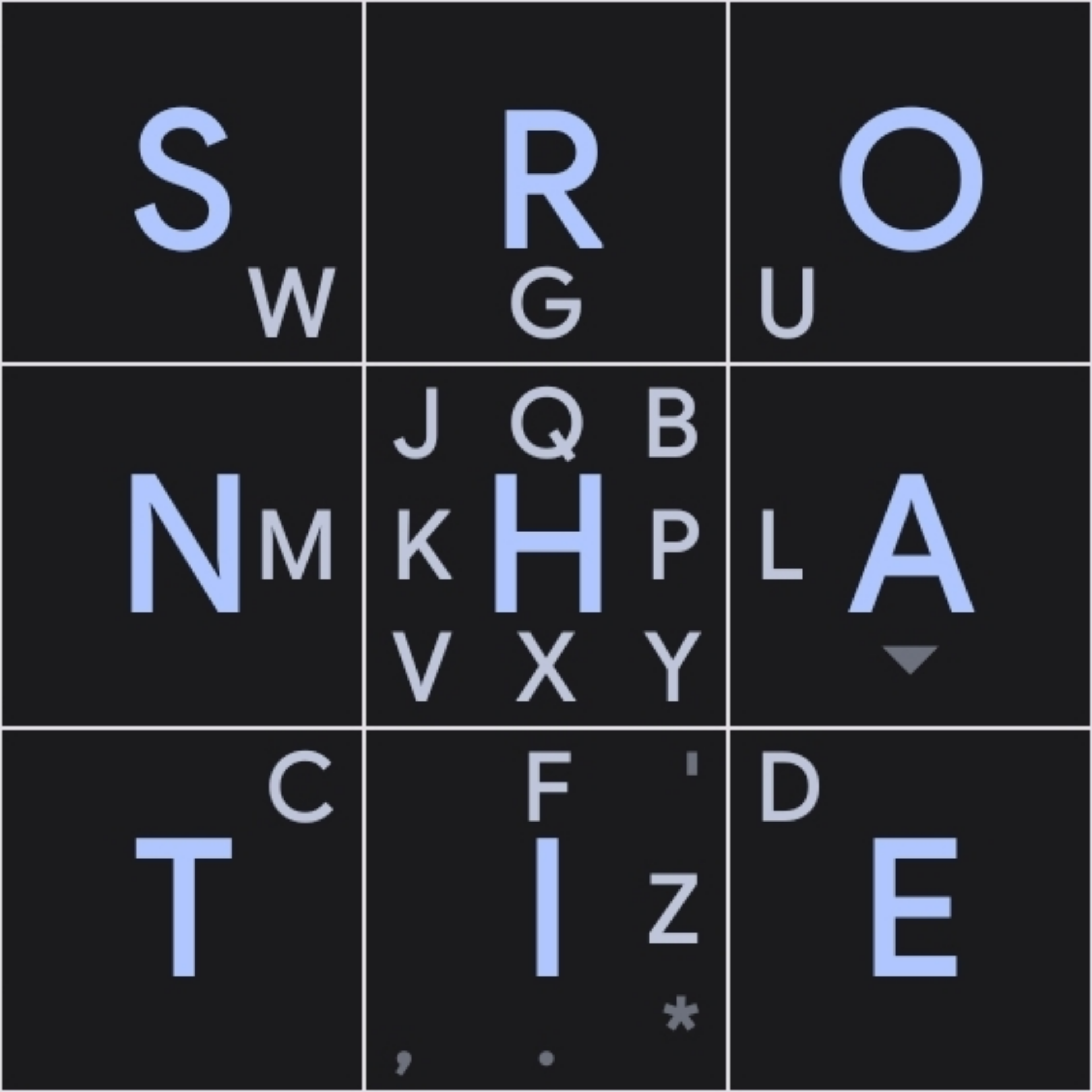
After many years of using MessageEase and Thumb-Key I came up with the idea of putting 2 letters on one key and 3 on the remaining keys. Each key then represents a restricted set of letters, and a set of taps corresponds to all the words that start with some combination of the letters on the tapped keys. This is not very clear, so an example is probably a good idea. A potential layout is
 ----- ----- -----
|     |     |     |
|  A G|  I P|B O  |
|    L|  D  |U    |
 ----- ----- -----
|     |     |  ^  |
|  T C|  S K|M R  |
|    V|  J  |     |
 ----- ----- -----
|    W|  Y  |F    |
|  H X|  E Q|Z N  |
|     |     |     |
 ----- ----- -----
I don’t know if this is good layout, but that’s not important. I should mention that I hold my phone in my left hand and type with my right index finger, so those whose type in other ways might come up with another layout.
If the user taps the T key, this matches a large number of words (493 of the 2971 most common English words). When followed by taps on H and E, this decreases to 24 words, including “there” and “check”. Some subset of the matches would be displayed for selection, with the most common words appearing first. I anticipate that most input would be done in this manner, tapping a few keys and selecting the desired word.
When that doesn’t work, I think a long press on a key should force the center letter, and a swipe should force the swiped letter. This allows for typing uncommon words.
I wrote a simulation of such a keyboard (without long presses and swipes), and it seems to work well. I found a file of the 2971 most common words, in frequency order, that is supposed to account for 95% of English text, that I used for the matching.
I know nothing about creating a phone keyboard, so I put this idea out for review to see if it’s possible and if anyone thinks it might be a good idea.
I’m probably misunderstanding the idea but isn’t that called T9?
There are some similarities, but T9 only uses 8 keys for letters, 3-4 letters per key, and the letter assignment to keys is based on alphabetical order. I’m using 9 keys for letters, with the letters distributed based on letter frequency. Ideally common letter combinations would be on adjacent keys.
Yeah this seems like a t9 style to me.