

I work in pharma, regularly writing and filing things with the FDA (and other agencies), and this has been a topic of conversation at work. The good news for people is that the EMA is still a thing in the EU. So, at least the large pharma companies (like the one I work for), are likely to not really change much about their quality control/processes/etc. because we will still need to conform to the EMA guidelines which are typically in line with the current FDA (sometimes more strict, sometimes less so). The real quality concern would be smaller companies that only file for products in the US. They would only need to meet whatever new FDA guidelines come into effect (if they even do, changing stuff like GMP guidance is extremely complicated and time consuming) since the US is their only market.
We celebrated a one year birthday for both !anime@ani.social and !manga@ani.social. Over the past year we have grown from nothing to being (in my biased opinion), the best place on the fediverse to discuss anime and manga. It has been a lot of work, but they are both active enough now that I can do something like go on vacation for a couple days and they will keep going in my absence (including other mods that will manage things).
I made a series of birthday-themed anime clips to celebrate. If you are interested, here they are:
- Will You Come to My Birthday Party? - Gundam Wing (post on ani.social)
- Celebrating a Birthday with Yunyun - Konosuba (post on ani.social)
- Exchanging Birthday Presents - Azumanga Daioh (post on ani.social)
- Surprise! Happy Birthday! Let's Have Some Cake - Nichijou (post on ani.social)
- Bonus - Backup Cake - Nichijou
As somebody that mods other communities on ani.social, lemmy has a sizeable portion of its userbase that browses by All rather than by Subscribed. Lemmy also has a sizeable portion of users that are extremely hostile to anything anime or anime-adjacent (just see the lemmy.ml defederation drama from last year for example). So, random downvotes on active posts happen a lot since each new comment pushes that post to the top of the feed when sorted by Active. The important part is the engagement from your community members. One person commenting is worth >100 random up/down votes for keeping a community going.
The products I work on are mostly monoclonal antibodies (and the occasional gene therapy product mixed in). So, the types of diseases they are used to treat vary. To be honest, I work on the process/formulation side of the development pipleline and the actual clinical treatment part is pretty much inconsequential to what I do. Some of the past programs I have worked on include treatments for asthma, eczema, multiple myeloma, breast cancer, MS, hemophilia, and tons of others that I don't remember. Often, when dealing with antibodies, the same medicine can be effective for multiple indications.
The finished vials, post-lyophilization, sealing, labeling, and packaging, are sent to infusion clinics. There, clinicians will add water to the vials to reconstitute the drugs and then administer them to patients via IV (usually).
Watching TC do a video about something I do professionally has been a bit of a trip. For context, I work with freeze dryers (we call them lyophilizers) in pharmaceuticals rather than foods. I help design the lyophilization cycles for biologics and gene therapy products that get preserved through freeze drying. Until this video, I had no idea that people used these instruments for at-home food preservation (which is kind of insane imo).
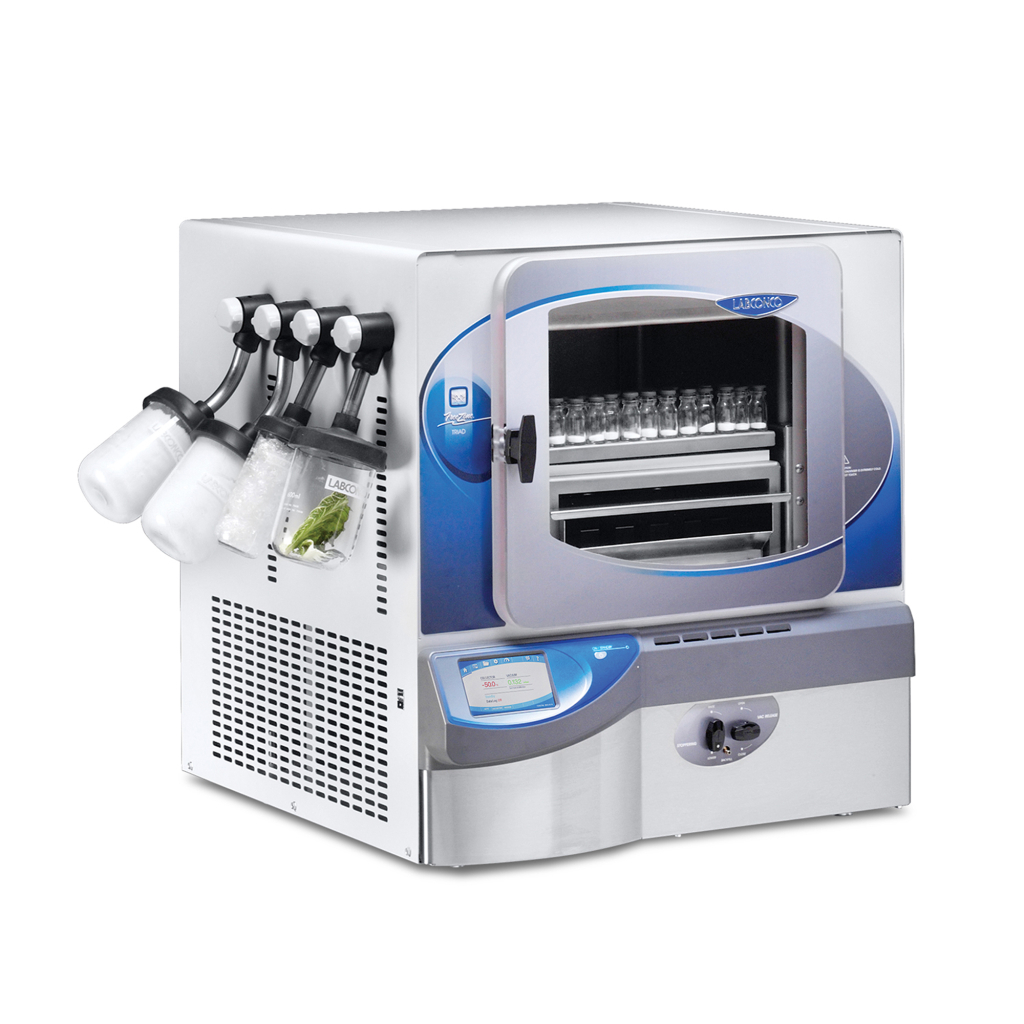
The instruments that I work with are typically a much larger version of the bench-scale machine that he is using (usually one of the LyoStar line). However, I have used smaller, bench-scale units as well for some quick and dirty work. I included some pictures at the end behind a spoiler tag. Happy to answer any questions people have.
Some differences in how I use lyophilizers in a scientific setting as opposed to a home-use food setting:
- Typically, we only lyo products that are already filled in vials as opposed to a full tray like he's done.
- We don't pre-freeze our products before they go into the lyophilizer. Instead we refrigerate the shelf that the vials are sitting on to freeze the contents before we proceed to the drying steps.
- Speaking of the shelves, in our instrument, the shelves can move up and down. This is used to compress the vials after the cycle is completely done, fully seating the vial stoppers and sealing them before we open up the main door.
- Also speaking about stoppering the vials, we typically allow some nitrogen into the chamber before sealing up the vials, at a pressure moderately less than atmospheric pressure. This helps keep the vial sealed until it is properly crimped with a seal.
- When it comes to drying, we do it in two stages. The primary drying step is when our product is kept cold, but put under vacuum. This removes most of the water, but not enough for our purposes. The secondary drying step is when the product is heated while the vacuum is maintained. This removes the rest of the water. We typically shoot for a residual moisture of <1% for a good cycle.
- He talks about how long the process takes. I have worked on processes that take from 1-5 days. Typically, the lyophilizer is limited with how much liquid can be removed per unit time. This limit is determined by the geometry of the vent that connects the main chamber with your vials, and the chamber containing the condenser. Also, if you try to dry too quickly, it can damage the product you are trying to preserve.
- He has some discussion at the end about the end of the cycle and the progress bar. What the instrument is doing is comparing the vapor pressure in the chamber using two different sensors. One of those is sensitive to the vapor pressure of water vapor, and the other is not. So, when things are fully dried out, those two are going to read the same pressure. While drying is still occurring, the sensor that detects water vapor will read a higher pressure. So, the instrument will continue to extend drying until those two pressures are the same.
::: spoiler Some Pictures Benchtop lyophilizer that I have experience using. You can see some vials lined up inside the door. I have never used the bottle connections hanging off the side:
One of the trays of vials that is loaded before going into the lyophilizer. The vials that are partially stoppered in the middle of the tray actually contain the drug. All the vials without stoppers are empty and simply there to help hold things in place as well as distribute heat predictably through the tray. The stoppered vials in the corners are there to help distribute the weight as the shelves compress to fully seat the stoppers.
Here are a small number of vials that I ran on a benchtop unit without any spacer vials or the tray. I would never do this for any reason other than to take a picture like this. This is a good view of what a partially stoppered vial looks like. It allows a path for water vapor to escape out the top of the vial.
Finally, here is a vial post-lyophilization. The liquid has turned into a solid, white cake at the bottom of the vial. This is because most lyophilization formulations include sugars that provide structure for the cake and keep it porous. The sugars provide protection against freeze/thaw stress for the molecule of interest as well. The porosity of the cake allows for quick and easy reconstitution by adding water, usually in <30 seconds or so.
I have hosted a wordpress site on my unraid box before, but ended up moving it to a VPS instead. I ended up moving it primarily because a VPS is just going to have more uptime since I end up tinkering around with my homelab too often. So, any service that I expect other people to use, I often end up moving it to a VPS (mostly wikis for different things). The one exception to that is anything related to media delivery (plex, jellyfin, *arr stack), because I don't want to make that as publicly accessible and it needs close integration with the storage array in unraid.
The fraud surrounding Alzheimer's research continues... Not too long ago the fraud was related to amyloid (archive version). That article was even written by the same author and features many of the same investigators.
I work in Pharma R&D (on the manufacturing side) and the company I work for has run trials for Alzheimer's products based on research that has since been found to be fraudulent. As a published scientist myself, I would like to think that this level of manipulation and fabrication is the exception rather than the rule. However, I do think it is worth asking at this point what it is about Alzheimer's research in particular that has led to this being so prevalent and, more importantly, so impactful. Basically, how did it go so far before anything was caught?
I suspect at least part of the answer is due to the large influx of money into the field. Researchers were tripping over themselves to earn those grants and then, once they had them, produce results to keep them. I am not in academia, so I don't have great insight into the NIH, NIA or their processes, but this should be a wake up call to put up a certain amount of guard rails.
!lightnovels@ani.social for light novels from Japan
!aoblightnovel@bookwormstory.social for Ascendance of a Bookworm specifically (which just recently published its final volume).
Two that are local to me:
@borebore@lemmy.world does an admirable job with these two. I try to chime in when I can, but am mostly busy with the communities I am running elsewhere.
I think that user donations are easier when an instance has a good focus. There are some other instances I can think of where the donation model has been enough to cover things. In addition to feddit.dk and beehaw, an instance I use most of the time, ani.social, is more than covered by donations last I checked.
It looks like @hitagi@ani.social even took away the donate link in the sidebar.Never mind, I am just blind. I didn't notice the little Ko-fi badge at the bottom. I was looking for a text link.There is a lot of collaboration between the different instance admins in this regard. The lemmy.world admins have a matrix room that is chock full of other instance admins where they share bots that they find to help do things like find similar posters and set up filters to block things like spammy urls. The nice thing about it all is that I am not an admin, but because it is a public room, anybody can sit in there and see the discussion in real time. Compare that to corporate social media like reddit or facebook where there is zero transparency.
This is what I do. I have a VPS that handles all the 443 traffic and then proxies it back to my home server on the correct port. I also just serve some things directly from the VPS since I have it already. It also works well to have a second box for things like uptime monitoring.
Yeah, spoiler tags are the one big feature that is missing. There are also some minor things on the moderation side that aren't there. For example, admin accounts don't have a full list of options in the moderation menu.
Some good answers in here already. It boils down to a couple points for me:
- Back when I started selfhosting, it was either nginx or apache, and I found nginx better and easier to set up
- All the nginx knowledge I learned years ago still works just the same as it did back then, so why potentially mess things up by switching if it all still works
- Basically every project has an example nginx config for reference, that can't be said about other proxies
- It is easier to find support online for edge cases that might pop up with nginx due to the ubiquity of its use and years of history
Intel confirmed on reddit that oxidation did impact some chips.
More than one thing can be wrong at the same time, so everybody can be right!
I didn't have a VPS with them, but long ago I had a couple domains through them. One of them had an issue with the auto-renewal and I never got a notification of any kind, only finding out when they had taken ownership of the domain, advertising it for sale. Then they wanted some way, way higher amount of money for me to buy it back. So, I don't have any domains with them any more.
This was years and years ago though, so they might be better now.
Everybody's pager went off in celebration!
I use Sonarr, but it does mess up sometimes for shows even when you mark it as an anime to use absolute numbering. It most often happens with older shows that have lots of OVAs that are sometimes listed as episodes and sometimes listed as specials, depending on the database. So, if you are having Sonarr manage your downloads, then it can grab the wrong episode if its database (I think TVDB) and the release (usually using MAL numbering) disagree.
I don't have a solution for you, but I will be watching this thread. Currently, I use Sonarr for library organization, but it doesn't always work well with anime due to title differences and differences between how seasons/specials are numbered in different databases. So, Shoko was on my radar to try out at some point since it uses anidb.
Recently, in !anime@ani.social, I configured the episode discussion bot to create posts using the poster art of the show rather than just an empty discussion post as a bit of an experiment about the effect of images. I don't have hard analytics to dig into, but I have noticed that the episode discussion threads have garnered significantly more votes when they have images, and a small increase in comments. Though, the additional comments are usually just wandering folks instead of people that stick around and engage.
I still don't let fanart in either the main anime nor manga community because it would too quickly spiral out of control. There is simply too much fanart in existence for these things. Instead, I limit it to official art only, which usually means teasers/posters/trailers. In the manga community, there is a bit of a special case in that I do allow fanart of a series if it was done by a different published author (not just some random pixiv user). This happens sometimes when a series ends and you get other authors drawing commemorative art for it.