It's easier to imagine a world of today but 4°C hotter than to imagine a world in which the 4° of warming shuts down the AMOC.
- Posts
- 3
- Comments
- 35
- Joined
- 6 mo. ago
- Posts
- 3
- Comments
- 35
- Joined
- 6 mo. ago
Yeah, no, that's not what the paper is saying.
" Charlson and colleagues concluded in 1992 that the climate forcing by aerosols – the cooling drive for climate change, see below – was similar in magnitude to the GHG forcing, but opposite in sign, thus tending to offset GHG warming "
Fossil fuels cool the planetary climate just as much as they warm it, but the effects / signals happen on two different timelines. The cooling effect is short run and temporary, the warming effect is long run and effectively permanent for human purposes.
The models and simulations that got us into this predicament just ignored the cooling and delivered us the sum total and said "look, It's not really that bad".
This made it seem like slowing growth or getting to net zero was a sustainable, survivable goal.
No, it's not. Now that the longer, slower effects are showing up and pulling ahead, we can see that all the other feedbacks (such as the amoc shutting down) have already been baked into the cake.
Like, "zero growth" is a death sentence, we actually would have needed atmospheric carbon removal to have a shot at one more generation of humanity. But now it's too late for *emissions" to matter, that's outside the solution space entirely.. It's now down to geoengineering.
This paper is about the science making a COLLOSAL error in judgement about how bad it is.
(You are badly stuck on the earlier paradigm, this earlier failed conception that downplays the problem. Everything everyone was fearful of is already happening based on TODAY's CO2. It's double as bad as what we thought. It's too late to change our pollution now and have anything about future emissions preventing a total calamity.)
I'll repeat this: the emissions we already made during history have already committed us to the amoc shutdown unless we artificially engineer our way out of that now.
Emissions don't matter any more, not in that sense.
Given THAT, and the total failure of all the other mitigations like sequestration etc, we have no shot at preventing feedbacks without geoengineering or blocking the sun or whatever. And whatever we do, we have a very very short time left in which to do it. Like 20 years is the remaining window for preventing a runaway hothouse.
Luckily, the cooling effect for fossil fuels lasts for about the amount of time we have left to geoengineer. Like we can temporarily pause warming for the next 15 years if we pollute like crazy. We just also need to engineer the energy balance during that time. This is the "Faustian bargain" that's mentioned in the paper.
TLDR, you shouldn't smoke, but if you have metastatic lung cancer it's too late for quitting to change the outcome.
That's tautologically true, yes. Lol.
'Why does the reduced speed matter? Because it keeps it from being too speedy?? ". Hahahaha.
But WHY? How does that make any difference? Why are people talking about the wrong number / a fake metric / an irrelevant goal?
I mean, read Hansen's paper. The Faustian bargain is that the faster we burn fossil fuels, the greater the dimming and therefore the lower the warming. The short term effects amplify benefits and you don't have to deal with the CO2 for another century either way.
Like... What's the real world goal of slowing it down? To kill more of nature sooner? I just do not grasp the scientific case for this.
Anyhow, we are not slowing down and we don't know how, so I suppose it doesn't matter. The more damage to the environment piles up, the more we will use fossil fuels to power our adaptation and rebuilding. We have no alternatives. I just don't follow the thinking, it just seems superficial.
The only solution space is removing atmospheric CO2. Not continuing to pollute but ever so slightly less as fast as we imagjnarily might have polluted. Lol.
Okay the math is getting weird,
So I genuinely don't understand "the math".
Here's how I understand this.
You have the current CO2 concentration, around 427ppm.
Then you have the first order derivative which is the rate of annual increase, which is whatever number, about +5 or +6ppm annually.
Then, you have this second order derivative which is the rate of acceleration or deceleration of the speed in the first order derivative.
That second order derivative is like extremely extremely sensitive to minute differences, like that particular number is super duper twitchy to a small change.
You have the iceberg at some distance. You have the speed of the titanic. You have the exact position of the engine speed controller. Everyone is discussing tiny angular changes to this controller as if it means something in this scenario. Special hint; there is no position of the speed controller that doesn't make the iceberg hit the ship. Literally all the positions make a collision, it's all similar in the way that the distance is closed and eliminated in short order. You only care about buying time if you imagine some way of avoiding the collision, but we simply don't even have a possibility of a scenario for that.
The thing is that the climate doesn't care about the first order derivative or the second order derivative at all. Only humans care about those numbers.
The climate is forced based on the concentration, period. The long and short secondary feedbacks also do not care about the derivatives, they only care about concentration and time.
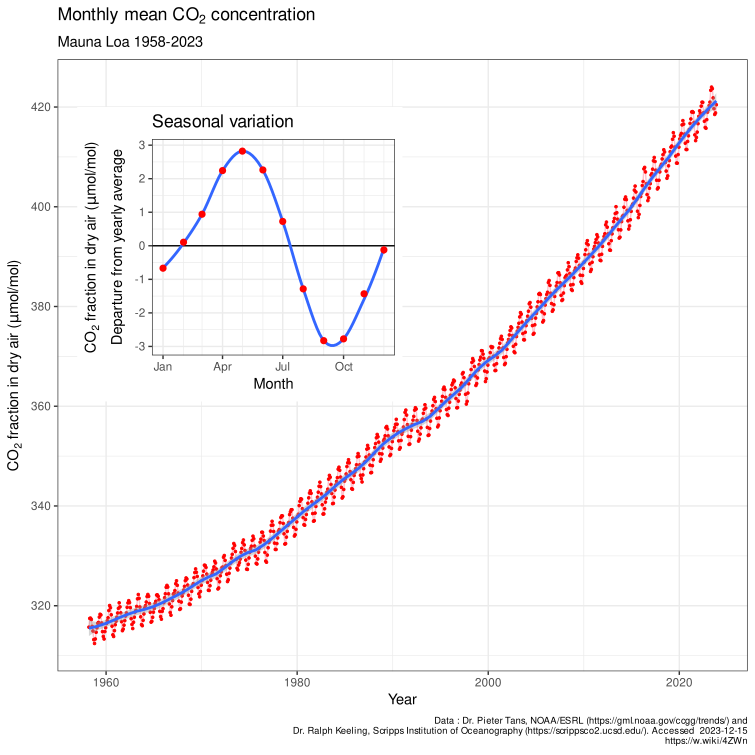
The keeling curve is the concentration. Here you can see all the conservative and liberal governments, all the climate accords, all the electric vehicles and technology in a single convenient graph: https://en.wikipedia.org/wiki/Keeling_Curve
So in my opinion, nobody is talking about *anything * that shows any relevance of any sort.
Do you understand why "reducing the speed of emissions" matters? Can you explain what that accomplishes?
To me it seems like a huge distraction from reality.
https://www.tandfonline.com/doi/full/10.1080/00139157.2025.2434494#abstract
This is a paper authored by none other than James Hansen.
The entire paper is well worth reading and digesting carefully, but he actually tackles the mistakes of the mainstream / pop culture stuff pretty head on here:
" Annual growth of greenhouse climate forcing is now more than double the amount in IPCC’s target scenario, which was never realistic because it relied on an assumption of massive carbon capture at powerplants with permanent burial of the captured CO2. Carbon capture at the gigaton scale does not exist; the estimated annual cost of CO2 extraction is now $2.2-4.5 trillion dollars per year, and the gap between the IPCC scenario and reality is rising rapidly. Such hypothetical large-scale carbon capture will not happen in anything near the required timeframe. "
The IPCC, I'm afraid, just fooled a lot of people by telling them what they already wanted to hear. They made up complete horseshit that the general lay public did not understand. "Future negative emissions'= removing CO2 by some unknown way in the future... This was baked into all the accounting all along. Like it was only ok if we deleted the pollution.
And obviously due to grade school physics like conservation of mass and conservation of energy, and the third law of thermodynamics, there is never going to be any way to sequester carbon that doesn't cost even more energy than what the high quality energy that was originally released. Like a priori that is a physical impossibility, regardless of technology.
Even when we were blowing our carbon budgets for decades, those budgets were a number that was picked that assumed we would be ok if we later on somehow removed that carbon so fast that climate was not affected.
Have you ever heard this thing about con artistry? The main mechanism is that you need to find someone who is, themselves, greedy. The way cons work is that you trick such a person by convincing them they are tricking some other person who is dumber. The person is fooled because they want to believe they are not the biggest fool.
The IPCC is a flavor of this exact scam. If only those billionaires, industrialists and climates denying hillbillies would see how we can fix everything through happy shopping, happy motoring and happy vacations... We don't have to sacrifice everything, windmills are cheaper!
Sometimes in complex systems you have a variable that tracks the overall system change. As you get closer to a tipping point, that variable starts increasing its variance from the mean as a predictor of the regime shift.
So, hypothetically, you have CO2 tracking smoothly upwards with little difference from year to year, then right before a major system tipping point the annual CO2 increase starts wobbling and varying more and more as a signal that big change is about to happen.
When they say that global CO2 sinks might be weakening, perhaps this portends a major shift. Not faster and faster but a completely different game...
However, scientists are concerned about a third factor: the possibility that the planet’s carbon sinks are beginning to fail. About half of all CO2 emissions every year are taken back out of the atmosphere by being dissolved in the ocean or being sucked up by growing trees and plants. But the oceans are getting hotter and can therefore absorb less CO2 while on land hotter and drier conditions and more wildfires mean less plant growth.
Let that sink in. No pun intended. Even without triggering all the natural runaway climate change tipping points, human CO2 has been getting bid A LOT lower by nature. If that were to weaken or go away that's a pretty big change.
https://bergensia.com/wp-content/uploads/2025/04/be9bb3c91b926de2910976829a37fce2.jpg
This is what the CO2 curve looks like lately.
This is what it used to look like
https://upload.wikimedia.org/wikipedia/commons/c/c5/Mauna_Loa_CO2_monthly_mean_concentration.svg
The thing I'm pointing out is the red dots. Notice the red dots used to have a very clean very specific pattern years ago? (Spacing, height etc repeating each year.) Now that's going away...
there are still in terms of the timeline of
Uh... You know this link is absolutely horse shit, right? The site is saying that we can prevent a 1.5° rise with a swift reduction to zero emissions over the future years.
We already passed 1.5! (So this is just wrong. All wrong.)
And we have no zero emissions technology. Even in theory there is no way to elaborate this hand wavey ideal. Its not a real achievable goal. For example, human agriculture (ie, farming) is about 20% of global emissions... Like... This is crazy crazy crazy insane nonsense being spewed without any reality context. Sorry, this is just batshit crazy. You are stopping food production? Really?
it's a ship headed towards an iceberg,
The expression is "rearranging deck chairs on rhe titanic".
You figured out the analogy, I'm just trying to help you click on *comprehension *. The meaning of the expression is to realize the futility of certain performed actions in the knowledge of the greater contextual meaning. There can be no greater pointlessness in doing things that will not matter.
To say that stopping all coal usage will have no effect and that equivalent or greater emissions must popup somewhere else (Jevon paradox) is patently false
The all time highest coal usage globally happened last year. Most coal burned in all human history. So, no, that's totally wrong. Jevons paradox is true.
Ontario, Canada [got rid of virtually all coal power in 2014]
Ontario now pays some of the highest power rates in all of north america. The deindustrialization of Ontario cost the province about 400,000 high paying fulltime careers and pushed Ontario from the #1 auto manufacturing jurisdiction on the planet to a "have not" province. Fully 2/3 of the "green power" energy system was developed (and owned) by foreign owned companies, the majority of the profits of this system were transferred abroad.
Most of ontarios windmills are made by Siemens. Some components of the windmills are made locally, but do you know where they come from? China and Taiwan.
Taiwan gets 40% of their power from coal.
China gets 70% of their power from coal.
You know who breathes China and Taiwan's CO2 pollution? Ontarians. Enjoy your wildfire smoke.
If Ontario wasn't such a big customer for the coal powered windmill production, would that coal have been burned? Because we have no way to get that CO2 back out of the atmosphere. That CO2 will last longer than most long lived nuclear waste species. It's going to be up there circulating and heating the planet for 10,000 years to come and nobody can fucking stop that. Imagine how twisted and short sighted your logic has to be to think this is what progress looks like. It's nuts. The Windmill production is just a global doom loop gas pedal.
Hope is not a plan.
Despite all this, do you know which of the planets inhabitants have the highest per capita CO2 emissions? Canadians. The average Ontario resident emits 2-3 tons of CO2 per year and thats not counting embedded CO2 from global trade.
This is what happens in complex systems. When you try to change things you can easily make it worse instead of better. The feedback loops can create very convoluted effects. We cannot economically and industrially grow our way out of climate change because our planetary systems run on resources.
This is a placebo. It works to fool you if you don't see this as systemic, global whole.
Doesn't mean we should do nothing.
If you read the article, it talked about Jevon's paradox.
Any so-called "alternatives" to coal that you deploy will just send a price signal that makes coal cheaper and easier to burn for someone else, someplace else. Alternatives accelerate the use of coal. So we need to tread carefully. You can't just make up a fake goalpost in a complex system, you need to understand feedback loops.
Even if I am to accept your premise that we are doomed one day no matter what,
Bingo, we got it. I pointed out your denialism in my first comment. You admit you don't accept the science. Even here, you use the weasel words "your premise". Your brain is tricking you. You are at the "bargaining" stage.
it is a difference to make that day come in 100 years vs 50.
Ok, so this is pretty much the only thing that has any meanings or importance. We are pretty much in a civilizational version of a palliative care scenario.
You are saying "quantity is a quality unto itself". The more years the better.
I am not saying that. Let's get real here.
We are in irreversible planetary overshoot. We have around 10 billion people who are being fed, clothed and housed by artificial life support (a lot of which is directly due to fossil fuels). At the same time, we have a climate driven ecological collapse coming at us like a freight train.
So we are basically now in a type of race-off where the question is whether reducing fossil fuel use would actually cause any form of benefit within the small climate timespan window that is still survivable.
Personally, I don't think the science supports that view.
So, what I think is going on is that many people have formed a sort of "sustainability cargo cult". There used to be many many steps we might have taken a lot of years ago, and some of those steps might have taken us into a different solution space than the one we are in today. The cargo cult wants to build out a version of that dream, regardless of whether it can make any difference now.
But today, all these "alternatives" could never be meaningfully built out in any sort of scale to matter. At all. The clock ran out.
There are no more future generations to worry about. We are going to need crop fertilizers, air conditioning and water purification for the people alive now, and it truly doesn't matter what happens next, not at this point.
This is why the climate scientists are now talking about geoengineering and adaptation, not mitigation.
The future, insofar as we have one at all, now involves rapid intensification of a technical industrial economy with as much power as we can use. The solutions space that's left is to do planetary scale geoengineering. And that too will fail broadly within one human lifespan -- more climate change positive feedbacks will kick in regardless of us attempting to control it.
The latest climate research is putting ECS around 4.8°C, which is almost double the earlier estimates based on model runs. The reason it appeared that climate sensitivity was so low during the last 100 years was that the models didn't properly factor in the cloud physics.
Smoke em if you got em.
There is no survivable future for humans unless we reduce the atmospheric CO2 we already have.
Decreased CO2 and other GHG emissions
Incorrect. All past emissions are EXACTLY the same.
You're only changing future emissions / rates of increase.
But I disagree with the nihilism that there is nothing we COULD do to make it such that we can have a world that slowly winds down the need to burn coal.
Ok, but what does winding down the need to burn coal accomplish as a practical outcome?
Let's say you even had an unlimited magical power, and you wave your wand and >poof< that's it, coal magically gets deleted and everything else is still operating normally. Walk us through it, what did that actually change?
I'm asking because your comment seems like almost an exemplar of the kind of "implicatory denial" that's often implicit in people who think it's not too late because you can make some imagined goalpost and move towards them by inches and never have to question why that matters.
You can get that on your phone now.
Try telling that to all the older generations. They are all paying $100/month for cable packages...
" Company says Disney+, Hulu and ESPN price rises were planned before uproar over Kimmel’s suspension prompted calls to cancel "
Imagine if you had a company that was so unpopular that you had to issue this statement? They want you to know they are doing two negative things, not just one.
Is there even a chance this cash grab wasn't caused because they started hemorrhaging customers and investors?

The paleo record downplays the risk:
Thus, in the past record as the greenland sheet was melting, the anarctic sheet was growing at the same time. The sum total sea level rise at any point was not representative of the simultaneous coordinated melting combination event. This is unlike today.
This mistake is artificially baked into the climate models we are using that predict the future:
Satellites have measured that the melting rate is above what was predicted:
This is an important observation: