

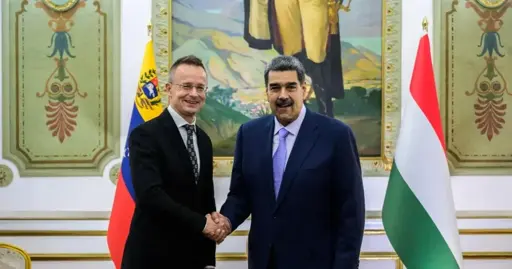
On 10 November 2023, Hungarian Foreign Minister Péter Szijjártó travelled to Caracas, the capital of Venezuela. His visit came 31 years after the last time a Hungarian foreign affairs delegation had visited the country. Szijjártó justified the visit with “the changed international context”. He met with president Nicolás Maduro, Minister of Oil Pedro Rafael Tellechea and Foreign Minister Yván Gil. Gil and Szijjártó even signed an agreement between the two countries.
Based on the communiqué about the visit and Szijjártó’s posts from the time, the Foreign Minister had high hopes concerning Venezuela. For example, he posted a photo of himself and Maduro, commenting that they agreed that “amidst the current changes in global politics, the main responsibility of elected officials is to defend their country’s sovereignty and to resist external attempts at interference. According to another one of his posts, “Venezuela is opening up to the world, and the Western world is also opening to Venezuela. Whoever is here first will reap the benefits”.
…
The … Hungarian Ministry of Foreign Affairs published at the time … wrote about Venezuela’s vast oil reserves and its gas extraction, which is why the representatives of MOL and MVM (Hungary’s two energy giants) also accompanied Szijjártó. According to the statement, they started negotiations about the possibility of importing natural gas from Venezuela, while Szijjártó argued for the easing of the sanctions which were in place against the country.
This could easily make one believe that Venezuela is an important ally of Hungary and the Hungarian government … Although many have now recalled that in 2024, Hungary vetoed a joint EU statement on the disputed results of the Venezuelan elections, the truth is that it joined the initiative with a delay. But following Maduro’s kidnapping by US forces on 3 January this year, only 26 of the EU’s 27 member states called “for calm and restraint by all actors, to avoid escalation and to ensure a peaceful solution to the crisis". There was one country which did not support this: Hungary.
…
It would therefore seem logical to think that Hungary stood up for its partner with whom it had sought an intensive economic relationship, but the comments coming from the government are telling an entirely different story. Balázs Orbán, the Prime Minister’s Political Director [not a relative to the PM], for example wrote that “the hundreds of Hungarians evacuated from Venezuela have told us about the oppressive dictatorship that had been established there”. And pro-government Mandiner’s journalist, Mátyás Kohán was quick to present the insignificant data relating to the trade between the two countries. He wrote: “Here, you can see proof of the friendly relationship and the huge deals between Péter Szijjártó and his “buddy”. This, as you see, equals zero. There has never been any strategic agreement, gigantic deal about energy resources.”
…
The events of the past few years therefore show that the Orbán government has long approached Venezuela without any moral compass or sense of values: when the need arose, they rescued people from there; when there was an opportunity to do so, they sought to do business there; and now they are calling the country a narco-state, even though a little more than two years ago, Szijjártó was full of smiles in Caracas. It is telling that the otherwise hyperactive Szijjártó did not post anything about Venezuela until Monday evening – except to write about Hungarians affected by the situation – and said nothing about what will now become of the secret agreement signed between the two countries in 2023.
At his press conference on Monday, Viktor Orbán actually admitted that the Hungarian position is that they do not want to take a moral stance on the US intervention: in his view, international law no longer matters, what matters is what the great powers want to do. “It happened, it is what it is, and what we are concerned with is whether it is good or bad for Hungary. And it is good for Hungary.” Apparently then, two and a half years ago, Maduro was good for Hungary, but now, it is his downfall that is deemed beneficial.
…