

…
An investigation by the Institute of International and European Affairs urges the Irish government to speedily publish a National Security Strategy.
The report, co-produced by Deloitte Ireland, drew on interviews and discussions with public and private sector leaders that took place last September. In its interviews, business groups called on the Department of Justice to expedite high-level security clearances for staff applying for sensitive posts in critical infrastructure and services, because of “elevated” attempts by foreign intelligence agencies to infiltrate their businesses.
…
Kieran O’Neill, a defence and security partner with Deloitte, said companies have real concerns over attempts by agencies in China and Russia to plant operatives.
“Ireland is a target,” he said. “Many organisations here are directly involved in countering Russian cyber threats in Ukraine, implementing sanctions on Russian officials, and involved in countering disinformation. “We don’t have the security architecture in place to expedite that security clearance process for people working in government and the private sector,” he added, saying more needed to be done to either “prevent that threat of espionage, or to detect it very quickly”.
The report tries to separate Ireland’s neutrality from the issue of protecting the country’s assets at a time when the security environment is at its most “challenging” and “dangerous” in recent history.
…
“Of greatest concern is that the possibility of an armed attack on an EU member state — and its consequences for Ireland — are no longer outside the bounds of possibility,” the report warned.
Among the recommendations are that the Government should follow Sweden’s example and issue fact-based pamphlets to citizens on the risks in times of crisis.
Mr O’Neill said the Russian attack on Ukraine was the “pivot point” for European security, and events since then have elevated instability and tension.
…
The report also urges the Government to develop a strategy to allow Ireland’s technology sector engage with the EU’s defence programme, which has allocated €150bn to boost investment in Europe’s defence industry.
“Ireland has a strong technology sector with dual-use potential, and with the increased focus on security and defence spending across Europe, there is a significant economic opportunity for Ireland that can also support efforts to lift our own security and resilience posture,” Mr O’Neill said.
…
The threats have been acknowledged by Garda Commissioner Justin Kelly, who said last year that “hostile state actors” posed a threat to national security.
Irish exposure to security risks was highlighted last month by the five unidentified drones that appeared during the visit of Ukrainian president Volodymyr Zelensky. The drones hovered over an Irish naval vessel that was guarding the flight path of Zelensky’s plane, before disappearing. They were later tracked to an unidentified ship.
…
However, years after a National Security Strategy was promised, it is still being finalised. Work on developing a new National Security Authority to oversee high-level security clearances has only just begun.
…
[Chairman of the Oireachtas Foreign Affairs Committee John] Lahart said he supports Irish neutrality, but believes “neutrality is nothing if you cannot protect it and ensure it continues”. He said Ireland needed to cooperate with others in order to protect Irish assets.
“That is not about joining Nato. But it is about ensuring that whatever we do on the security front is inter-operative at a very basic level,” he said.
The changing global climate has driven much of the debate about Ireland’s neutrality, with one issue being the Government’s plans to change the “triple lock”, which means the large-scale deployment of Irish troops abroad can only happen with Irish Government, Dáil and UN Security Council approval.
The Government wants to change the triple lock, arguing it gives Russia and China a veto over Irish peacekeeping missions.
…
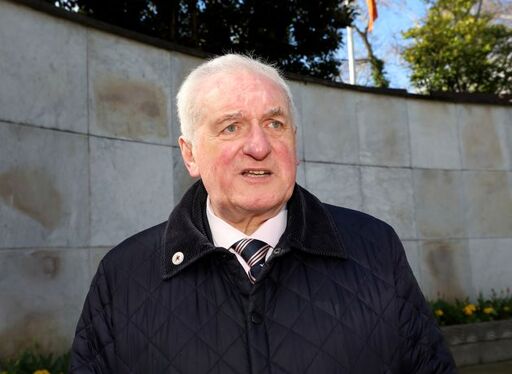
Meanwhile, former taoiseach Bertie Ahern believes Ireland needs to work with other countries to protect Irish undersea assets amid the growing geopolitical turbulence.
…
Mr Ahern said he was doubtful that Trump would stage a military takeover of Greenland, as to do so would “wreck Nato” … “I don’t think he’d try and take it over by military force,” said Mr Ahern. “I really don’t. If he did try to do that, it would wreck Nato and destroy confidence between the European Union and America.
…
“If I was on the other side of the negotiation table, I would say to Trump: ‘Well, what are you looking for here? Are you looking for rare earths? Are you looking for oil? Are you looking for US security?’ And if it’s US security that he really wants, then let’s talk about putting back some military bases there.
“But if he wants it for rare minerals, then I think we’re all into a very difficult position, because if he were to pursue that, I cannot see how you could get an agreement. I can’t see Denmark or Europe agreeing to that position.
“If he really wants it, what he should be doing is compromising with Denmark and Greenland and with Europe to put back in his military bases.
…
What about hostile US agents?
Centrist managerial organisation says, be afraid of the far away enemy, ignore the web of class war we are waging on you with our allies.
Centrist organizations like this ascribe to the Western hegemonic information warfare paradigm.